This guide offers practical, real-world insights to help you strike the right balance, so your audits are not just routine tasks but powerful tools for revenue optimization and compliance.

Why Self-Audits Matter in Medical Billing
How Often Should You Conduct Medical Billing Audits?
| Practice Type | Suggested Audit Frequency | Focus Area |
|---|---|---|
|
Small Practices |
Quarterly |
Basic compliance and claim accuracy |
|
Mid-Sized Clinics |
Monthly or Bi-Monthly |
Denials, coding accuracy, workflow efficiency |
|
Large Healthcare Organizations |
Ongoing + Monthly Reviews |
Full revenue cycle performance and compliance |
- Weekly or bi-weekly checks can focus on high-risk claims or recent submissions
- Monthly audits can evaluate trends and recurring issues
- Quarterly reviews should assess overall compliance and performance
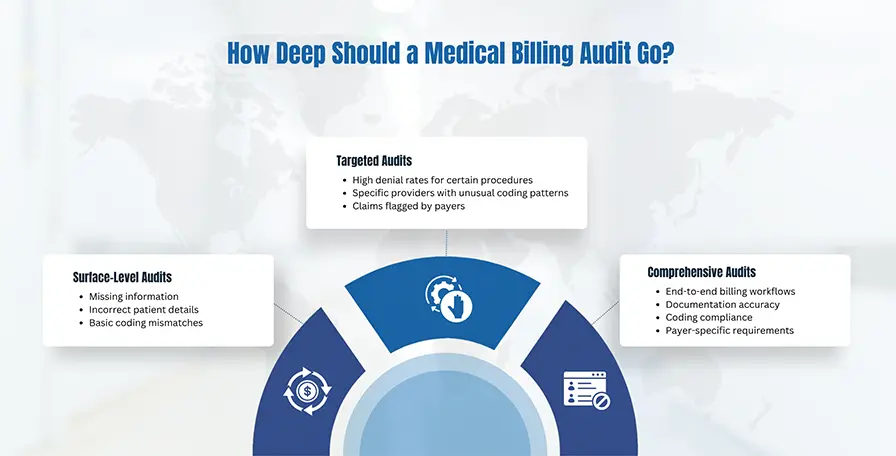
How Deep Should a Medical Billing Audit Go?
1: Surface-Level Audits
- Missing information
- Incorrect patient details
- Basic coding mismatches
2: Targeted Audits
- High denial rates for certain procedures
- Specific providers with unusual coding patterns
- Claims flagged by payers
3: Comprehensive Audits
- End-to-end billing workflows
- Documentation accuracy
- Coding compliance
- Payer-specific requirements
Key Areas to Include in a Billing Self-Audit
Core Audit Components
-
Coding Accuracy
Ensure that CPT and ICD codes align with documentation. Undercoding and overcoding can both lead to revenue loss or compliance issues. -
Claim Submission Accuracy
Check for errors in patient data, insurance details, and modifiers. Even small mistakes can result in claim rejections. -
Denial Management
Analyze denied claims to identify root causes. Are they due to coding errors, eligibility issues, or missing documentation? -
Documentation Quality
Verify that clinical documentation supports billed services. Lack of proper documentation is a major compliance risk. -
Compliance Checks
Ensure adherence to payer guidelines and regulatory requirements, including HIPAA standards.
Common Mistakes Billing Managers Make
Over-Auditing
Conducting too many deep audits can overwhelm your team and reduce productivity. Not every claim needs a full review.
Under-Auditing
On the other hand, infrequent audits allow errors to accumulate, leading to larger issues over time.
Lack of Focus
Audits without clear objectives often produce little value. Each audit should answer a specific question or address a known risk.
Ignoring Data Trends
Failing to analyze audit findings over time means missed opportunities for improvement. Patterns in denials or errors often reveal systemic issues.
Self-Audit Checklist for Billing Teams
| Audit Area | Key Questions to Ask | Action Required |
|---|---|---|
|
Patient Information |
Is all demographic and insurance data accurate? |
Correct errors before resubmission |
|
Coding |
Do codes match clinical documentation? |
Review and update codes |
|
Claims Submission |
Were claims submitted the first time correctly? |
Identify and fix submission gaps |
|
Denials |
What are the top reasons for denials? |
Implement corrective strategies |
|
Compliance |
Are we meeting payer and regulatory requirements? |
Address compliance risks immediately |

How Technology Simplifies Medical Billing Audits
Solutions like MaxRemind are designed to support audit-ready billing operations. With built-in compliance checks, automated audit trails, and intelligent reporting, your team can maintain accuracy without increasing workload.
This not only improves efficiency but also reduces the risk of revenue leakage and compliance violations.
Conclusion
- Audit frequently enough to catch issues early
- Go deep enough to uncover root causes
- Stay focused on high-impact areas
Start Building an Audit-Ready Revenue Cycle Today
- How often should medical billing self-audits be conducted?
-
The ideal frequency depends on your practice size and claim volume. Smaller practices can conduct audits quarterly, while larger organizations should aim for monthly or ongoing audits. A balanced approach, combining regular quick checks with deeper periodic reviews, helps maintain accuracy without overwhelming your team.
- What should be included in a medical billing self-audit?
-
A comprehensive self-audit should review coding accuracy, claim submission processes, denial trends, patient data accuracy, and documentation quality. It should also ensure compliance with payer requirements and identify inefficiencies in the revenue cycle.
- What is the difference between internal and external medical billing audits?
-
Internal audits are conducted by your in-house billing team to monitor ongoing performance and compliance. External audits are performed by third-party experts and offer a more objective, in-depth evaluation. Both are important, but internal audits ensure continuous improvement and audit readiness.
- How deep should a medical billing audit be?
-
Not all audits need to be exhaustive. Routine audits can focus on surface-level errors, while targeted audits address specific issues like frequent denials. Comprehensive audits should be conducted periodically to evaluate the entire revenue cycle, including compliance and documentation.
- How can MaxRemind help improve medical billing audits?
-
MaxRemind supports smarter, more efficient audits by offering end-to-end revenue cycle management solutions. With features like real-time reporting, denial tracking, compliance monitoring, and workflow optimization, MaxRemind helps healthcare organizations identify issues early, reduce errors, and stay audit-ready without increasing manual workload.
Transform Your
Practice with
AI-Powered EHR
Reduce administrative burden, streamline workflows, accelerate revenue, and deliver exceptional patient care.
- AI-Assisted Documentation
- HIPAA-Compliant Platform
- Faster Claims & Billing
- Specialty-Based Solutions