Billing Compliance Red Flags That Trigger Payer Audits

In today’s increasingly regulated healthcare environment, billing compliance is no longer just an operational necessity; it is a critical safeguard for your practice’s financial health and reputation. Payer audits are becoming more frequent, more data-driven, and more unforgiving. For practice owners, even minor billing inconsistencies can escalate into significant financial penalties, claim denials, or reputational damage.
Understanding the red flags that trigger these audits is the first step toward prevention. This guide explores the most common billing compliance risks, explains why they matter, and outlines practical strategies to help your practice stay audit-ready.

What Are Payer Audits and Why Do They Happen?

Payer audits are systematic reviews conducted by insurance companies or regulatory bodies to ensure that healthcare providers are billing accurately and complying with established guidelines. These audits are not random; they are typically triggered by patterns or anomalies in billing data.
Insurance payers rely on advanced analytics to identify unusual trends such as overutilization of certain codes, frequent high-level billing, or inconsistent documentation. When such irregularities are detected, they raise concerns about potential fraud, waste, or abuse, even if the issues are unintentional.
For practice owners, this means that maintaining compliance is not just about accuracy, but also about consistency and transparency across all billing activities.
What Are Payer Audits and Why Do They Happen

The Cost of Ignoring Compliance Red Flags

Failing to address billing compliance issues can have far-reaching consequences. While some practices assume audits are rare or manageable, the reality is quite different.
Financially, audits often result in denied claims, repayment demands, or even fines. Operationally, they can disrupt workflows, consume staff time, and create unnecessary stress. More importantly, repeated compliance issues can damage your practice’s credibility with payers, making future claims more likely to be scrutinized.
In severe cases, unresolved compliance risks can lead to legal implications, especially when patterns suggest fraudulent behavior, even if unintentional.
The Cost of Ignoring Compliance Red Flag

Common Billing Compliance Red Flags That Trigger Audits

One of the most significant audit triggers is upcoding, in which services are billed at a higher level than was actually provided. While sometimes accidental, repeated instances can signal intentional overbilling to payers.

Similarly, unbundling services and billing separately for procedures that should be grouped under a single code raises immediate concerns. This practice can artificially inflate reimbursement and is closely monitored by payers.

Another common red flag is duplicate billing, where the same service is billed multiple times. Even if caused by system errors or workflow inefficiencies, duplicate claims can quickly attract audit attention.

Inconsistent or missing documentation of medical necessity is another critical issue. Payers expect clear justification for every billed service. If documentation does not align with the billed codes, it creates a discrepancy that auditors are quick to investigate.

Frequent use of evaluation and management (E/M) codes compared to peer benchmarks can also trigger scrutiny. Payers often compare providers within the same specialty, and any deviation from the norm can raise suspicion.

Lastly, a high volume of claim denials followed by resubmissions can indicate underlying billing inefficiencies or attempts to bypass payer rules.
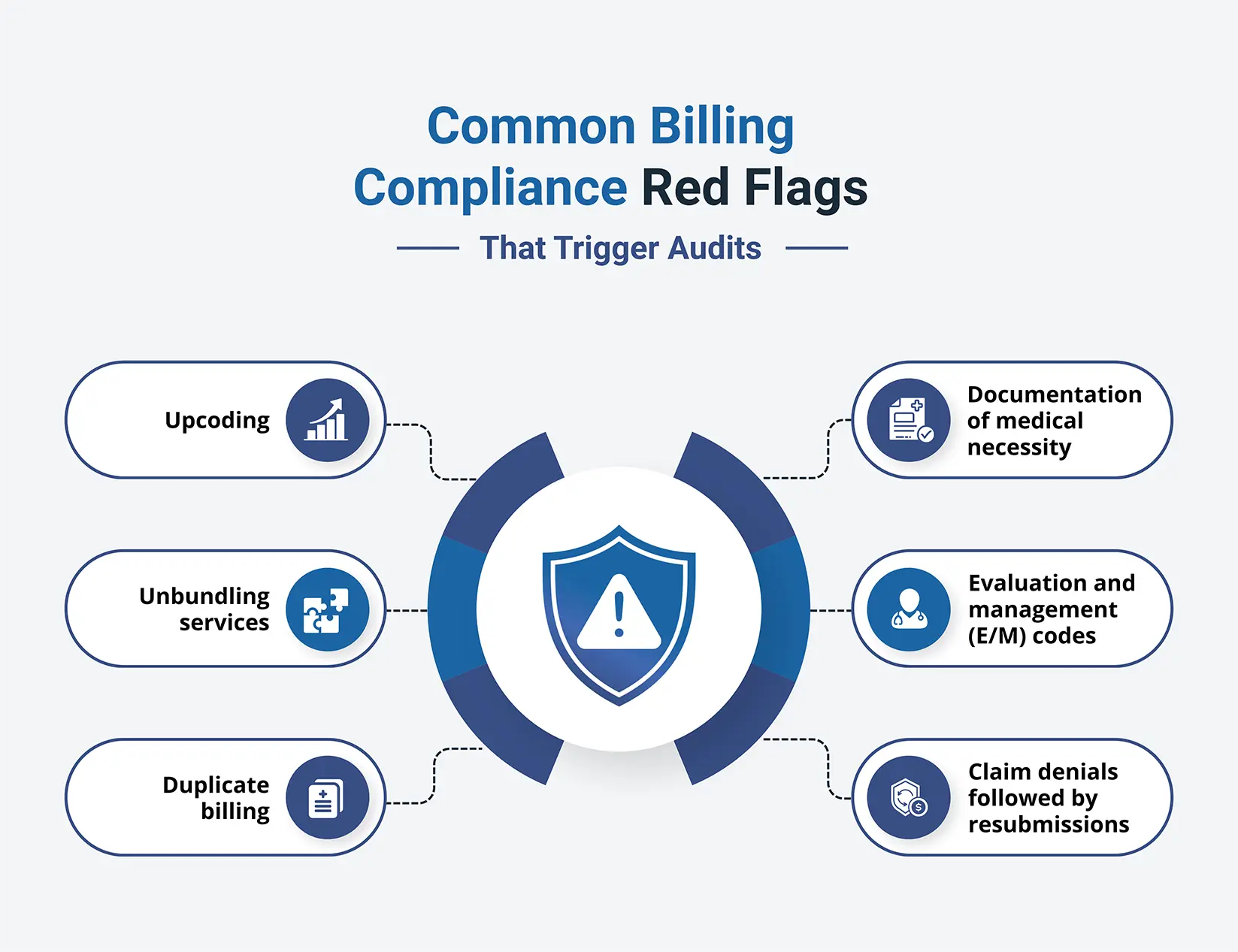
Common Billing Compliance Red Flags That Trigger Audits

High-Risk Billing Behaviors and Their Impact

Billing Behavior Why It Triggers Audits Potential Impact
Upcoding
Suggests overbilling
Penalties, repayments
Unbundling
Violates coding guidelines
Claim rejections, audit escalation
Duplicate Billing
Indicates system or process errors
Revenue loss, compliance flags
Excessive High-Level Coding
Deviates from peer benchmarks
Increased audit likelihood
Frequent Claim Resubmissions
Signals billing inefficiencies
Payer scrutiny

How Documentation Gaps Increase Audit Risk

Documentation is the foundation of billing compliance. Even when services are correctly performed and coded, inadequate documentation can make it appear otherwise during an audit.
For example, if a provider bills for a complex procedure but fails to document the medical necessity or detailed steps involved, the claim may be flagged. Auditors rely heavily on documentation to validate claims, and any inconsistencies between clinical notes and billing data can quickly escalate into compliance issues.
Moreover, incomplete patient records, missing signatures, or vague descriptions of services further increase audit risk. These gaps create ambiguity, making it difficult to justify billed services.
How Documentation Gaps Increase Audit Risk

Documentation vs. Audit Risk Indicators

Documentation Issue Audit Risk Level Reason for Concern
Missing Medical Necessity
High
No justification for services
Incomplete Patient Records
High
Lack of supporting evidence
Mismatched Codes & Notes
High
Signals potential billing errors
Delayed Documentation
Medium
Raises questions about accuracy
Generic or Vague Descriptions
Medium
Difficult to validate services

Proactive Strategies to Avoid Payer Audits

Avoiding audits is not about reacting to problems; it is about building a proactive compliance framework. Practice owners should focus on creating systems that detect and resolve issues before they escalate.
Regular internal audits are a crucial starting point. By reviewing claims periodically, practices can identify patterns that may raise red flags and correct them early. This not only reduces audit risk but also improves overall billing accuracy.
Staff training is equally important. Billing and coding teams must stay updated with the latest guidelines and payer-specific requirements. Even minor changes in coding standards can significantly impact compliance.
Another key strategy is implementing robust claims scrubbing processes. This involves reviewing claims for errors or inconsistencies before submission, ensuring that they meet payer requirements.
Clear and consistent documentation practices must also be enforced. Providers should be trained to document thoroughly, ensuring that every billed service is fully supported by clinical notes.

How Technology Can Strengthen Compliance

In an era where payer audits are increasingly driven by data analytics, relying solely on manual processes is no longer sufficient. Technology plays a critical role in identifying compliance risks and streamlining billing workflows.
Advanced Revenue Cycle Management (RCM) solutions can automatically detect anomalies, flag high-risk claims, and ensure adherence to payer guidelines. These systems not only reduce human error but also provide actionable insights that help practices improve their billing processes.
For example, intelligent analytics can highlight unusual coding patterns, while automated alerts can notify teams about potential compliance issues before claims are submitted. This level of visibility allows practice owners to stay one step ahead of auditors.

Solutions like MaxRemind are designed to simplify compliance by integrating claims scrubbing, audit tracking, and reporting into a single platform. By leveraging such tools, practices can significantly reduce their exposure to audit risks while improving overall revenue performance.

How Technology Can Strengthen Compliance

Conclusion

Billing compliance is not just about avoiding audits; it is about protecting your practice’s financial stability and reputation. As payer scrutiny continues to increase, understanding and addressing compliance red flags becomes essential for long-term success.
From upcoding and unbundling to documentation gaps and inconsistent billing patterns, even small issues can trigger audits if left unchecked. However, with the right combination of proactive strategies, staff training, and technology, these risks can be effectively managed.
For practice owners looking to strengthen compliance and stay audit-ready, investing in smarter RCM solutions is a strategic move. MaxRemind empowers healthcare providers with advanced tools to detect red flags early, ensure accurate billing, and maintain full compliance with payer requirements.

Ready to safeguard your practice from costly audits?

Discover how MaxRemind can help you stay compliant, reduce risks, and optimize your revenue cycle.
FAQs
What are the most common triggers for payer audits in medical billing?

The most common triggers include upcoding, unbundling of services, duplicate billing, excessive use of high-level codes, and inconsistent or missing documentation. Payers use data analytics to identify unusual billing patterns, and any deviation from standard practices can raise a red flag for audit review.

How can my practice reduce the risk of a billing audit?

Reducing audit risk starts with maintaining accurate documentation, conducting regular internal audits, and ensuring your coding and billing staff are well-trained on current guidelines. Implementing claims scrubbing tools and monitoring billing patterns can also help detect and correct issues before claims are submitted.

Why is documentation so important in billing compliance?

Documentation serves as proof that the services billed were medically necessary and properly delivered. If there is a mismatch between clinical notes and billed codes, or if documentation is incomplete, it can lead to claim denials or trigger an audit, even if the services were legitimately provided.

What happens if my practice is selected for a payer audit?

If your practice is audited, you may be required to submit detailed records for review. Depending on the findings, outcomes can range from claim corrections and repayments to financial penalties. In some cases, repeated compliance issues may lead to increased scrutiny or legal consequences.

How can technology help prevent billing compliance issues?

Modern RCM solutions like MaxRemind help identify billing errors, flag compliance risks, and automate claims scrubbing before submission. These tools provide real-time insights and analytics, allowing practices to proactively address issues and maintain compliance, significantly reducing the likelihood of audits.