Why High Patient Volume Doesn’t Always Mean Higher Revenue
Introduction: The Full Waiting Room, Empty Bank Account Paradox
The Revenue-Ready Framework
- Medicaid and Medicare Advantage plans often reimburse at 60–80% of what commercial payers pay for the identical CPT code.
- Poorly negotiated commercial contracts lock practices into rates that haven’t been renegotiated in years, even as overhead costs climb.
- High-deductible health plans shift more of the payment burden onto patients, and patient collections are notoriously harder and slower to recover than payer collections.
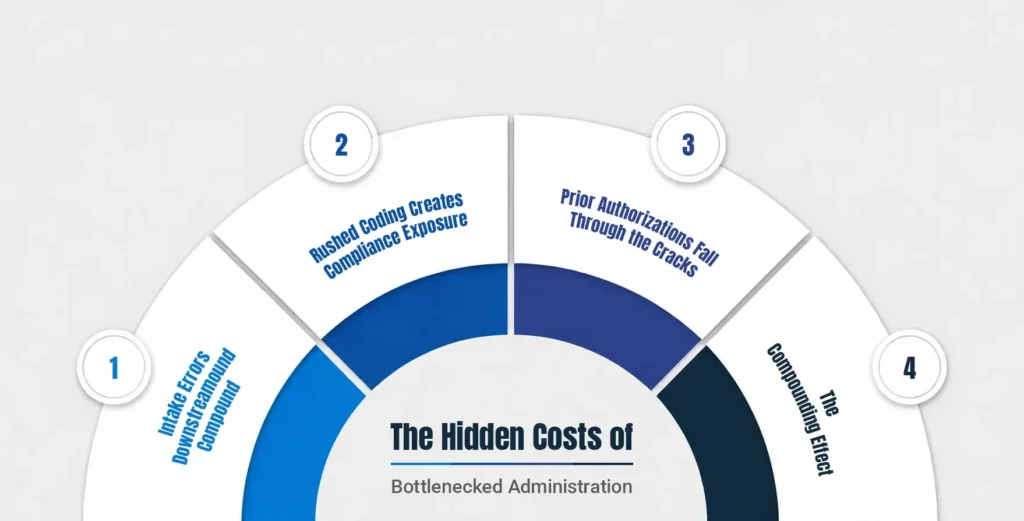
The Hidden Costs of Bottlenecked Administration
Intake Errors Compound Downstream
- Misspelled names and outdated insurance details slip through
- Eligibility verification gets skipped or rushed
- Demographic errors trigger automatic claim rejections before a provider even sees the patient
Rushed Coding Creates Compliance Exposure
Prior Authorizations Fall Through the Cracks
The Compounding Effect
None of these problems live in isolation. An intake error causes a denial. A denial requires rework. Rework delays the next batch of claims. The backlog grows faster than the team can clear it. This is how a “successful” high-volume week quietly manufactures next month’s cash flow crisis.
Accounts Receivable Accumulation: The Profit Killer
- Claims aged 0–30 days: Roughly 95%+ are still fully collectible
- Claims aged 60–90 days: Collectibility often drops below 75%
- Claims aged 90–120+ days: Collectibility can fall under 50%, and continues declining every additional 30 days
The Volume vs. Value Matrix
| Core Indicator | High Volume / Low Efficiency Practices | Optimized / Revenue Cycle Mastered Practices |
|---|---|---|
|
Daily Patient Throughput |
High, but treated as the primary success metric |
Moderate to high, but never the only metric tracked |
|
Clean Claim Rate |
75–85%, weighed down by coding and eligibility errors |
95%+, driven by front-end verification and automation |
|
Days in AR |
50–70+ days, climbing every quarter |
Under 35 days, actively managed |
|
Cost to Collect |
8–12% of collections, often hidden in overhead |
Under 4%, streamlined through automated workflows |
|
Net Collection Rate |
75–85% of allowable reimbursement |
96–99% of allowable reimbursement |
|
Denial Rate |
10–15%, frequently unappealed |
Under 5%, actively worked and appealed |
Shifting the Metric: From Throughput to Collection Yield
- Net Collection Rate (NCR)
This measures what you actually collected against what you were contractually entitled to collect. It's the single most honest number in your entire operation. A practice seeing 40 patients a day with a 97% NCR is outperforming one seeing 60 patients a day at 78% NCR, every time. - Days in Accounts Receivable (Days in AR)
This tracks the average time it takes to convert a claim into cash. Best-in-class practices keep this under 35 days. Anything climbing past 50 is a signal your revenue cycle is losing the race against your patient volume. - Clean Claim Rate
The percentage of claims that get accepted and paid on first submission, no errors, no rework. A high clean claim rate means less staff time wasted on resubmissions and faster cash conversion across the board. - Cost to Collect
What it actually costs, in staff time, software, and overhead, to collect each dollar of revenue. This number exposes whether your billing operation is an asset or a liability.
The mindset shift is simple: stop asking “how many patients did we see?” Start asking “how much of what we earned did we actually keep?” That second question is where real profitability lives.
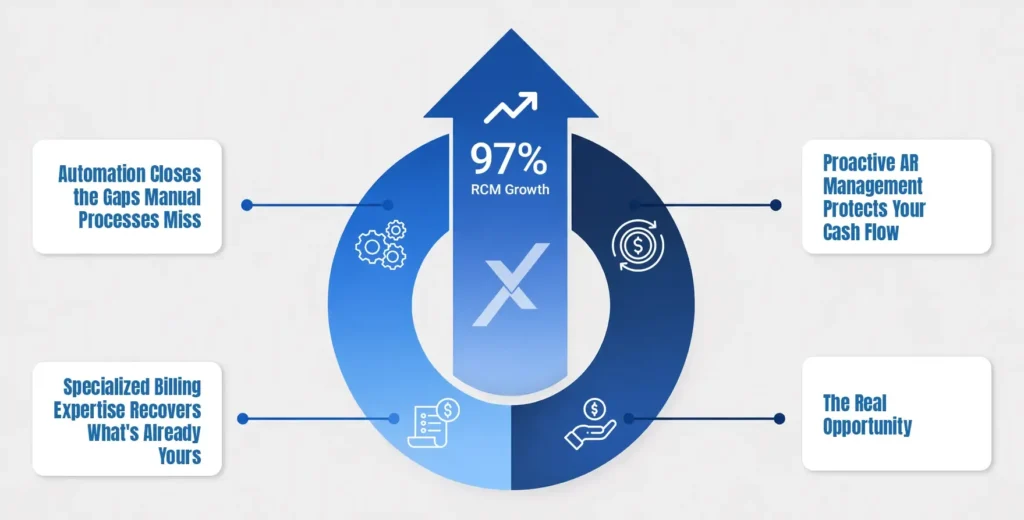
Reclaiming Your Margins with Strategic RCM
- Automation Closes the Gaps Manual Processes Miss
Clean claim technology catches eligibility issues, coding mismatches, and missing documentation before a claim ever reaches the payer, not after it bounces back 30 days later. - Specialized Billing Expertise Recovers What's Already Yours
Dedicated billing specialists who understand payer-specific rules catch underpayments, aggressively appeal denials, and keep AR moving rather than aging. - Proactive AR Management Protects Your Cash Flow
Instead of reacting to a growing AR backlog, a strategic RCM partner works claims on a disciplined timeline, flagging and resolving issues at the 30-day mark instead of the 90-day mark. - The Real Opportunity
You've already done the hard part. You built the patient volume. The revenue is already sitting inside your existing patient base, in denied claims that should have been paid, in aging AR that should have converted to cash, in payer contracts that should be renegotiated. Strategic RCM doesn't ask you to work harder. It makes sure you finally get paid for the work you've already done.
Take the Next Step: Book Your Revenue Cycle Audit
MaxRemind exists for exactly this moment. As a dedicated Revenue Cycle Management partner, we specialize in finding the leaks that generic billing software and overstretched in-house teams miss, and closing them for good. From clean claim technology to specialized denial management to disciplined AR follow-up, we build the infrastructure that lets your existing patient volume finally translate into the revenue it deserves.
Schedule a comprehensive, zero-obligation Revenue Cycle and AR Leakage Audit with MaxRemind today, and find out exactly how many dollars are waiting to be reclaimed from your current patient base.
Turn Patient Volume Into Real Revenue
- Does seeing more patients always mean I'm making more money?
-
No. Revenue depends on what you actually collect, not how many patients you see. A packed schedule with a low clean claim rate, aging AR, or a heavy low-reimbursement payer mix can generate less profit than a smaller, well-managed patient base.
- What is a "good" Net Collection Rate for a private practice?
-
Top-performing practices land at 96% or higher. Anything consistently below 90% signals you're leaving contracted revenue on the table, whether through denials, underpayments, or write-offs.
- How does payer mix affect my bottom line if my patient volume stays the same?
-
Every payer reimburses differently for the same CPT code. If your new patient growth skews toward Medicaid, Medicare Advantage, or poorly negotiated commercial plans, your cost to service each visit can outpace what that visit actually pays, shrinking margins even as your schedule fills up.
- Why is "Days in AR" more important than daily patient count?
-
Patient count measures activity. Days in AR measures how fast that activity turns into cash. Claims aging past 60-90 days become significantly harder to collect, so a low Days in AR means your revenue is actually reaching your bank account instead of sitting with insurers.
- Can I fix revenue leakage without seeing fewer patients or hiring more staff?
-
Yes. Strategic RCM automation and specialized billing management close leaks at the source, clean claim submission, faster denial resolution, and disciplined AR follow-up, so you recover more from the patients you're already seeing instead of adding volume to compensate.
Transform Your
Practice with
AI-Powered EHR
Reduce administrative burden, streamline workflows, accelerate revenue, and deliver exceptional patient care.
- AI-Assisted Documentation
- HIPAA-Compliant Platform
- Faster Claims & Billing
- Specialty-Based Solutions