The Most Common Telehealth Billing Errors in 2026
What Virtual Care Providers Must Know About POS Codes, Modifiers & Payer Updates
The 2026 Telehealth Billing Landscape
Key 2026 Regulation: The CAA 2026 extended Medicare telehealth flexibilities through December 31, 2027. CMS also requires new billing codes or modifiers by 2027 to identify services delivered via third-party virtual platforms.

Error #1 — Confusing POS 02 and POS 10
| POS Code | When to Use It | Reimbursement Rate | Common Mistake |
|---|---|---|---|
|
POS 10 |
Patient connects from their home or temporary residence |
Non-facility (higher) rate |
Using POS 02 when the patient is actually at home |
|
POS 02 |
Patient connects from a clinic, office, or skilled nursing facility |
Facility (lower) rate |
Using POS 10 when the patient is in a clinical setting |
How to Avoid This Error:
- Always confirm the patient’s physical location at the start of every telehealth encounter.
- Document the patient’s location explicitly in the visit notes.
- Build a location-verification step into your intake workflow.
Error #2 — Wrong or Missing Telehealth Modifiers
| Modifier | Meaning | Primary Use | Notes |
|---|---|---|---|
|
95 |
Synchronous audio-video service |
Medicare & most commercial payers |
Required on Medicare E/M codes 99202–99215 |
|
GT |
Interactive audio-video telecommunication |
Medicare Advantage & some commercial |
Not used on standard Medicare Fee-for-Service |
|
93 |
Audio-only telehealth |
Medicare (limited services) |
Must document why audio-video was not used |
|
FQ |
Audio-only behavioral health |
Medicare behavioral health services |
Used alongside 93 for specific BH services |
Pro Tip: Maintain a payer modifier policy tracker, a simple spreadsheet updated quarterly, listing which modifier each payer requires per service type. This single tool can dramatically reduce your denial rate.
Error #3 — Using Outdated CPT Codes
| Old Code | Status in 2026 | Replacement Code | Applicable Payers |
|---|---|---|---|
|
99441–99443 |
Deleted – invalid |
98000–98016 series |
Commercial & some Medicaid |
|
G2012 |
Retired |
98016 (brief virtual check-in) |
Medicare |
|
98000–98015 |
NEW, E/M via video |
Use for commercial payers |
Commercial & some state Medicaid |
|
99202–99215 |
Active for Medicare |
Pair with POS + modifier |
Medicare Fee-for-Service |
Error #4 — Ignoring the Medicare vs. Commercial Payer Split
The most significant billing complexity of 2026 is the divergence between what Medicare accepts and what commercial payers require. This two-track system trips up even experienced billing teams.
| Payer Type | Accepted Code Set | Modifier Required | POS Code |
|---|---|---|---|
|
Medicare Fee-for-Service |
99202–99215 (E/M) |
95 or 93 |
POS 02 or POS 10 |
|
Medicare Advantage |
Varies by plan |
Often GT |
Per plan policy |
|
Commercial (most) |
98000–98016 or 99202–99215 |
95 or GT (payer-specific) |
POS 02 or POS 10 |
|
Medicaid |
Varies by state |
Varies widely |
Per state policy |
|
FQHCs / RHCs |
G2025 (Medicare) |
Per CMS guidance |
Distant site |
Billing the wrong code set to the wrong payer is one of the fastest ways to trigger a denial. Never assume that what works for Medicare applies to a commercial plan, or vice versa.
Error #5 — Billing Audio-Only Services Incorrectly
When Audio-Only Is Permitted:
- Behavioral health services: Medicare has permanent coverage for audio-only behavioral health.
- Situations where the patient lacks access to video technology.
- Situations where the patient did not consent to video.
Required Documentation for Audio-Only Claims:
- Clear statement that audio-video was not used.
- Clinical or technological reason why the video was unavailable or not appropriate.
- Patient consent documentation per applicable state law.
- Modifier 93 on the claim, along with Modifier FQ for behavioral health services.
Common Mistake: Billing audio-only visits with Modifier 95 (which indicates audio-video) is a frequent error. Always use Modifier 93 for audio-only encounters and document why video was not used.
Error #6 — Weak or Missing Documentation
- The date and start/end time of the encounter.
- The patient’s physical location (home, clinic, nursing facility, etc.).
- The provider’s location at the time of service.
- The technology platform used (must be HIPAA-compliant).
- Patient consent for telehealth as required by state law.
- Medical necessity, why telehealth was clinically appropriate.
- Whether the service was audio-video or audio-only, and why.
2026 Payer Update Cheat Sheet
| Update | Effective Date | Impact on Billing |
|---|---|---|
|
CAA 2026 extends Medicare telehealth through Dec 31, 2027 |
Feb 3, 2026 |
Geographic and originating-site waivers remain active |
|
98016 replaces G2012 for brief virtual check-ins |
Jan 1, 2026 |
Update code sets; G2012 claims will be denied |
|
99441–99443 retired; replaced by 98000-series |
Jan 1, 2026 |
Commercial payers, update to new codes immediately |
|
New modifier/code required for 3rd-party virtual platforms |
By 2027 (CMS mandate) |
Begin tracking which visits use external telehealth vendors |
|
Audio-only behavioral health, permanent Medicare coverage |
Ongoing 2026 |
Bill with Modifier 93 + FQ; document patient access barriers |
Quick-Reference: Telehealth Billing Checklist
- Confirmed patient’s physical location at time of service.
- Applied correct POS code: POS 10 (home) or POS 02 (non-home facility).
- Verified whether payer requires Modifier 95, GT, 93, or FQ.
- Used correct CPT code set for this payer: 99202–99215 (Medicare) or 98000-series (commercial).
- Documented medical necessity for a telehealth visit.
- Documented technology platform used and its HIPAA compliance.
- Documented patient consent per state law.
- For audio-only: used Modifier 93, documented reason video was not used.
- Checked payer’s current telehealth policy before submission (not just last quarter’s).
- Ensured credentialing is active with this payer for telehealth services.
How MaxRemind Helps You Bill Telehealth Right
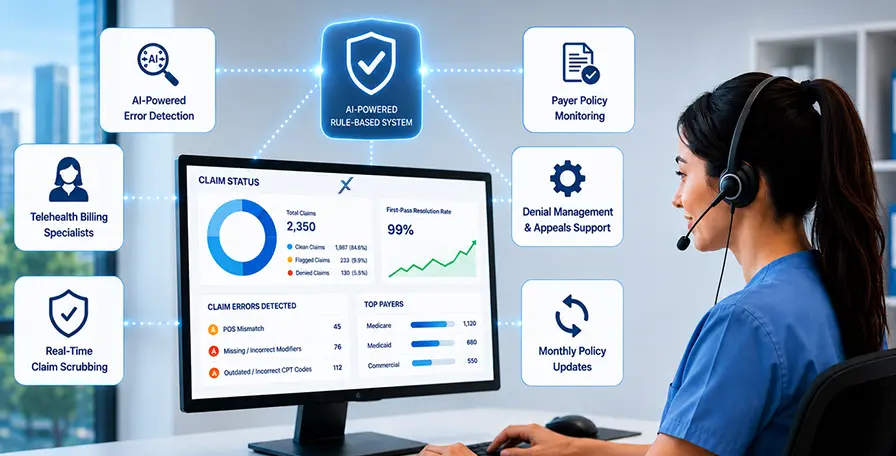
MaxRemind‘s AI-powered Rule-Based System (RBS) automatically flags telehealth claims with POS mismatches, missing or incorrect modifiers, and outdated CPT codes before submission. Our billing specialists maintain live payer policy trackers across Medicare, Medicaid, and major commercial plans, so your claims always reflect current requirements.
What You Get With MaxRemind Telehealth Billing:
- Real-time claim scrubbing with AI-powered error detection.
- Dedicated telehealth billing specialists trained on 2026 CMS and payer updates.
- Payer-specific modifier and code set verification before every submission.
- Denial management and appeals support with a 99% first-pass resolution target.
- Monthly policy update briefings so your team is never caught off guard.
Ready to Reduce Your Telehealth Denial Rate? MaxRemind offers a free demo and a 1-month free trial with no credit card required. Our team will identify billing gaps in your current telehealth workflow and show you exactly how much revenue you may be leaving on the table.
Reduce Telehealth Claim Denials Before They Happen
- What is the difference between POS 02 and POS 10 for telehealth billing?
-
POS 10 is used when the patient receives telehealth services from their home or temporary residence and is generally reimbursed at the non-facility rate. POS 02 is used when the patient is located in a healthcare facility, clinic, or other non-home setting during the telehealth visit.
- Which telehealth modifier should I use in 2026?
-
The correct modifier depends on the payer and the type of telehealth service provided. Modifier 95 is commonly used for audio-video telehealth visits, Modifier 93 is used for audio-only services, GT may be required by certain Medicare Advantage and commercial plans, and Modifier FQ applies to specific audio-only behavioral health services.
- Are the new 98000–98016 telehealth CPT codes accepted by Medicare?
-
In most cases, Medicare Fee-for-Service does not reimburse the new 98000–98016 telehealth E/M code series. Medicare providers should generally continue using E/M codes 99202–99215 with the appropriate POS code and telehealth modifier. Commercial payer policies may differ.
- Can audio-only telehealth visits still be billed in 2026?
-
Yes. Medicare continues to allow audio-only billing for certain services, particularly behavioral health. Providers must use the appropriate modifier, document why video was not used, and maintain all required consent and clinical documentation to support the claim.
- How can healthcare practices reduce telehealth claim denials?
-
Practices can reduce denials by verifying patient location, selecting the correct POS code, applying payer-specific modifiers, using current CPT codes, maintaining complete telehealth documentation, and regularly reviewing payer policy updates. Automated claim-scrubbing solutions can also help identify billing errors before submission.
Transform Your
Practice with
AI-Powered EHR
Reduce administrative burden, streamline workflows, accelerate revenue, and deliver exceptional patient care.
- AI-Assisted Documentation
- HIPAA-Compliant Platform
- Faster Claims & Billing
- Specialty-Based Solutions