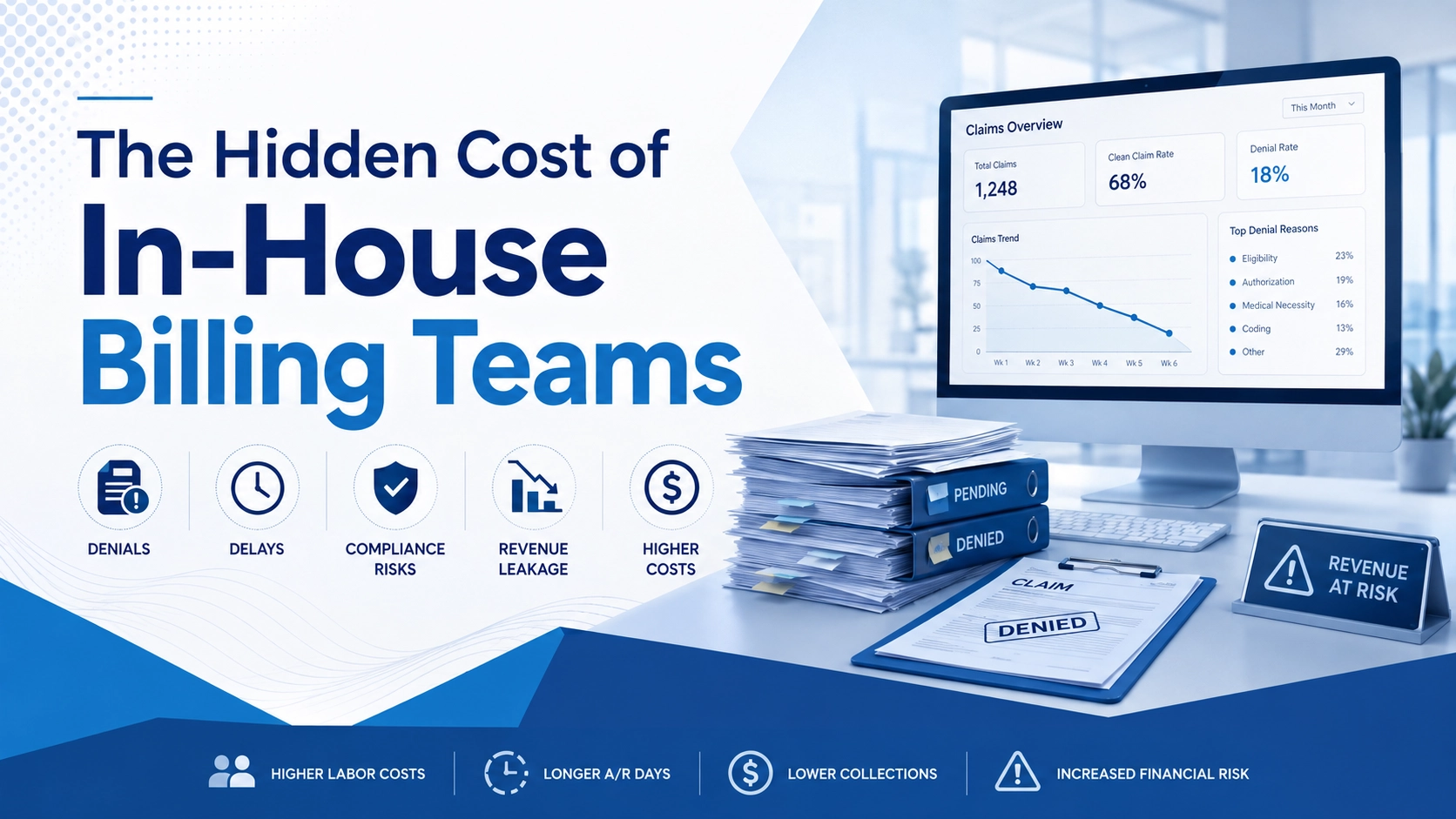
The Hidden Cost of In-House Billing Teams
Introduction: The Myth of "Cheaper" In-House Billing
But visibility isn’t the same as efficiency, and control isn’t free.
The Financial Drain of Staff Turnover
What actually happens when a biller quits:
- Stalled claims:
Work-in-progress claims sit untouched until a replacement is trained, often 30 to 60 days. - Recruitment costs:
Job postings, staffing agency fees, and background checks routinely run $4,000–$7,000 per hire. - Executive time:
Practice owners and office managers lose hours screening resumes and conducting interviews, time not spent on patients or growth. - Institutional knowledge loss:
Payer-specific quirks, denial patterns, and provider preferences walk out the door with every departure. That knowledge isn't documented; it's memorized.
The Hidden Costs of Continuous Training and Compliance
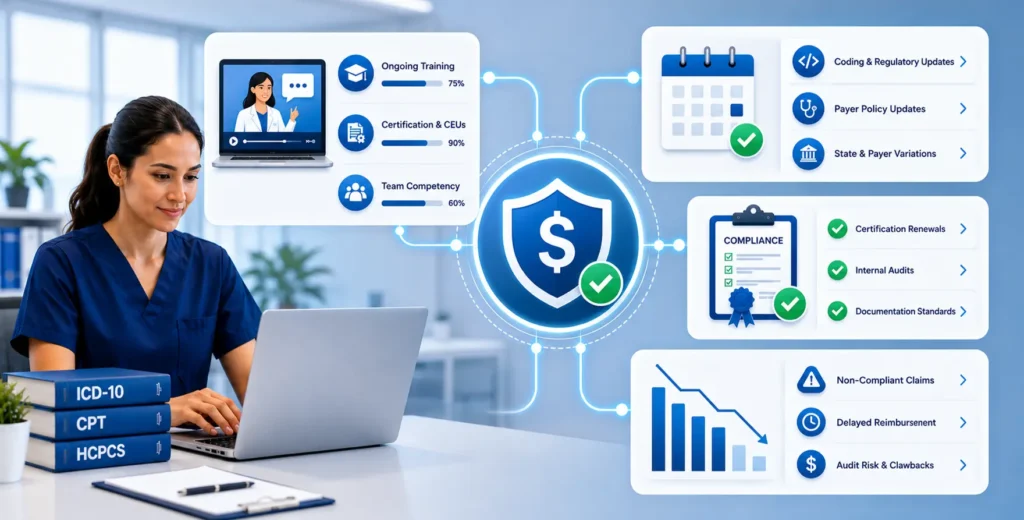
The ongoing training burden includes:
- Annual coding certification renewals and CEU requirements
- Specialty-specific coding updates (E/M guidelines, telehealth billing rules, prior authorization changes)
- State-by-state compliance variation for multi-location practices
- Payer policy updates that shift quarterly, sometimes monthly
READ MORE: The Hidden Cost of In-House Billing Teams
The Software and Tech Stack Tax
Line items practice owners consistently underestimate:
- Clearinghouse subscriptions:
Per-claim or monthly fees for every claim submitted - Specialty coding software licenses:
Often $300–$800 per seat, per month - Data backup and security systems:
Required for HIPAA compliance, not optional - Hardware refresh cycles:
Workstations, servers, and networking equipment that need periodic upgrades to stay secure and functional - IT support contracts:
Someone has to maintain uptime, patch vulnerabilities, and troubleshoot outages
The Opportunity Cost of Administrative Disruption
In-house billing management pulls you into:
- Interviewing and onboarding replacement staff
- Resolving software outages or clearinghouse errors
- Auditing claim accuracy after a compliance scare
- Managing performance issues with underperforming billers
The True Cost of Billing: In-House Overhead vs. MaxRemind Managed RCM
| Cost Category | In-House Billing Team | MaxRemind Managed RCM |
|---|---|---|
|
Base Salaries & Benefits |
$45K–$65K/biller + payroll tax, health insurance, PTO |
Included – no salaries, no benefits, no HR overhead |
|
Billing Software & Clearinghouse Fees |
$300–$800/month per license, plus per-claim clearinghouse fees |
Bundled into service – no separate license costs |
|
Continuing Education & Compliance Training |
$1,500–$3,000/staff/year for coding updates & certifications |
Built into MaxRemind’s certified coding team |
|
Recruitment & Turnover Costs |
$4,000–$7,000 per replacement hire, plus productivity gap |
Zero – no hiring, no onboarding, no coverage gaps |
|
Technology Infrastructure/Hardware |
Workstations, servers, backup systems, IT support contracts |
None – fully hosted, secure infrastructure included |
|
Cost Structure |
Fixed cost – paid whether claims go out or not |
Variable, performance-based – tied to collections |
Shifting to a Variable Cost Model with MaxRemind
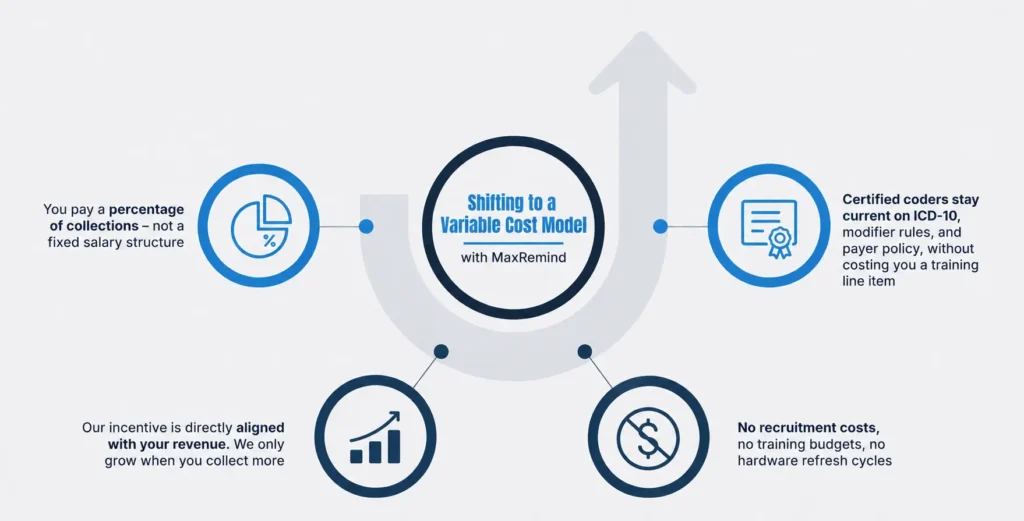
Here’s the core financial shift outsourcing creates: fixed overhead becomes variable cost.
MaxRemind’s model works differently:
- You pay a percentage of collections – not a fixed salary structure
- Our incentive is directly aligned with your revenue. We only grow when you collect more
- No recruitment costs, no training budgets, no hardware refresh cycles
- Certified coders stay current on ICD-10, modifier rules, and payer policy, without costing you a training line item
This isn’t just cost reduction. It’s a structural realignment where your billing partner’s success is mathematically tied to yours.
Ready to See Your Real Numbers?
MaxRemind will add it up for you.
Find Out What In-House Billing Is Really Costing You
- Is in-house medical billing really more expensive than outsourcing?
-
In most cases, yes. When you factor in salaries, benefits, software licenses, clearinghouse fees, training, and turnover costs, in-house billing often costs more than an outsourced RCM percentage-of-collections model, especially once lost revenue from denials and delayed claims is included.
- How much does staff turnover actually cost a medical practice?
-
Replacing a single biller typically costs $4,000–$7,000 in recruitment alone, not counting 30–60 days of stalled claims, executive interview time, and the loss of institutional payer knowledge that walks out the door with them.
- Why do untrained billing staff create compliance risk?
-
Coding rules change constantly, with annual ICD-10 updates, shifting modifier requirements, and state-specific payer policies. Without ongoing training, staff submit non-compliant claims, which trigger denials, delayed reimbursement, and potential audit exposure.
- What's included in the "hidden" cost of billing software and hardware?
-
Beyond the visible subscription fee, practices absorb clearinghouse per-claim charges, specialty coding software licenses, HIPAA-compliant data backup systems, IT support contracts, and periodic hardware refresh cycles, all recurring costs that scale as you.
- How does MaxRemind's pricing model differ from in-house billing costs?
-
MaxRemind charges a percentage of collections rather than fixed salaries and overhead. This turns billing into a variable cost that scales with your revenue, aligning our incentives directly with your practice's financial performance.
Transform Your
Practice with
AI-Powered EHR
Reduce administrative burden, streamline workflows, accelerate revenue, and deliver exceptional patient care.
- AI-Assisted Documentation
- HIPAA-Compliant Platform
- Faster Claims & Billing
- Specialty-Based Solutions