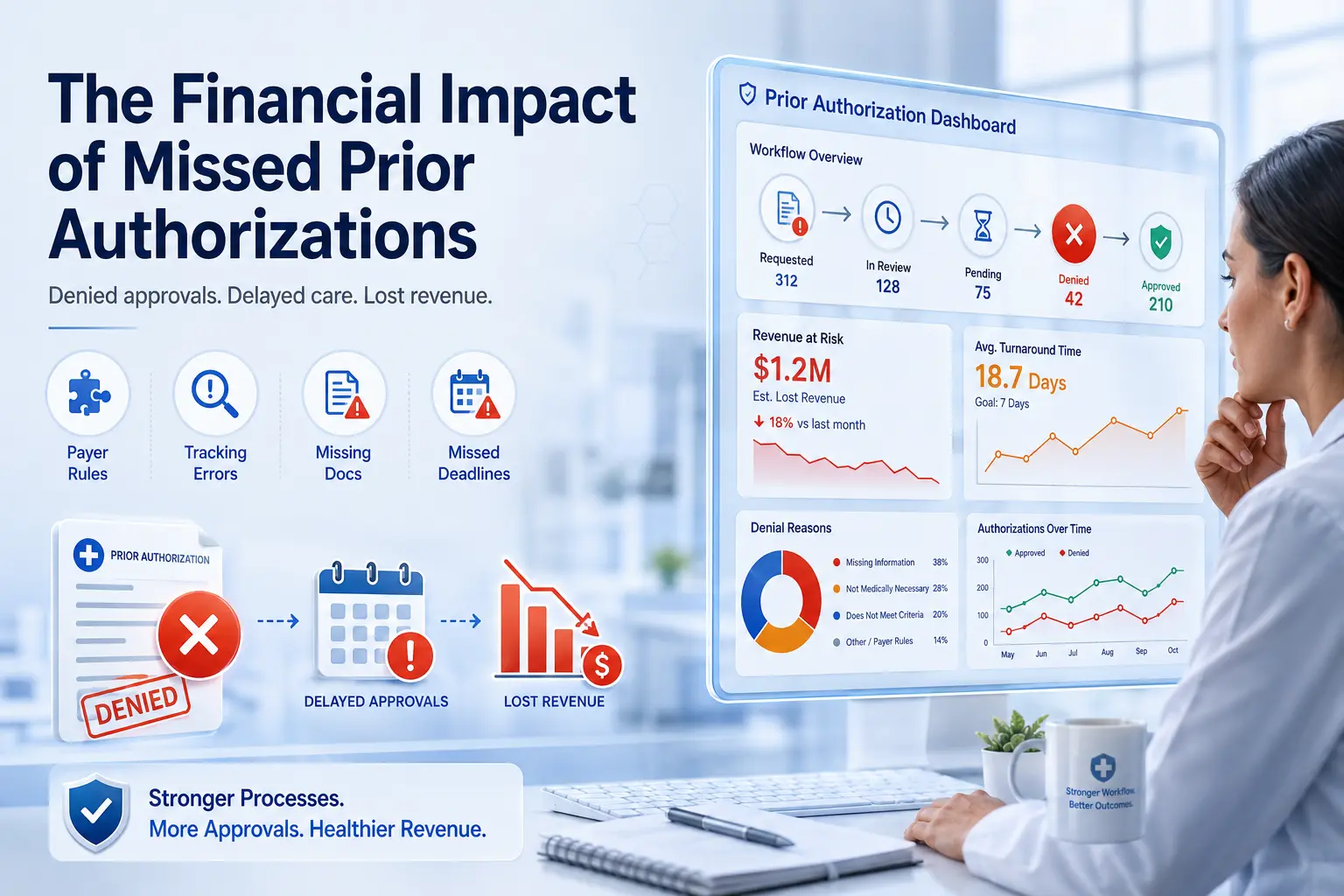
The Financial Impact of Missed Prior Authorizations
Stop Losing Revenue to Authorization Gaps
Introduction: The Silent Revenue Killer
The True Cost of Authorization Denials
- Sunk clinical costs:
Staff time, equipment use, and supplies for the procedure are already spent, win or lose the appeal. - Low-probability appeals:
Retro-authorization requests succeed far less often than pre-service approvals, yet they consume the same (or more) billing team hours. - Opportunity cost:
Every hour spent fighting a denial is an hour not spent on clean, collectible claims. - Write-off creep:
Practices that don't track denial root causes tend to normalize write-offs as "the cost of doing business" – quietly eroding margin quarter after quarter.
The Downstream Effect: Delayed Care and Patient Leakage
- Patients wait 1–2 weeks for approval on a procedure they were told they needed.
- Anxiety and frustration build, especially for time-sensitive diagnostics.
- A competing practice offers a faster path, and the patient reschedules elsewhere.
- Your practice loses not just that procedure’s revenue, but the downstream visits, referrals, and lifetime patient value tied to it.
Top 4 Prior Authorization Bottlenecks
1- Shifting Payer Criteria
2- Manual Tracking Errors
3- Fragmented Documentation
4- Missed Deadlines
The Cost of Authorization Failure
| Operational Metric | Manual / Reactive Authorization Workflows | Optimized / Proactive Authorization Management |
|---|---|---|
|
Initial Denial Rate |
15–20% of high-cost claims |
Under 5% |
|
Average Approval Turnaround |
7–14 business days |
24–48 hours |
|
Average Cost to Rework a Denial |
$25–$118 per claim (staff time, appeals, resubmission) |
Near $0 — caught pre-service |
|
Patient Retention Rate (delayed procedures) |
60–70% (30%+ leakage to competitors) |
90%+ |
|
Net Reimbursement Yield |
80–85% of billed value |
97%+ of billed value |
A Solution-Oriented Blueprint: Building a Bulletproof Authorization Engine
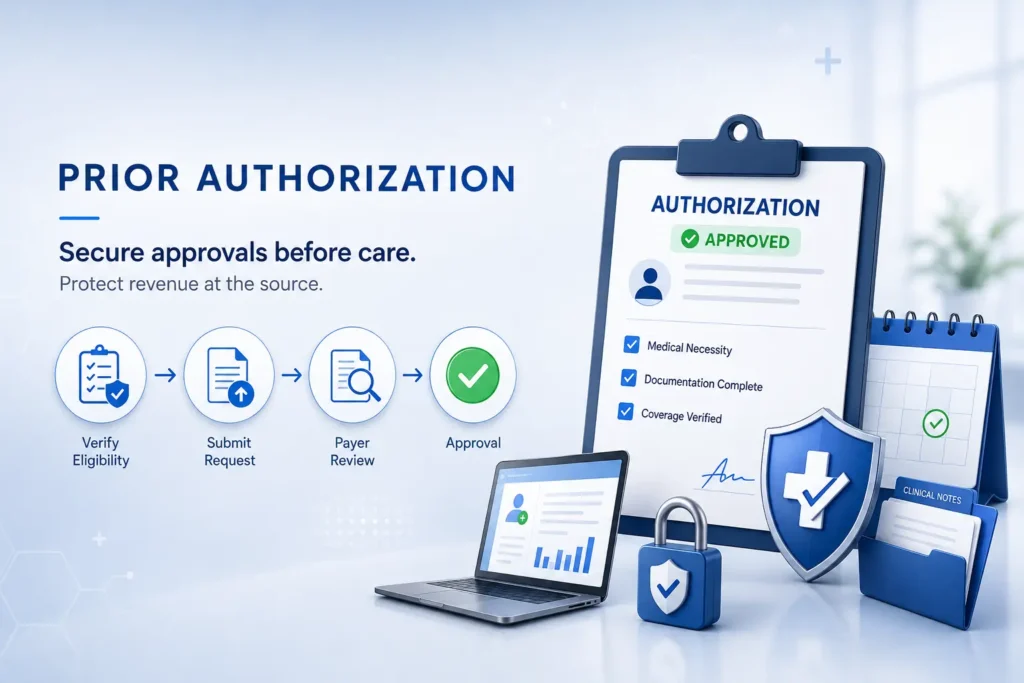
Fixing this requires structure, not effort alone. Use this checklist as your framework:
- Run real-time eligibility checks:
Verify coverage and authorization requirements at the clearinghouse level before scheduling, not after. - Centralize authorization tracking:
Use a dedicated tracker (not email threads) that flags submission date, payer response window, and expiration in one view. - Standardize documentation templates:
Build clinical-to-billing templates that capture medical necessity language payers actually require, every time. - Conduct pre-procedure audits:
Confirm active, valid authorization 24–48 hours before every scheduled high-cost service, no exceptions. - Assign clear ownership:
One accountable role (not a shared task) per authorization request, from submission to confirmation. - Monitor payer rule changes monthly:
Build a recurring review cycle so criteria updates don't catch your team off guard.
Eliminating the Burden: Outsourcing to an Advanced RCM Partner
- Rules-engine technology flags authorization requirements automatically, before scheduling ever finalizes.
- Dedicated authorization specialists own the submission-to-confirmation process, so nothing sits untracked.
- Payer-specific expertise keeps pace with shifting criteria across every plan your practice accepts.
- Pre-service lockdown ensures procedures are never performed without confirmed, active authorization, eliminating retro-denial risk.
The result: fewer denials, faster approvals, and a reimbursement cycle that protects revenue instead of chasing it after the fact.
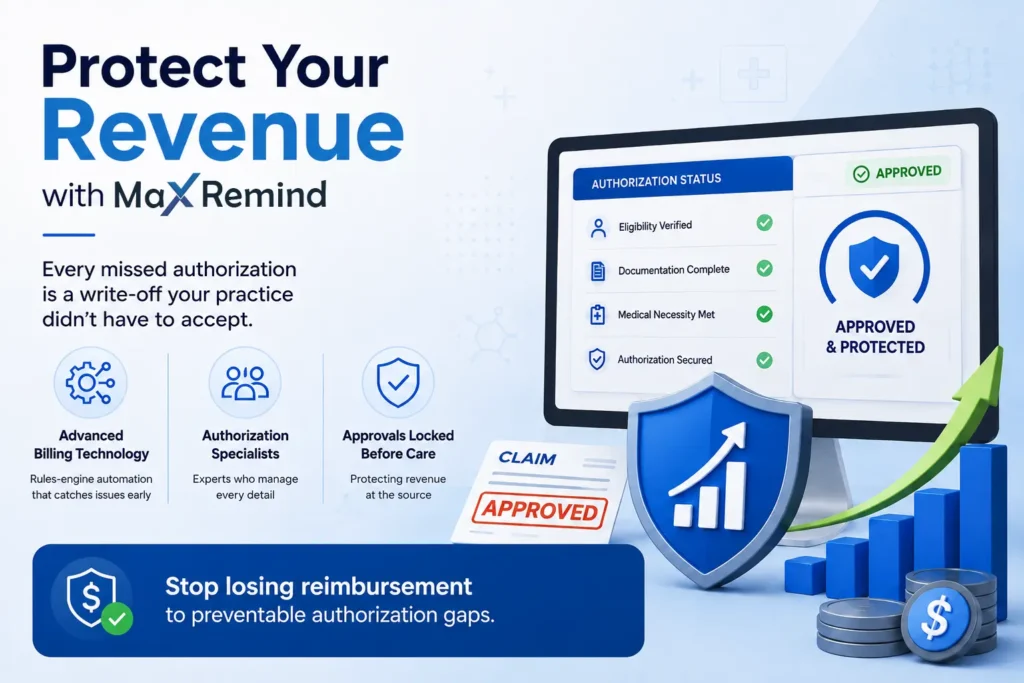
Protect Your Revenue: Schedule Your Free Health Check
MaxRemind combines rules-engine billing technology with dedicated authorization specialists to lock down approvals before care is delivered, protecting your revenue at the source, not after the denial hits.
Stop losing reimbursement to preventable authorization gaps.
Schedule Your Free Prior Authorization Health Check
- What happens if a procedure is performed without prior authorization?
-
The claim is typically denied outright, and the practice loses leverage to appeal. Since the service has already been rendered, retro-authorization requests succeed far less often, turning the cost of care into a straight write-off.
- How long does a prior authorization typically take to process?
-
With manual, reactive workflows, approvals often take 7–14 business days. Practices using real-time eligibility checks and dedicated tracking can cut that down to 24–48 hours.
- Can a denied prior authorization be appealed after the service is provided?
-
Yes, but success rates drop sharply once care has already happened. Payers weigh pre-service medical necessity documentation far more favorably than after-the-fact justification.
- What's the highest hidden cost of authorization delays?
-
Patient leakage. Long approval waits frustrate patients enough that they cancel and go to a faster competitor, costing the practice not just that procedure, but the referrals and repeat visits tied to it.
- Is outsourcing prior authorization management worth it for small practices?
-
For practices handling high-volume procedures, imaging, or specialty services, yes. A dedicated RCM partner locks down authorizations before care is delivered, which typically costs far less than the revenue lost to preventable denials.
Transform Your
Practice with
AI-Powered EHR
Reduce administrative burden, streamline workflows, accelerate revenue, and deliver exceptional patient care.
- AI-Assisted Documentation
- HIPAA-Compliant Platform
- Faster Claims & Billing
- Specialty-Based Solutions