The Biggest Billing Workflow Inefficiencies Automation Can Eliminate
Introduction: The Manual Data Burden Is Breaking Small Practices
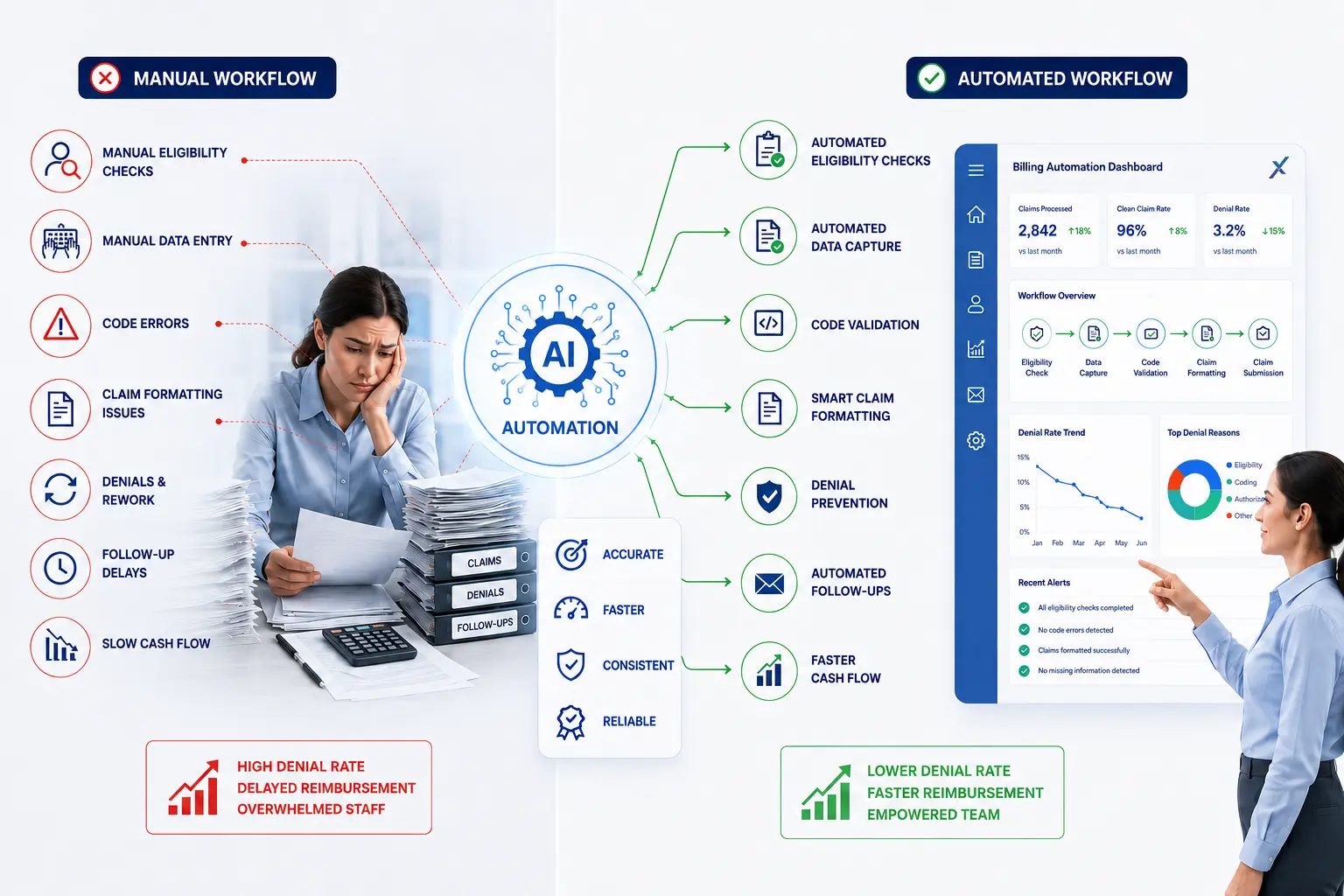
Intelligent rules engines don’t replace your billing team or threaten your independence. They remove the repetitive, error-prone tasks that shouldn’t require a human decision in the first place. Eligibility checks, code validation, and claim formatting follow predictable rules. Automation applies those rules instantly, consistently, and without fatigue.
The result: fewer front-end rejections, faster reimbursement, and a billing staff that spends time on judgment calls instead of data entry.
Seamless Integration Protocols: HL7 and APIs
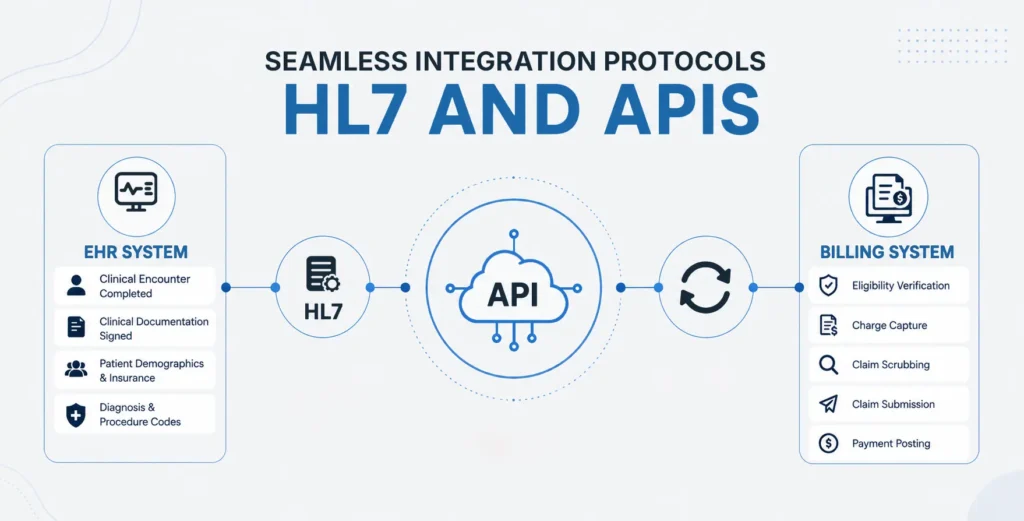
HL7 protocols give your EHR and billing clearinghouse a shared language. When a clinical encounter closes, HL7 messaging pushes structured data (diagnosis codes, procedure codes, patient demographics) directly into the billing pipeline. No PDF exports. No re-keying.
- Instant data transfer:
Clinical documentation converts to billable charges the moment a note is signed. - Zero double-entry:
Staff never re-type information that already exists in the EHR. - Continuous sync:
Updates to patient demographics or insurance information flow to the billing system automatically, not on the next manual refresh.
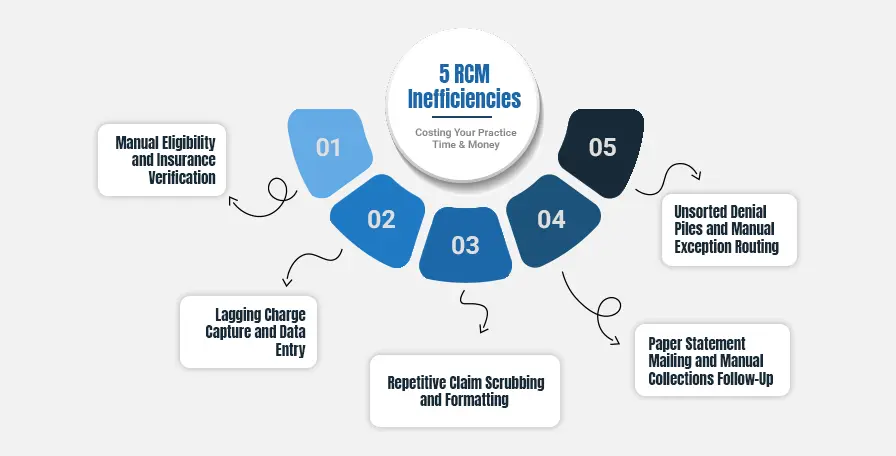
Inefficiency 1: Manual Eligibility and Insurance Verification
Inefficiency 2: Lagging Charge Capture and Data Entry
- Same-day charge entry instead of multi-day backlogs
- Fewer missed or under-coded charges
- Faster overall claim submission timelines
Inefficiency 3: Repetitive Claim Scrubbing and Formatting
Inefficiency 4: Paper Statement Mailing and Manual Collections Follow-Up
- E-statements generate and send the moment a balance is finalized, not on a fixed monthly schedule
- Text-to-pay alerts reach patients on the channel they actually check
- Systematic balance tracking flags overdue accounts automatically, without a staff member reviewing an aging report line by line
Inefficiency 5: Unsorted Denial Piles and Manual Exception Routing
The Automation Lift: Manual vs. Automated RCM Workflows
| Task | Manual Process | Automated Process |
|---|---|---|
|
Eligibility Verification |
Staff log into individual payer portals or call payers one patient at a time |
Batch eligibility checks run automatically before every scheduled encounter |
|
Charge Capture |
Codes transcribed by hand from paper superbills into the billing system |
Charges sync from the EHR to billing modules in real time via API |
|
Claim Scrubbing/Validation |
Staff manually review each claim line for payer-specific formatting rules |
Clearinghouse scrubbers validate every claim segment instantly against payer edits |
|
Patient Statement Generation |
Statements printed, stuffed, and mailed on a fixed monthly cycle |
E-statements and text-to-pay alerts trigger automatically based on balance status |
|
Denial Sorting/Routing |
ERAs reviewed line by line to prioritize which denials to work first |
Denial codes are read, ranked by dollar value, and routed to the right specialist automatically |
Take Control of Your Revenue Cycle Today
MaxRemind gives independent practices the same automated infrastructure that large health systems rely on, without sacrificing the independence that makes your practice yours.
Our clients see the results directly in their numbers:
- 23% increase in practice revenue
- 99% first-pass clean claim rate
- 24 days or lower average Accounts Receivable
Eliminate Manual Billing Bottlenecks
- What's the difference between eligibility verification automation and just checking online portals faster?
-
Manual portal checks still require staff to log in and pull data one patient at a time. Automated batch eligibility runs for your entire schedule at once, 24-48 hours ahead of appointments, with results delivered to a single dashboard instead of a dozen browser tabs.
- Will automation replace our billing staff?
-
No. Automation removes repetitive, rules-based tasks like data entry and claim formatting. Your billing team shifts from manual processing to reviewing exceptions and handling the judgment calls that actually need a human.
- How does HL7 integration work with our existing EHR?
-
HL7 is a data-exchange standard that lets your EHR and billing clearinghouse "speak" the same language. Once connected, clinical documentation converts into billing data automatically, with no manual export or re-entry required.
- How fast can automated claim scrubbing catch errors before submission?
-
Clearinghouse scrubbers validate every claim line against payer-specific edits in seconds, before the claim leaves your office. That's the difference between catching a formatting error upfront and waiting weeks for a denial to come back.
- What kind of ROI can a small independent practice expect from RCM automation?
-
MaxRemind clients typically see a 23% increase in practice revenue, a 99% first-pass clean claim rate, and A/R averaging 24 days or lower. Results vary by practice size and specialty, which is why we start every engagement with a free Revenue Cycle Automation Assessment.
Transform Your
Practice with
AI-Powered EHR
Reduce administrative burden, streamline workflows, accelerate revenue, and deliver exceptional patient care.
- AI-Assisted Documentation
- HIPAA-Compliant Platform
- Faster Claims & Billing
- Specialty-Based Solutions