Revenue Leakage in Small Practices: Where Money Commonly Slips Away
Stop Revenue Leakage Before It Hurts Your Practice
Introduction
What Is Revenue Leakage, Exactly?

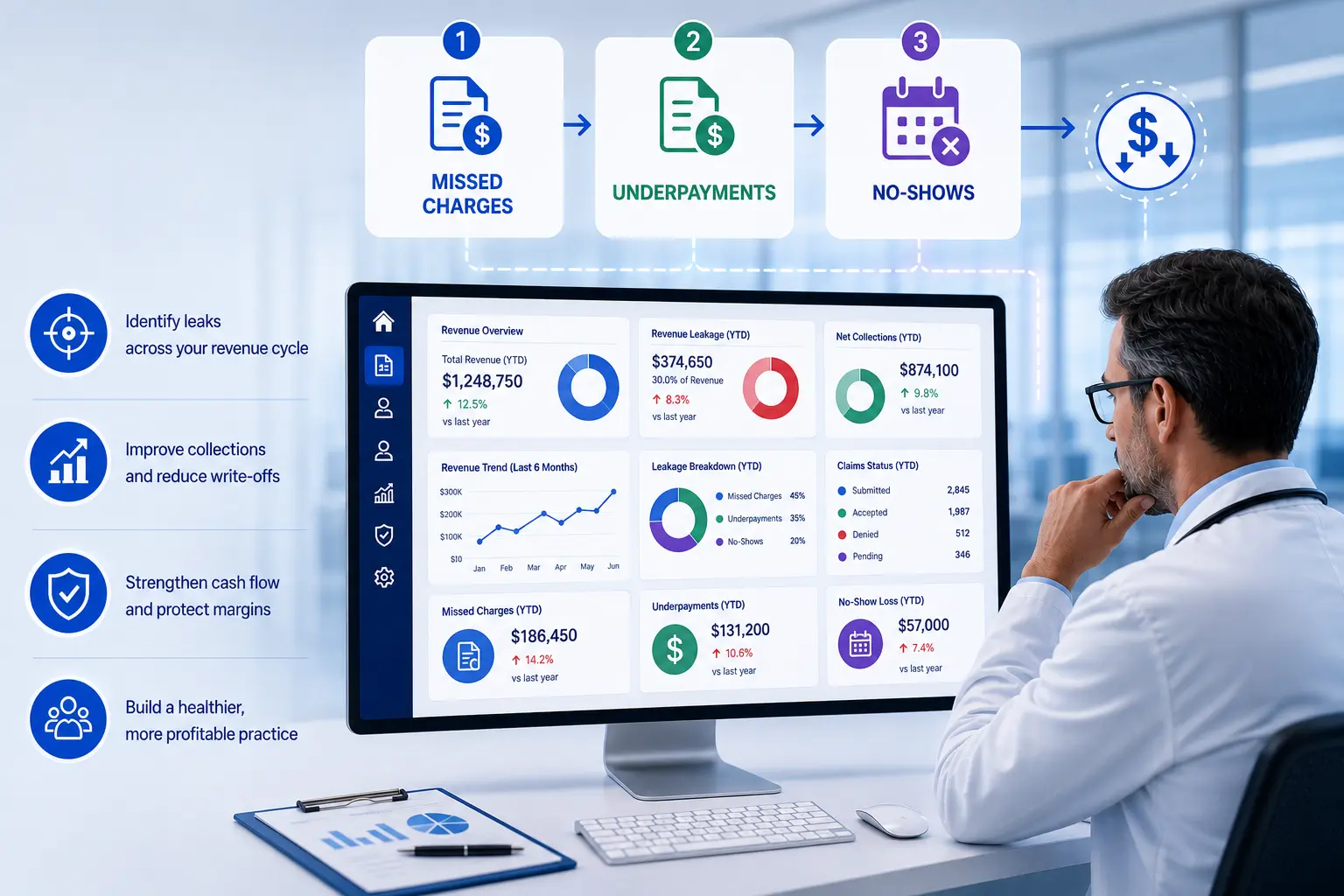
Missed Charges: The Silent Billing Gap
- Manual charge entry that depends on staff memory instead of system prompts.
- Ancillary services (labs, immunizations, supplies) captured on paper but never transferred to billing.
- EHR and practice management systems that don’t talk to each other.
- High patient volume that leaves front-desk and clinical staff no time to double-check charge capture.
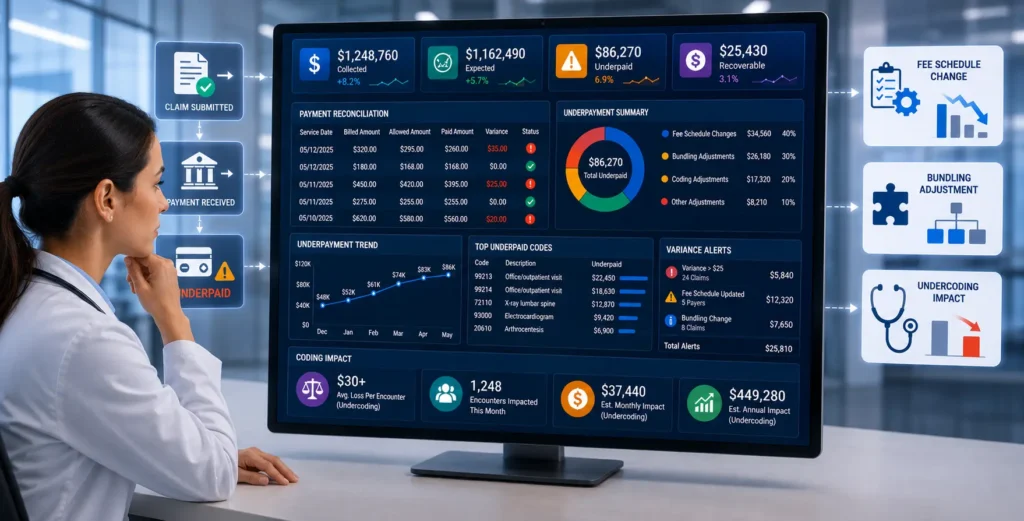
Underpayments: When “Paid” Doesn't Mean Paid in Full
No-Shows: The Hidden Cost of Empty Chairs
Where the Money Goes: A Quick Comparison
| Leakage Source | What's Happening | Typical Annual Impact |
|---|---|---|
|
Missed charges |
Services rendered but never entered into the billing system |
Thousands per month, compounding quarterly |
|
Underpayments |
Claims marked “paid” but reimbursed below the contracted rate |
$2,800–$4,200/month recoverable once tracked |
|
Undercoding |
Documentation supports a higher-level code than what’s billed |
$32,000–$161,000, depending on volume |
|
No-shows |
Patients miss appointments without cancelling in advance |
Up to $150,000 for an independent practice |
How Small Practices Can Plug the Leaks
Most revenue leakage isn’t due to poor effort; it’s due to workflows that can’t keep up with day-to-day volume. A structured, recurring review process closes most gaps without adding headcount:
- Conduct monthly internal audits of a sample of claims for missed charges and coding accuracy.
- Track key performance indicators: denial rate, days in AR, clean claim rate, net collection rate, on a weekly dashboard.
- Reconcile every remittance advice against your contracted fee schedule.
- Automate eligibility verification before the appointment, not after.
- Pair appointment reminders with frictionless online rescheduling to reduce no-shows.
| Warning Sign | Recommended Fix |
|---|---|
|
Denial rate above 5% |
Run monthly denial-pattern reports by payer and reason code |
|
AR aging past 30–40 days |
Set automated AR follow-up triggers inside your EHR/PM system |
|
No-show rate above 15% |
Layer SMS and email reminders with easy online rescheduling |
|
Unexplained revenue dips |
Audit fee schedules and payer contracts at least annually |
|
No unbilled-charges report |
Configure your PM system to flag encounters closed without a charge |
How MaxRemind Helps
Catching revenue leakage consistently requires visibility; most small practices don’t have time to build on their own. MaxRemind’s Revenue Cycle Management services combine eligibility verification, claims scrubbing, denial management, and underpayment tracking to close these gaps at the source. Paired with Maximus EHR‘s integrated charge capture and real-time reporting, practices get a single system where every service rendered is documented, billed, and tracked through to full payment, MaxRemind with automated patient reminders built in to help reduce no-shows.
If your practice suspects it’s leaving money on the table, a revenue cycle audit is the fastest way to find out where. Contact MaxRemind today to schedule a consultation and see how we can help your practice recover lost revenue and run on a stronger financial foundation.
Schedule a Revenue Cycle Audit with MaxRemind
- What is revenue leakage in a medical practice?
-
Revenue leakage is the loss of income caused by services that are provided but not fully billed or reimbursed. It can result from missed charges, underpayments, coding errors, claim denials, or patient no-shows. While each issue may seem small, together they can significantly impact a practice's financial performance.
- What are the most common causes of revenue leakage?
-
The most common causes include missed charges, payer underpayments, undercoding, patient no-shows, insurance eligibility issues, and inefficient billing workflows. These problems often occur due to manual processes, poor system integration, or a lack of regular revenue cycle audits.
- How can small medical practices reduce revenue leakage?
-
Small practices can reduce revenue leakage by conducting regular billing audits, automating eligibility verification and appointment reminders, monitoring payer reimbursements, reconciling payments against contracted rates, and using integrated EHR and revenue cycle management solutions to improve charge capture and claims accuracy.
- Why are payer underpayments difficult to detect?
-
Payer underpayments are often overlooked because claims appear to be paid, even when the reimbursement is lower than the contracted amount. Without comparing remittance advice to payer fee schedules, practices may never realize they were paid less than they were owed.
- How can MaxRemind help prevent revenue leakage?
-
MaxRemind helps reduce revenue leakage through comprehensive Revenue Cycle Management services, including eligibility verification, claims scrubbing, denial management, underpayment tracking, and automated patient reminders. When combined with Maximus EHR, practices gain integrated charge capture and real-time reporting to help ensure services are accurately documented, billed, and reimbursed.
Transform Your
Practice with
AI-Powered EHR
Reduce administrative burden, streamline workflows, accelerate revenue, and deliver exceptional patient care.
- AI-Assisted Documentation
- HIPAA-Compliant Platform
- Faster Claims & Billing
- Specialty-Based Solutions