Medicare vs. Commercial Payers: Key Billing Differences Practices Must Know
Stop Letting Payer Rules Delay Your Revenue
Introduction
The Billing Blueprint: Medicare vs. Commercial Insurance
| Comparison Metric | Traditional Medicare (CMS) | Commercial Payers (BCBS, Aetna, UHC) |
|---|---|---|
|
Prior Authorization Rules |
Rarely required for standard, medically necessary outpatient care. |
Heavily mandated across advanced imaging, procedures, and specialties. |
|
Fee Schedule Adjustments |
Fixed annual rates based on geographically adjusted RBRVS. |
Negotiated contract rates based on percentage of charges or proprietary metrics. |
|
Code Modifier Utilization |
Strict, standardized, and uniformly enforced across all jurisdictions. |
Highly variable; rules depend entirely on specific local payer contracts. |
|
Timely Filing Deadlines |
365 days from the exact date of service. |
Much tighter windows; typically ranging from 90 to 180 days. |
|
Appeal Frameworks |
Structured, 5-level federal administrative process with explicit deadlines. |
Fragmented, internal 1-to-2 level reviews followed by independent arbitration. |
Prior Authorization Battlegrounds
Coding Nuances and Modifier Variances
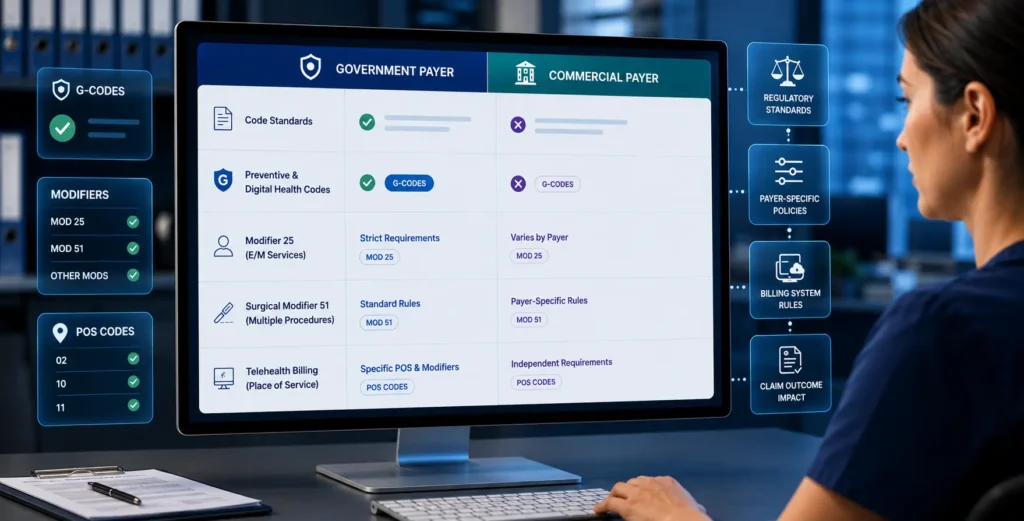
Coding compliance reveals severe technical discrepancies between government and private entities. CMS maintains strict transparency regarding acceptable HCPCS and CPT codes. For example, Medicare mandates specific G-codes for preventative exams and digital health services. Medicare also enforces rigid regulations on modifiers, such as modifier 25 for significant, separately identifiable evaluation and management (E/M) services on the same day as a procedure. If documentation fails to meet the tight federal criteria for modifier 25, Medicare automatically drops or rejects the claim.

Reimbursement Models: Fee Schedules vs. Contract Negotiations
Timely Filing and Appeals: Managing the Clock
- The Medicare Appeal Pathway:
Follows a formal, multi-level federal hierarchy. It progresses systematically from a Redetermination by a Medicare Administrative Contractor (MAC), through a Reconsideration by a Qualified Independent Contractor (QIC), up to an Administrative Law Judge (ALJ) hearing. Each level features predictable turnaround times and explicit statutory legal guidelines. - The Commercial Appeal Pathway:
Operates without uniform federal structures. Billing teams must navigate internal, proprietary grievance mechanisms unique to each insurance carrier. This usually involves a first-level peer review and a second-level administrative appeal. If these internal levels fail, the practice must pivot to independent external arbitration or contract litigation, which drastically extends the time it takes to recover revenue.
Best Practices for Billing Teams
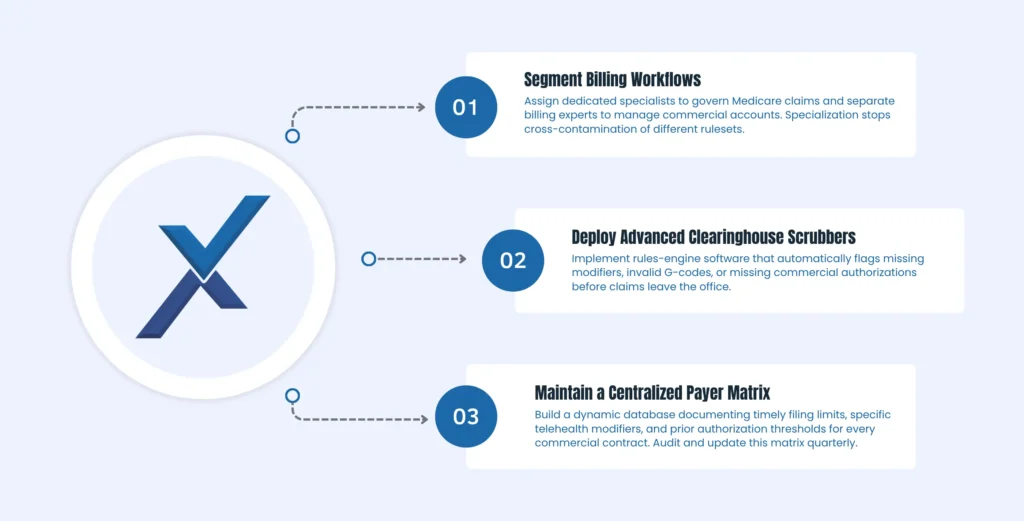
- Segment Billing Workflows:
Assign dedicated specialists to govern Medicare claims and separate billing experts to manage commercial accounts. Specialization stops cross-contamination of different rulesets. - Deploy Advanced Clearinghouse Scrubbers:
Implement rules-engine software that automatically flags missing modifiers, invalid G-codes, or missing commercial authorizations before claims leave the office. - Maintain a Centralized Payer Matrix:
Build a dynamic database documenting timely filing limits, specific telehealth modifiers, and prior authorization thresholds for every commercial contract. Audit and update this matrix quarterly.
Streamline Your Revenue Cycle with MaxRemind
Stop letting complex payer rules drain your practice’s hard-earned revenue. MaxRemind delivers elite Revenue Cycle Management (RCM) services backed by advanced, automated rules-engine technology designed to handle both rigid Medicare frameworks and volatile commercial contracts seamlessly. Our team of expert medical billers eliminates billing friction, optimizes coding modifiers, and secures clean claim submissions to accelerate your cash flow.
Streamline Your Revenue Cycle with MaxRemind
- What is the biggest billing difference between Medicare and commercial insurance?
-
The biggest difference is that Medicare follows standardized CMS regulations with fixed reimbursement rates, while commercial insurers have their own policies, negotiated payment rates, prior authorization requirements, and filing deadlines. Billing teams must follow each payer's specific rules to avoid claim denials.
- Does Medicare require prior authorization for medical services?
-
Traditional Medicare rarely requires prior authorization for medically necessary outpatient services covered under CMS guidelines. However, Medicare Advantage plans often have prior authorization requirements that are similar to those used by commercial insurance companies.
- Why do commercial insurance claims get denied more often than Medicare claims?
-
Commercial claims are more likely to be denied because each insurer has unique policies regarding prior authorization, coding, modifiers, and coverage. Missing an authorization, using incorrect modifiers, or failing to meet payer-specific guidelines can result in claim denials.
- How do timely filing limits differ between Medicare and commercial payers?
-
Traditional Medicare generally allows claims to be filed within 365 days from the date of service. Commercial insurers typically require claims to be submitted within 90 to 180 days, depending on the payer and contract, making timely claim submission essential.
- How can medical practices reduce billing errors across different payers?
-
Practices can reduce billing errors by maintaining payer-specific billing guidelines, verifying prior authorizations before services are provided, using automated claim-scrubbing software, keeping coding updates current, and partnering with experienced Revenue Cycle Management (RCM) providers like MaxRemind.
Transform Your
Practice with
AI-Powered EHR
Reduce administrative burden, streamline workflows, accelerate revenue, and deliver exceptional patient care.
- AI-Assisted Documentation
- HIPAA-Compliant Platform
- Faster Claims & Billing
- Specialty-Based Solutions