How Specialty-Specific Coding Impacts Reimbursement Rates
Prepare Your Revenue Cycle for Medicaid Payment Changes
Introduction
How Medical Coding Determines Reimbursement
- Whether a service is covered under the patient’s plan
- Whether the provider is eligible to bill for that service
- What the payment amount should be, typically based on Relative Value Units (RVUs)
- Whether the claim requires review, additional documentation, or prior authorization
Cardiology: High Complexity, High Stakes
Key Reimbursement Risks in Cardiology
- Bundling restrictions on IVUS, FFR, and related procedures mean that billing component codes separately can trigger denials or audits.
- Work RVU cuts on high-revenue procedures: left atrial appendage occlusion (CPT 33340) saw a nearly 27% RVU reduction in 2026.
- Stress test reimbursement (CPT 93017) dropped from $311.40 to $220.60 nationally
- New codes require immediate adoption; failure to use updated codes results in rejected claims or systematic underpayment.
- Modifier 26 errors when billing the professional component only for imaging services; the modifier must be applied correctly, or claims are paid at the wrong rate or denied entirely.
Cardiology CPT Snapshot: 2026
| Service | CPT Code | Common Billing Issue |
|---|---|---|
|
ECG (complete) |
93000 |
Splitting into 93005/93010 when full service is provided |
|
Stress Test |
93017 |
Reimbursement reduced; documentation must justify medical necessity |
|
Coronary Angioplasty |
92920–92944 |
Bundling restrictions apply across the code family |
|
Atrial Fibrillation Ablation |
93656 |
Must reflect correct clinical context, not generalized “heart failure” coding |
|
AI Coronary Plaque Assessment |
75577 |
New 2026 code; reimbursed at $950.50 under OPPS |
Mental Health & Behavioral Health: Under coded and Underpaid
Individual psychotherapy codes (90832, 90834, 90837) are strictly time-dependent. A single documentation error can result in a denial or a downcode to a lower-paying code. Common issues include an unclear session start time, missing total face-to-face minutes, or a note that doesn’t accurately reflect the billed duration. When this happens systematically across hundreds of monthly claims, the cumulative revenue impact is significant.
Provider credential level adds another layer of complexity. Psychologists billing CPT 90837 receive approximately $154.29, while LMFTs and LMHCs billing the same code under Medicare receive roughly $115.72, about 75% of the psychologist rate. LMFTs and LMHCs only gained direct Medicare billing privileges recently, and many are still navigating the transition, submitting claims under incorrect or outdated billing structures.
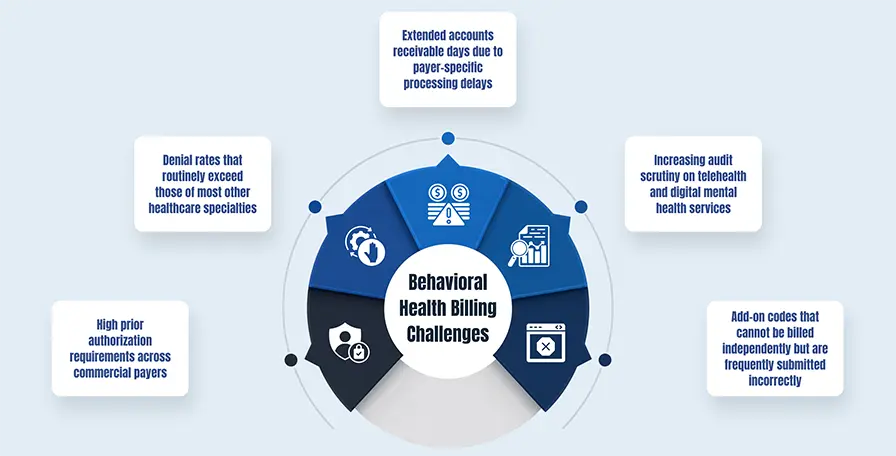
Behavioral Health Billing Challenges
- High prior authorization requirements across commercial payers
- Denial rates that routinely exceed those of most other healthcare specialties
- Extended accounts receivable days due to payer-specific processing delays
- Increasing audit scrutiny on telehealth and digital mental health services
- Add-on codes that cannot be billed independently but are frequently submitted incorrectly
Primary Care: The E/M Coding Trap
E/M codes (99202–99215 for office visits) are determined by either medical decision-making (MDM) complexity or total time spent on the encounter. Many primary care providers default to mid-level codes (99213 or 99214) out of habit or risk aversion — even when the clinical complexity or time clearly supports a higher-level code. The financial gap between a 99213 and a 99215 may seem modest per visit, but across thousands of encounters per year, systematic undercoding can represent hundreds of thousands of dollars in unrealized revenue.
Orthopedics: Where Modifier Errors Cost Thousands
ICD-10 specificity compounds the problem. Payers now enforce coding to the 7th character level for surgical claims. Submitting M17.9 (knee osteoarthritis, unspecified) instead of M17.11 (primary osteoarthritis, right knee) triggers medical necessity review or outright rejection. The revenue gap between a correctly coded shoulder arthroscopy (CPT 29827) and the wrong code (CPT 29822) exceeds $800 per case, a discrepancy that can represent over $96,000 in annual revenue loss for a mid-size practice, with no denials required to cause it.
Specialty Coding Reimbursement Comparison at a Glance
| Specialty | Primary Code Types | Highest Risk Areas | Revenue Impact of Errors |
|---|---|---|---|
|
Medicare Fee-for-Service |
99202–99215 (E/M) |
95 or 93 |
POS 02 or POS 10 |
|
Cardiology |
CPT 92920–93799, device codes |
Bundling, RVU reductions, and new code adoption |
High – single denied claim can exceed $1,000+ |
|
Mental Health |
CPT 90832–90837, add-on codes |
Time documentation, credential-based differentials |
Moderate-High – systematic underpayment common |
|
Primary Care |
E/M codes 99202–99215 |
Undercoding MDM, poor documentation |
Moderate – cumulative annual impact is significant |
|
Orthopedics |
CPT 27xxx, 29xxx surgical codes |
Modifier errors, ICD-10 specificity, global periods |
High – $800+ per case errors documented |
Common Coding Mistakes That Reduce Reimbursement Across All Specialties
-
Using Unspecified ICD-10 Codes:
Using unspecified ICD-10 codes when more specific options are available can trigger medical-necessity reviews and payer-side delays. -
Failing to Update Codes Annually:
Using deleted or revised codes can generate automatic claim rejections from January 1 onward. -
Ignoring Payer-Specific LCDs (Local Coverage Determinations):
Medicare coverage requirements may differ significantly from what a commercial payer allows for the same code. -
Inadequate Documentation:
A valid CPT code with insufficient documentation is just as vulnerable as an incorrect code; the clinical record must fully support every billed service. -
Missing or Incorrect Modifiers:
Errors involving modifiers, particularly for bilateral procedures, multiple same-day procedures, and global period exceptions, can lead to denials or payment delays. -
Taxonomy/Specialty Code Mismatches:
The provider specialty on file must align with the services being billed, or claims may be flagged before reaching human review.

How to Protect and Maximize Reimbursement in Your Specialty
- Invest in specialty-trained coders. Generic coding knowledge is insufficient for cardiology, orthopedics, or behavioral health. Each specialty requires dedicated expertise in the applicable CPT families, modifier rules, and payer policies.
- Conduct regular coding audits. Routine internal audits catch documentation gaps and recurring denial patterns before they affect reimbursement. Quarterly reviews are a minimum; monthly is better for high-volume practices.
- Stay current on annual code changes. CPT updates take effect January 1 each year. Practices that adopt new codes immediately avoid the claim rejections that come from submitting outdated codes.
- Align documentation with the billed code — not the other way around. Coding should flow from thorough clinical documentation, not be retrofitted after the fact. Physician-coder collaboration on complex cases is essential.
- Use technology to reduce human error. AI-assisted coding tools can flag documentation gaps, suggest accurate code combinations, and identify unbundling risks before claims are submitted.
- Partner with a specialty-focused billing service. Outsourced billing partners with specialty-specific expertise provide access to RCM infrastructure, denial management protocols, and payer relationship knowledge that most in-house teams can't replicate.
Final Thought: Generic Coding Has a Price Tag
At MaxRemind, our specialty-specific billing and coding services are built around exactly these distinctions. From cardiology to behavioral health to primary care, we bring the coding depth your practice needs to capture every dollar it has earned.
Ready to see where your practice stands?
- Why does specialty-specific medical coding affect reimbursement rates?
-
Specialty-specific coding ensures that procedures, diagnoses, and services are documented and billed according to the unique requirements of each medical specialty. Accurate coding helps prevent denials, reduces audits, and ensures providers receive the full reimbursement they have earned.
- Which specialty faces the highest coding-related reimbursement risks?
-
Every specialty has unique challenges, but cardiology and orthopedics often face the highest financial risk due to complex procedures, modifier requirements, bundling rules, and frequent coding updates that can significantly impact reimbursement.
- How can undercoding impact a healthcare practice's revenue?
-
Undercoding occurs when providers bill a lower-level service than what was actually performed. While it may seem safer, consistent undercoding can lead to substantial revenue loss over time, especially in primary care and behavioral health practices.
- What are the most common coding mistakes that lead to claim denials?
-
Common mistakes include using unspecified ICD-10 codes, missing or incorrect modifiers, outdated CPT codes, inadequate documentation, and taxonomy or specialty code mismatches. These errors can result in claim rejections, payment delays, or reduced reimbursement.
- How can healthcare practices improve coding accuracy and maximize reimbursement?
-
Practices can improve coding accuracy by investing in specialty-trained coders, conducting regular coding audits, staying current with annual coding updates, strengthening clinical documentation, and utilizing AI-assisted coding or specialty-focused billing services to reduce errors and optimize revenue.
Transform Your
Practice with
AI-Powered EHR
Reduce administrative burden, streamline workflows, accelerate revenue, and deliver exceptional patient care.
- AI-Assisted Documentation
- HIPAA-Compliant Platform
- Faster Claims & Billing
- Specialty-Based Solutions