EHR and Billing Integration Problems That Hurt Revenue
The Invisible Leak: Why Disconnected Systems Bleed Revenue
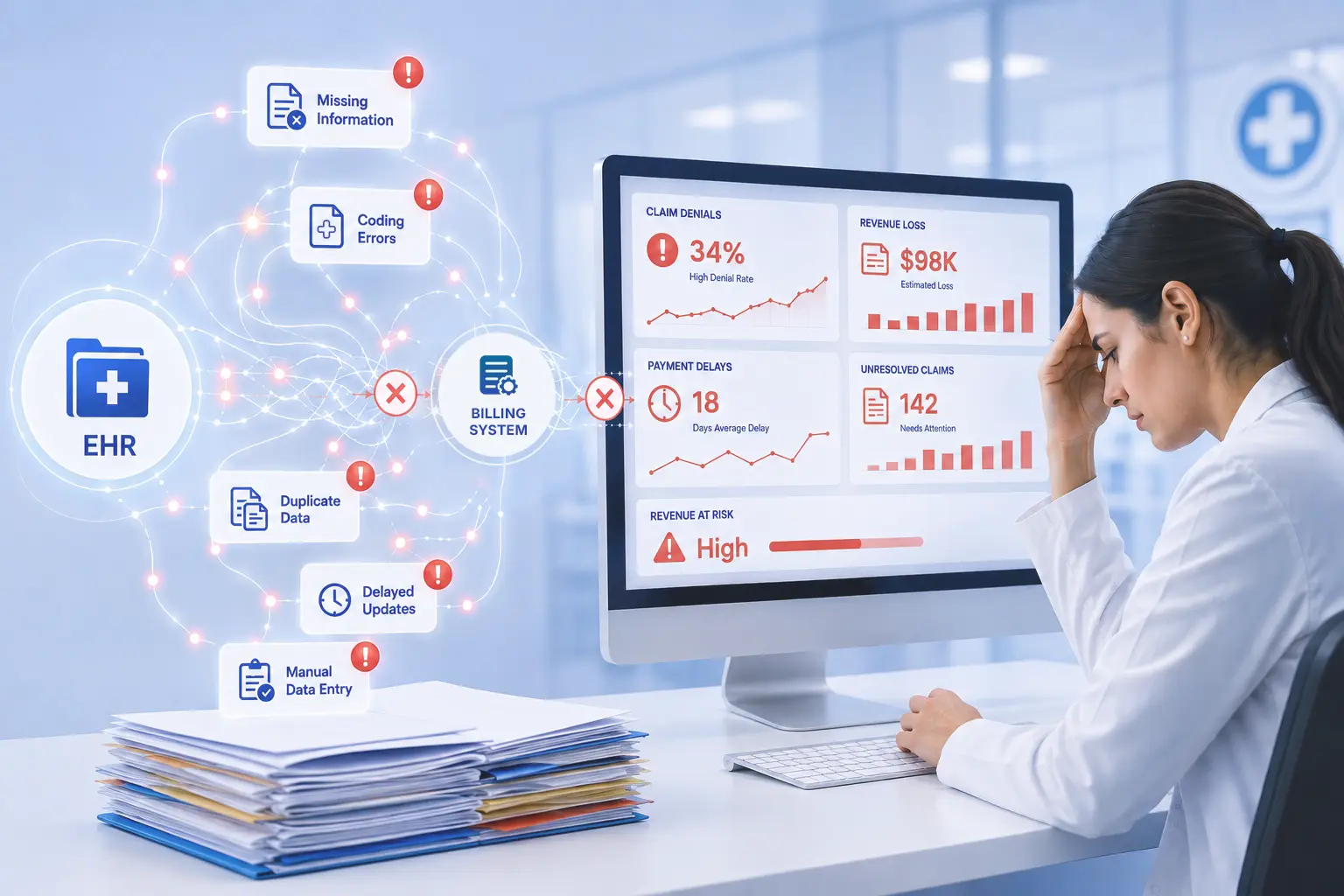
The Demographic Disconnect: Missing Data and Front-End Rejections
Common failure points:
- Insurance ID mismatches:
A payer ID entered correctly in the EHR but transposed during manual re-entry into the billing system. - Stale address or subscriber data:
Demographic updates made during a visit that never propagate to the billing side. - Duplicate patient records:
Two partial profiles created because the systems do not share a single source of truth.
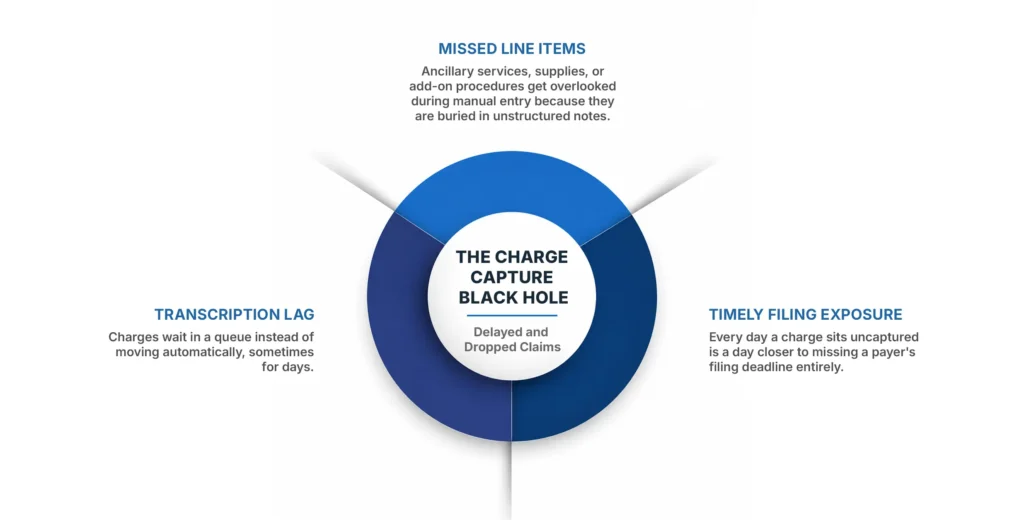
The Charge Capture Black Hole: Delayed and Dropped Claims
- Transcription lag:
Charges wait in a queue instead of moving automatically, sometimes for days. - Missed line items:
Ancillary services, supplies, or add-on procedures get overlooked during manual entry because they are buried in unstructured notes. - Timely filing exposure:
Every day a charge sits uncaptured is a day closer to missing a payer's filing deadline entirely.
The Documentation to Coding Disconnect: Modifier and CPT Friction
The result:
- Billers scroll through free-text notes trying to find the specific line that supports a modifier.
- CPT selection depends on the biller’s interpretation of clinical intent instead of a structured, protocol-driven mapping.
- Coding accuracy varies from claim to claim, even for the same provider and the same service type.
Integration Snapshot: Fragmented vs. Unified Systems
| Metric | Fragmented EHR/Billing Systems | Seamlessly Unified Systems |
|---|---|---|
|
Patient Demographics Syncing |
Manual re-entry or batch updates, often lagging by hours or days |
Real-time bidirectional sync at check-in |
|
Charge Capture Latency |
Delayed until manual transcription, sometimes days after the encounter |
Automated capture at point of documentation |
|
Claim Scrubbing Point |
Happens after manual entry into billing software, catching errors late |
Happens inline as codes are generated, catching errors early |
|
Encounter Error Resolution |
Fixed in billing system only, clinical record left uncorrected |
Corrected in both systems simultaneously |
|
Staff Administrative Labor |
High: duplicate entry, manual reconciliation, cross-checking |
Low: system-driven validation replaces manual cross-checking |
The Nightmare of Multi-System Error Resolution
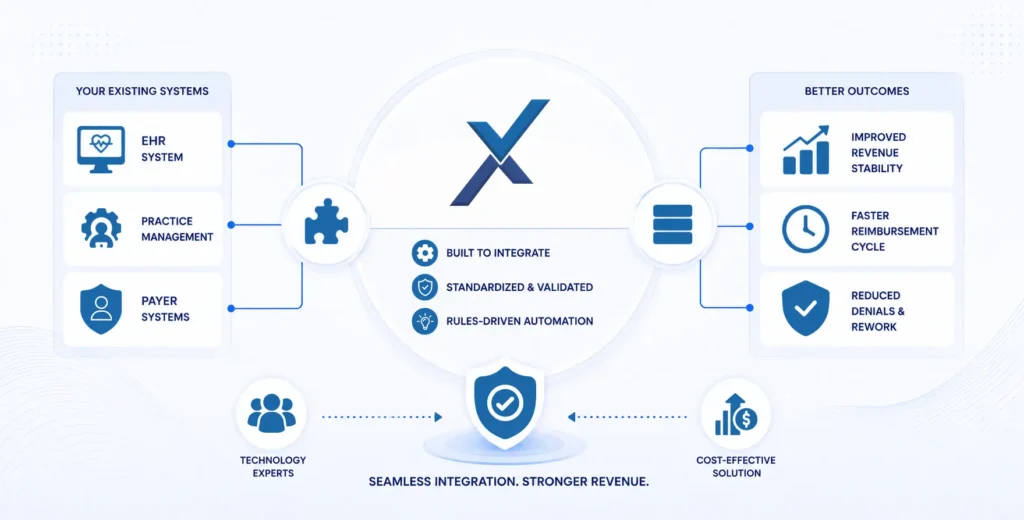
Securing the Technical Foundation: Leveraging Managed RCM Partners
- Builds the bridge, not a replacement:
Interface engines and structured data mapping connect existing systems without a costly platform migration. - Standardizes the handoff:
Demographic, charge capture, and coding data move through one validated pathway instead of multiple manual touchpoints. - Applies a billing rules engine on top of existing workflows:
Errors get caught before submission, not after rejection.
Take Control of Your Revenue Cycle
Integration friction is a silent tax on every practice running disconnected EHR and billing systems. MaxRemind closes that gap.
Stop Losing Revenue to Disconnected Systems
- What is EHR and billing integration?
-
It is the technical connection between clinical documentation software and billing software, allowing patient, charge, and coding data to move automatically between the two without manual re-entry.
- How do integration problems cause claim denials?
-
Data that fails to sync, like demographic updates or charge capture, creates errors that trigger eligibility rejections or coding mismatches before a claim ever reaches the payer.
- Can a practice fix integration issues without replacing its EHR?
-
Yes. A managed RCM partner can build an interface layer that connects existing systems, avoiding the cost and disruption of a full platform migration.
- What is the financial impact of delayed charge capture?
-
Delayed capture risks missed billable services and expired timely filing windows, meaning revenue that was earned during the encounter is never billed at all.
- How does MaxRemind address EHR-billing integration gaps?
-
MaxRemind combines a technology-driven billing rules engine with hands-on RCM management to unify clinical and billing data, reducing manual errors and stabilizing cash flow.
Transform Your
Practice with
AI-Powered EHR
Reduce administrative burden, streamline workflows, accelerate revenue, and deliver exceptional patient care.
- AI-Assisted Documentation
- HIPAA-Compliant Platform
- Faster Claims & Billing
- Specialty-Based Solutions