Denial Management vs. Denial Prevention: Which Saves More Revenue?
Schedule a Free Revenue Cycle Analysis
Introduction: The Real Cost of Claim Denials
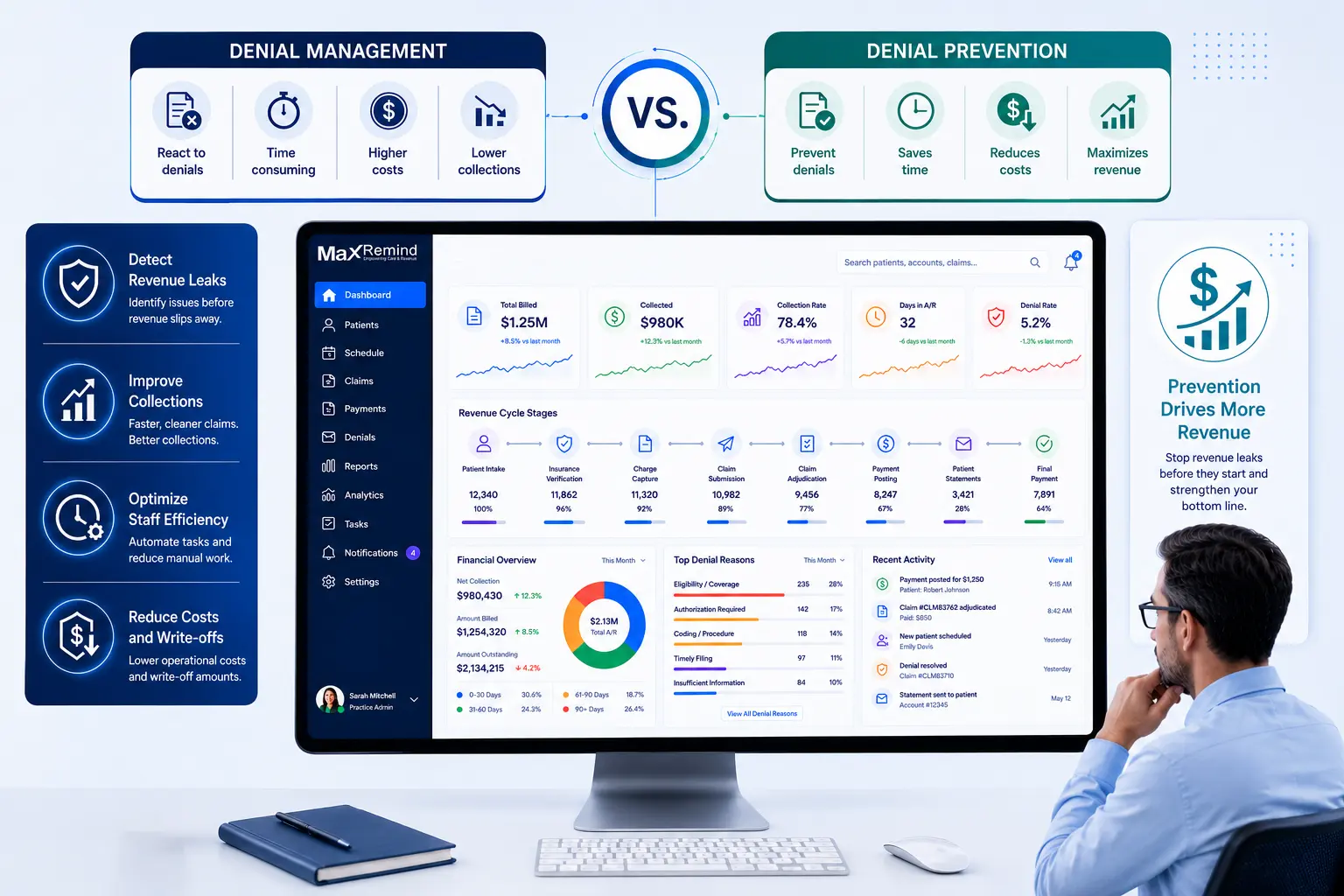
Denial Management vs. Denial Prevention at a Glance
| Metric | Denial Management | Denial Prevention |
|---|---|---|
|
Focus |
Reactive – fixing claims after rejection |
Proactive – stopping errors before submission |
|
Timing |
Post-denial (back-end) |
Pre-submission (front-end) |
|
Cost of Implementation |
Low upfront, high ongoing labor cost |
Higher upfront (tech, training), lower ongoing cost |
|
Cost per claim |
$25-$118+ to rework and appeal |
A fraction of that – mostly automated |
|
Long-Term ROI |
Diminishing returns as volume grows |
Compounding savings as clean rate rises |
|
Impact on Clean Claim Rate |
No direct impact, treats symptoms |
Directly raises first-pass clean claim rate |
|
Staff Burden |
High _ repetitive, manual rework |
Lower – automation absorbs routine checks |
What Is Denial Management?
How the process typically works
- Identify the denial:
The claim is flagged in the payer's remittance advice with a specific denial code. - Investigate the root cause:
Billing staff reviews the claim, documentation, and payer policy to determine what went wrong. - Correct and resubmit:
The claim is fixed and either resubmitted or routed into a formal appeal. - Track and follow up:
Staff monitors the appeal until it resolves, which can take weeks depending on the payer.

What Is Denial Prevention?
Core components of a prevention strategy
- Staff training:
Registration, coding, and billing teams trained continuously on payer-specific rules and documentation standards. - Prior authorization tracking:
Automated flags for services that require payer approval before scheduling. - AI-powered claim scrubbing:
Advanced billing software that checks claims against payer edits and clinical documentation before submission, catching errors a human might miss.
The Financial Verdict: Breaking Down the Numbers
- A practice processing 5,000 claims a month with a 10% denial rate is generating roughly 500 denials monthly.
- At even a conservative $50 average rework cost per claim, that is $25,000 a month, or $300,000 a year, spent purely on administrative recovery, before accounting for the revenue that never comes back at all.
- Shifting even half of those denials to prevention, at a fraction of the per-claim cost, can save six figures annually while also accelerating cash flow, since prevented claims get paid on the first pass instead of weeks later.
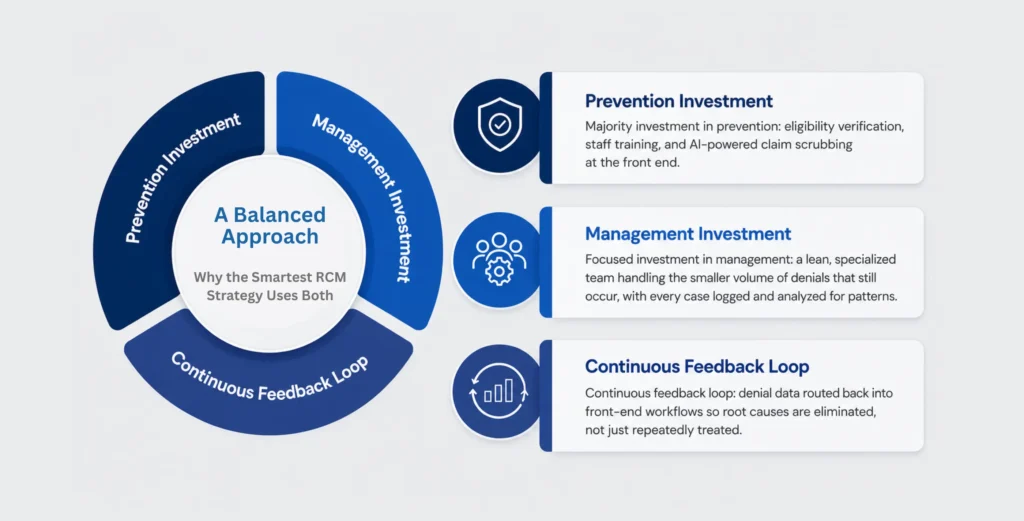
A Balanced Approach: Why the Smartest RCM Strategy Uses Both
- Majority investment in prevention:
eligibility verification, staff training, and AI-powered claim scrubbing at the front end. - Focused investment in management:
a lean, specialized team handling the smaller volume of denials that still occur, with every case logged and analyzed for patterns. - Continuous feedback loop:
denial data routed back into front-end workflows so root causes are eliminated, not just repeatedly treated.
The result is a revenue cycle that gets progressively more efficient over time, instead of one that treats the same denial patterns month after month.
Take Action: Find the Leaks Before They Cost You More
MaxRemind offers a free revenue cycle analysis and claim audit designed to do exactly that. Our team reviews your current denial patterns, identifies the root causes draining your revenue, and shows you precisely where a shift toward proactive denial prevention will save the most money and stabilize your cash flow fastest.
Stop Paying to Fix the Same Denials
- What is the difference between denial management and denial prevention?
-
Denial management is the process of correcting and appealing claims after they have been denied by the payer. Denial prevention focuses on identifying and eliminating errors before claims are submitted, reducing the likelihood of denials and improving first-pass payment rates.
- Which approach saves more revenue: denial management or denial prevention?
-
While both are important, denial prevention generally delivers greater long-term financial benefits. Preventing claim denials reduces administrative rework, accelerates reimbursements, lowers operational costs, and improves overall revenue cycle performance.
- What are the most common causes of claim denials?
-
Claim denials are commonly caused by incorrect patient information, insurance eligibility issues, missing prior authorizations, coding errors, incomplete documentation, duplicate claims, and failure to meet payer-specific requirements.
- How can healthcare practices prevent claim denials?
-
Practices can reduce denials by verifying patient eligibility before appointments, obtaining prior authorizations, maintaining accurate clinical documentation, providing ongoing staff training, and using AI-powered claim-scrubbing tools to identify errors before submission.
- Why should denial data be analyzed instead of just appealing denied claims?
-
Analyzing denial trends helps identify recurring issues in the revenue cycle, allowing practices to address root causes rather than repeatedly fixing the same mistakes. This continuous improvement approach reduces future denials, increases clean claim rates, and strengthens long-term financial performance.
Transform Your
Practice with
AI-Powered EHR
Reduce administrative burden, streamline workflows, accelerate revenue, and deliver exceptional patient care.
- AI-Assisted Documentation
- HIPAA-Compliant Platform
- Faster Claims & Billing
- Specialty-Based Solutions