Credentialing Backlogs After Hiring New Providers: How to Stay Revenue-Ready
Introduction: The Hidden Cost of a Great Hire
The Revenue-Ready Framework
| Operational Metric | Reactive/Delayed Enrollment Processes | Proactive/MaxRemind Optimized Onboarding |
|---|---|---|
|
Application Initiation Timeline |
Starts after start date, once HR paperwork clears |
Starts at offer acceptance, 90+ days pre-launch |
|
Data Verification Method |
Manual data entry, staff cross-checks CAQH by hand |
Automated primary source verification with digital validation tools |
|
Payer Follow-Up Frequency |
Ad hoc, reactive calls when a claim gets denied |
Scheduled weekly status checks with direct payer contacts |
|
Revenue Leakage/Hold Period |
90 to 180 days of unbilled or held claims |
Reduced to 45 to 60 days through parallel processing |
|
Staff Labor Hours |
15 to 25 hours per provider, spread across untrained staff |
Under 5 hours of internal oversight, execution outsourced |
|
Claim Rejection Rate (Post-Approval) |
High, due to incomplete effective-date documentation |
Minimal, backed by pre-verified data packets |
Anatomy of the Modern Credentialing Backlog
- Application volume is climbing:
Provider turnover, telehealth expansion, and group practice growth mean payers are drowning in submissions. Every major commercial payer is processing more applications than it did five years ago, with the same or shrinking staff. - Payer-side staffing hasn't kept pace:
Insurance panels run lean credentialing departments. A single reviewer might handle hundreds of files at once, so any application with a gap, a mismatch, or a missing attachment gets pushed to the bottom of the queue. - Primary source verification (PSV) protocols are strict:
Payers must independently verify medical school, residency, licensure, board certification, and work history directly with the issuing source. Every discrepancy triggers a manual review cycle that can take weeks. - NCQA and CMS compliance requirements add friction:
Payers must document every verification step for audit purposes. That paperwork trail protects patients, but it also slows throughput. It is critical to realize that the backlog isn't going away. Your only lever is how early and how cleanly you feed the process.
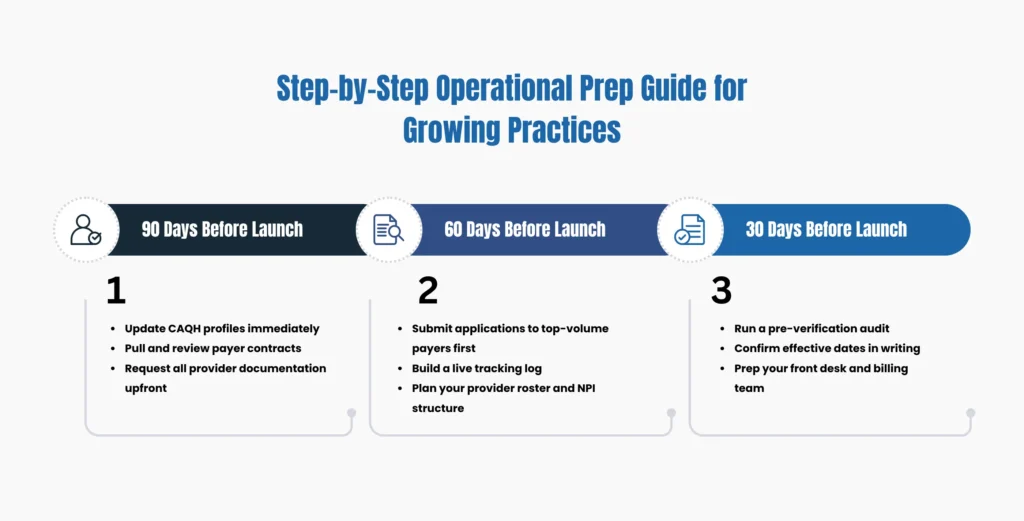
Step-by-Step Operational Prep Guide for Growing Practices
90 Days Before Launch
- Update CAQH profiles immediately:
If the provider already has a CAQH ID, re-attest it and refresh every document. Expired malpractice certificates or old licenses are the number one cause of early rejection. - Pull and review payer contracts:
Confirm which panels are open, which are closed to new providers, and which require group-level amendments instead of a standalone application. - Request all provider documentation upfront:
Diplomas, board certifications, DEA registration, malpractice history, and a complete work history with no unexplained gaps. Chase this before the start date, not after.
60 Days Before Launch
- Submit applications to top-volume payers first:
Prioritize by patient panel size and reimbursement impact, not alphabetically. - Build a live tracking log:
One shared document (or better, a dedicated platform) showing submission date, payer contact, status, and next follow-up date for every application. - Plan your provider roster and NPI structure:
Confirm Type 1 and Type 2 NPI assignments, group affiliations, and whether the provider needs to be added to existing locations in PECOS and state Medicaid portals.
30 Days Before Launch
- Run a pre-verification audit:
Cross-check every submitted application against payer requirements before it's flagged internally. Catch typos, mismatched addresses, or outdated license numbers before a reviewer does. - Confirm effective dates in writing:
Get payer confirmation of the anticipated effective date so billing can be scheduled the moment approval lands. - Prep your front desk and billing team:
Make sure staff know which payers are pending, which are cleared, and how to route new patients accordingly.
Maximizing the Gap: Legitimate Workarounds for New Hires
- See non-panel and self-pay patients:
Providers can treat cash-pay patients or those with out-of-network benefits from day one, no enrollment required. - Use supervision and incident-to billing where compliant:
In many states, a newly hired provider can deliver care under a fully credentialed supervising physician, with services billed under the supervisor's NPI, provided payer and state rules are met. Confirm specific payer policies first; incident-to rules vary by payer and specialty. - Leverage locum tenens billing rules where applicable:
Medicare's locum tenens provisions allow a substitute physician to see patients under an absent physician's NPI for a defined period. This isn't a universal fix, but it's a legitimate bridge in the right circumstances. - Adjust the scheduling matrix:
Front-load the new hire's calendar with already-credentialed patient populations (existing patients transferring within the practice, Medicare patients if enrollment is faster, or telehealth visits where applicable) while commercial panels finalize. - Assign non-billable, high-value work:
Chart reviews, protocol development, and patient education sessions keep the provider productive and reduce onboarding friction once billing goes live.

The Financial Impact of Manual Onboarding Disasters
Here’s what that actually costs:
- Daily revenue write-off:
A single specialist generating $2,000 to $4,000 in daily billable services means every week of delay costs the practice $10,000 to $20,000 in unrecoverable revenue. Claims submitted before an effective date are typically denied outright, not delayed. - Staff time drain:
Internal staff without dedicated credentialing training spend 15 to 25 hours per provider chasing documents, correcting errors, and following up with payers. That's time pulled from billing, collections, and patient care coordination. - Compounding rework:
One incorrect data field can force a full re-submission, adding another 30 to 45 days to an already long timeline. - Opportunity cost:
Every month a provider can't bill commercial payers is a month your practice can't reinvest that revenue into growth, staffing, or equipment.
How an Outsourced RCM and Enrollment Partner Clears the Bottleneck
.The practices that stay revenue-ready almost always have one thing in common: they don’t run credentialing as a side task for an already-stretched office manager.
- Automated tracking tools:
Real-time dashboards flag stalled applications before they become 60-day problems, instead of discovering the issue when a claim bounces. - Established payer relationships:
Direct contacts inside credentialing departments mean status checks get answered in days, not weeks, and errors get corrected before they trigger a full restart. - Rigorous digital data validation:
Every application is scrubbed against payer-specific requirements before submission, cutting rejection rates dramatically. - Parallel processing across payers:
Instead of working panels sequentially, a dedicated partner submits and tracks multiple payer applications simultaneously, compressing the total timeline. - End-to-end accountability:
One team owns the process from CAQH to effective date confirmation, so nothing falls into the gap between HR, billing, and the practice manager's inbox.
The result: providers start generating revenue weeks sooner, and your internal team gets its time back.
Call to Action: Get Revenue-Ready with MaxRemind
Schedule your free provider enrollment and credentialing audit today, and find out exactly where your process is bleeding time and revenue, before your next hire walks through the door.
Get New Providers Revenue-Ready Faster
- How long does provider credentialing usually take?
-
Provider credentialing typically takes 90 to 180 days, depending on the payer, application accuracy, and verification requirements. Starting the process as soon as a provider accepts an offer can significantly reduce delays.
- Can a new provider see patients before credentialing is complete?
-
Yes, in some cases. New providers may treat self-pay or out-of-network patients, and certain services may qualify for incident-to or locum tenens billing when payer and state regulations permit. Practices should always verify compliance before using these options.
- What are the most common reasons for credentialing delays?
-
The most common causes include incomplete applications, outdated CAQH profiles, missing supporting documents, discrepancies in provider information, and slow payer processing. Even minor errors can result in lengthy resubmissions and approval delays.
- How can practices reduce credentialing backlogs for new hires?
-
Practices can reduce delays by initiating credentialing immediately after offer acceptance, maintaining accurate provider documentation, prioritizing high-volume payer enrollments, tracking application statuses regularly, and following up proactively with payers throughout the process.
- How does outsourcing provider credentialing benefit medical practices?
-
Outsourcing provider credentialing to an experienced RCM partner helps streamline enrollment, improve application accuracy, accelerate payer follow-ups, reduce administrative workload, and enable new providers to become revenue-generating sooner while maintaining compliance.
Transform Your
Practice with
AI-Powered EHR
Reduce administrative burden, streamline workflows, accelerate revenue, and deliver exceptional patient care.
- AI-Assisted Documentation
- HIPAA-Compliant Platform
- Faster Claims & Billing
- Specialty-Based Solutions