Can AI Reduce Denials What Practices Are Seeing So Far
Introduction: The Denial Crisis Practices Can't Ignore
Real-World Case 1: Predictive Denial Analytics
Here’s what this looks like in practice:
- Pattern matching against payer history:
The model cross-references a new claim against thousands of prior remittances from that same payer, identifying which combinations of CPT codes, modifiers, and diagnosis codes have historically triggered denials. - Missing documentation flags:
If a claim lacks the supporting documentation a specific payer typically requires for that procedure, the system flags it before submission. - Modifier conflict detection:
AI catches modifier pairings that clash with payer-specific edit rules; a common, costly, and entirely preventable denial trigger. - Payer-specific anomaly scoring:
Each claim receives a risk score based on that payer's unique adjudication behavior, not a generic industry rule set.
The result: claims get corrected before they exit the clearinghouse, not after a 30-day denial cycle forces a resubmission.
Real-World Case 2: Intelligent Prior Authorization Tracking
Natural language processing tools are now built to:
- Continuously scan payer policy updates and translate dense policy language into structured, actionable rules.
- Link authorization requirements directly to clinical records, checking whether the documented medical necessity matches what the payer requires for approval.
- Alert staff in real time when a scheduled service requires authorization that hasn’t yet been secured.
Real-World Case 3: Automated Appeal Document Generation
- Automatic data extraction pulls the denial reason code, payer language, and claim details directly from the denial notice.
- Cross-referencing with clinical notes identifies the specific documentation that supports medical necessity or corrects the payer’s stated reason for denial.
- Structured appeal drafting produces a compliance-friendly, payer-ready appeal letter formatted to that payer’s submission standards.
The Current Limits of AI in RCM
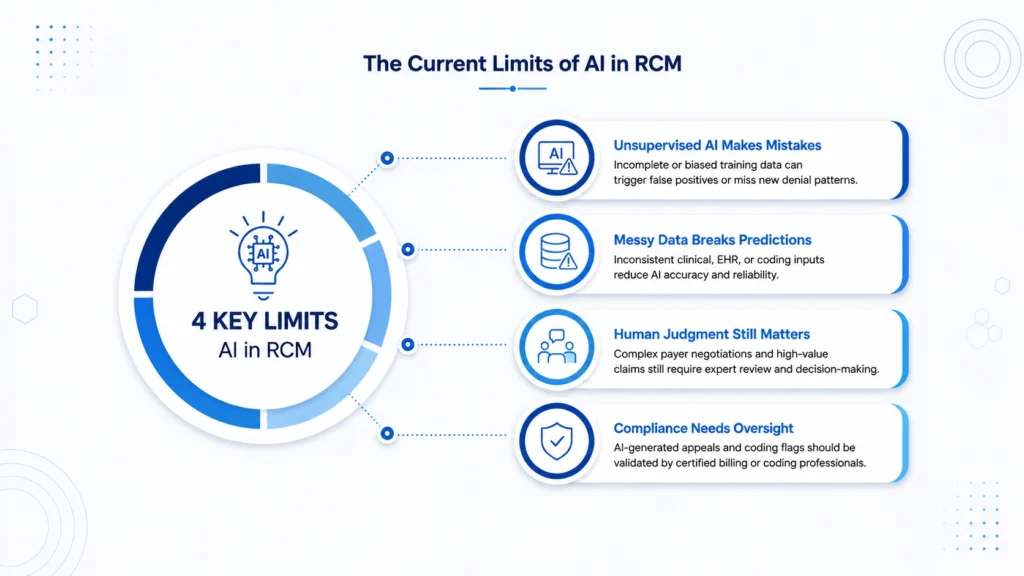
No credible conversation about AI in billing is complete without addressing what it still can’t do reliably.
- Unsupervised algorithms make mistakes:
AI models trained on incomplete or biased historical data will replicate those blind spots, flagging false positives or missing genuinely novel denial patterns. - Messy source data breaks predictions:
If clinical documentation, EHR data, or coding inputs are inconsistent, the AI's output quality drops proportionally. Garbage in, garbage out still applies. - Complex payer negotiations require human judgement:
AI can draft an appeal, but it cannot negotiate a peer-to-peer review, interpret an ambiguous payer contract clause, or make a judgment call on a high-dollar, high-complexity claim. - Regulatory nuance still needs expert oversight:
Compliance risk means every AI-generated appeal or coding flag needs a certified biller or coder to validate it before submission.
The AI Impact Blueprint
| Core Metric | Traditional Rule-Based Billing Systems | AI-Driven Revenue Cycle Engines |
|---|---|---|
|
Denial Prediction Accuracy |
Reactive; flags errors only after payer rejection |
Proactive; predicts high-risk claims pre-submission with 80-90%+ accuracy on trained payer sets |
|
Prior Authorization Tracking |
Manual lookup of payer policies, prone to outdated rules |
NLP continuously scans payer policy updates and auto-matches requirements to clinical documentation |
|
Code Pattern Recognition |
Static logic; requires manual rule updates for new denial trends |
Continuously learns from remittance history to detect emerging modifier and coding conflicts |
|
Appeal Generation Speed |
Hours to days per appeal, heavily manual drafting |
Minutes per appeal; auto-drafted using denial notice and clinical note cross-referencing |
|
Cost to Clean Claims |
Higher rework costs due to late-stage error discovery |
Lower cost per claim; errors caught before clearinghouse submission |
The Combined Strategy: Hybrid AI and Human RCM
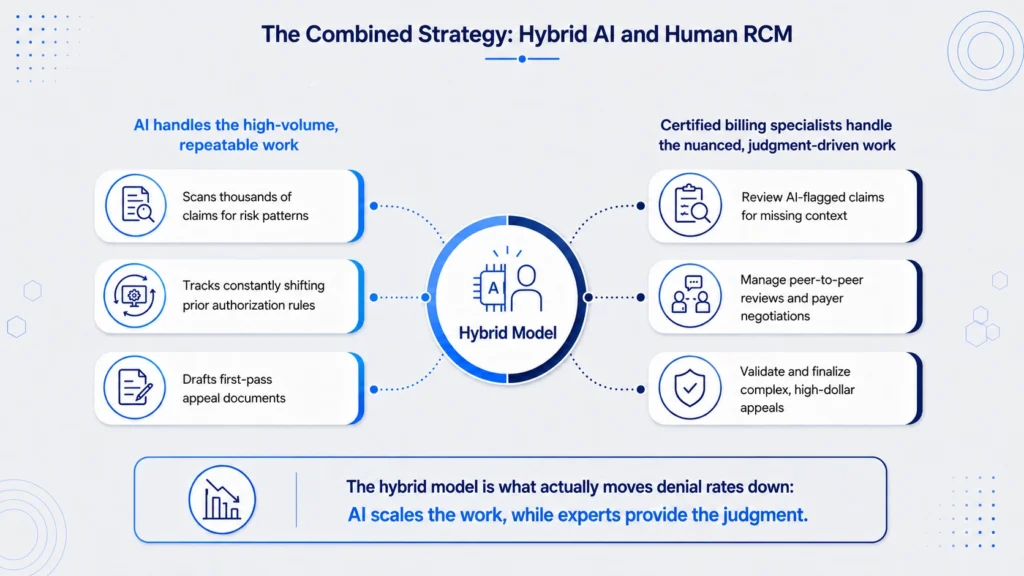
AI handles the high-volume, repeatable work:
- Scanning thousands of claims for risk patterns
- Tracking constantly shifting prior authorization rules
- Drafting first-pass appeal documents
Certified billing specialists handle the nuanced, judgment-driven work:
- Reviewing AI-flagged claims for context the model can’t see
- Managing peer-to-peer reviews and payer negotiations
- Validating and finalizing complex, high-dollar appeals
Take the Next Step
MaxRemind combines AI-driven rules engines with certified human billing specialists to catch denials before they happen — and resolve the ones that slip through, fast.
Schedule your free, no-obligation demo today and see exactly where your revenue cycle stands and what a hybrid AI-human strategy could recover for your practice.
Schedule Your Free AI Readiness Audit
- Can AI actually reduce claim denials, or is it just hype?
-
Yes. Practices using AI-driven predictive analytics are catching high-risk claims before submission, which directly lowers denial rates. The key is that AI works best as a prevention layer, not a magic fix after denials already happen.
- What types of denials is AI best at preventing?
-
AI is most effective against predictable, pattern-based denials, missing documentation, modifier conflicts, and payer-specific coding anomalies. Complex, judgment-based denials still require human billing expertise to resolve.
- Does AI eliminate the need for human billing staff?
-
No. AI handles high-volume pattern detection and drafting, but certified billers are still essential for payer negotiations, peer-to-peer reviews, and validating claims before submission. The strongest results come from combining both.
- How does AI help with prior authorization specifically?
-
NLP-based tools scan constantly changing payer policies and match them against clinical documentation in real time, flagging missing authorizations before a claim is even submitted, reducing front-end technical rejections.
- How fast can a practice see results after adopting AI in RCM?
-
Timelines vary by claim volume and data quality, but many practices see measurable improvement in clean claim rates within the first few billing cycles, especially when AI is paired with human oversight from the start.
Transform Your
Practice with
AI-Powered EHR
Reduce administrative burden, streamline workflows, accelerate revenue, and deliver exceptional patient care.
- AI-Assisted Documentation
- HIPAA-Compliant Platform
- Faster Claims & Billing
- Specialty-Based Solutions