Signs Your Practice Has Outgrown Its Current Billing Partner
Introduction: Growth Exposes What Small Vendors Can't Fix
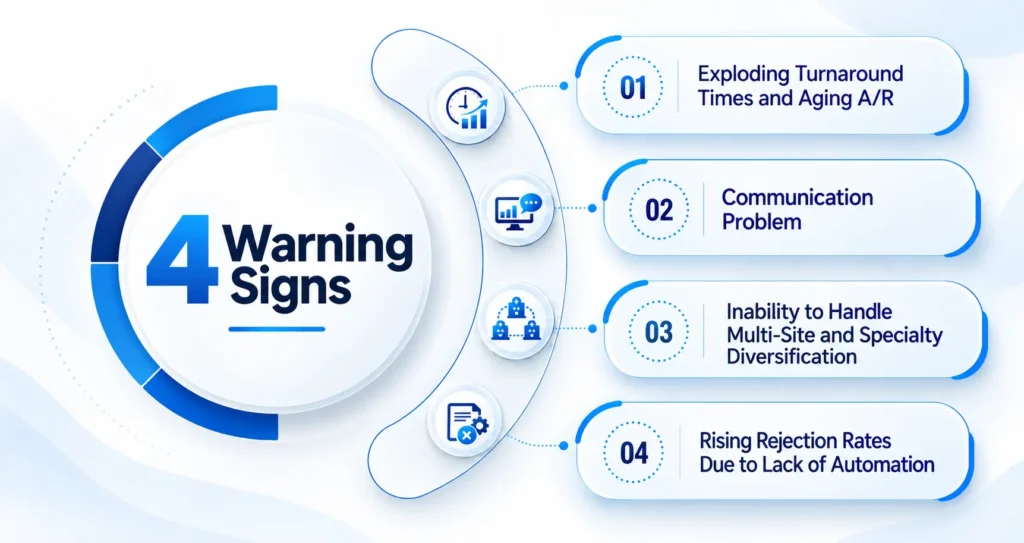
Sign 1: Exploding Turnaround Times and Aging A/R
- Claims sitting in “pending” status for days before submission
- Complex denials missing timely filing deadlines because no one caught them in time
- Days in A/R climbing past 40, then 50, then further, without a clear explanation
- Staff manually re-checking claim status because there’s no automated tracking

Sign 2: The "Black Box" Communication Problem
- Static monthly reports instead of live dashboards
- No visibility into denial patterns as they happen
- Delayed answers on payer collection yields
- Reactive communication instead of proactive alerts
Sign 3: Inability to Handle Multi-Site and Specialty Diversification
- A rules engine flexible enough to handle specialty-specific coding logic
- Certified coders trained across multiple specialties
- Standardized onboarding processes for new locations
- The bandwidth to scale support staff alongside claim volume
Sign 4: Rising Rejection Rates Due to Lack of Automation
- Typos introduced during manual re-entry between systems
- Eligibility verification errors caught too late, or not at all
- Front-end claim drops from mismatched patient or payer data
- No real-time eligibility checks before the claim goes out
The Scalability Gap: Stagnant Vendors vs. Enterprise-Ready RCM
| Operational Category | Outgrown / Legacy Billing Partners | MaxRemind Scalable RCM Infrastructure |
|---|---|---|
|
Multi-Location Support |
Manual setup per site, inconsistent workflows across locations |
Unified platform architecture built for multi-site rollouts from day one |
|
Automated Tech Stack |
Spreadsheets, manual data entry, disconnected systems |
HL7-compliant, API-driven integration with your EHR and PM systems |
|
Claim Volume Capacity |
Bottlenecks once volume exceeds staff bandwidth |
Elastic capacity built to absorb volume spikes without delay |
|
Denial Resolution Speed |
Denials sit in queues for weeks past filing deadlines |
Dedicated denial specialists working claims within days, not weeks |
|
Direct Dashboard Transparency |
Static monthly PDF reports, delayed visibility |
Real-time interactive dashboards with live claim and payer data |
The Financial Logic of Shifting to a True Growth Partner
- Your RCM partner profits when your collections improve, not just when claims go out
- Technology investment becomes the vendor’s cost, not an upsell to your practice
- Denial management becomes proactive instead of reactive, because unresolved denials directly cost the vendor revenue too
- Back-office operations shift from a bottleneck to a growth accelerator

Ready to Stop Outgrowing Your Billing Vendor?
Don’t Let Your Billing Partner Limit Your Growth
- How do I know if my billing vendor has actually stalled my growth, or if it's a temporary rough patch?
-
Look at the trend line, not a single bad month. If your Days in A/R has climbed steadily over 2-3 billing cycles, or your denial rate keeps rising even as patient volume grows, that's a structural gap, not a blip.
- What's a healthy Days in A/R benchmark for a growing practice?
-
Most high-performing practices keep average A/R at 30-40 days or lower. If yours is consistently pushing past 45-50 days, your billing partner's infrastructure likely can't keep pace with your claim volume.
- Can a small billing vendor really not handle multi-location billing?
-
Some can, but many were never built for it. Multi-site billing needs standardized onboarding, location-specific payer rules, and a rules engine that adapts automatically. Without that, every new location adds manual work instead of a scalable process.
- Why does EHR integration matter so much for claim accuracy?
-
Manual data entry between your EHR and your billing platform is where typos, eligibility errors, and front-end claim drops happen. HL7 standards and secure APIs remove that manual step entirely, which directly reduces rejection rates.
- What should I expect from a true enterprise RCM partner instead of a legacy vendor?
-
Real-time dashboards instead of monthly PDFs, denial resolution measured in days instead of weeks, certified coders across specialties, and a cost model that rewards the vendor for improving your collections, not just processing claims.
Transform Your
Practice with
AI-Powered EHR
Reduce administrative burden, streamline workflows, accelerate revenue, and deliver exceptional patient care.
- AI-Assisted Documentation
- HIPAA-Compliant Platform
- Faster Claims & Billing
- Specialty-Based Solutions