Upcoding vs. Downcoding: Understanding the Compliance Risks
Introduction: The Clinical-Coding Tightrope
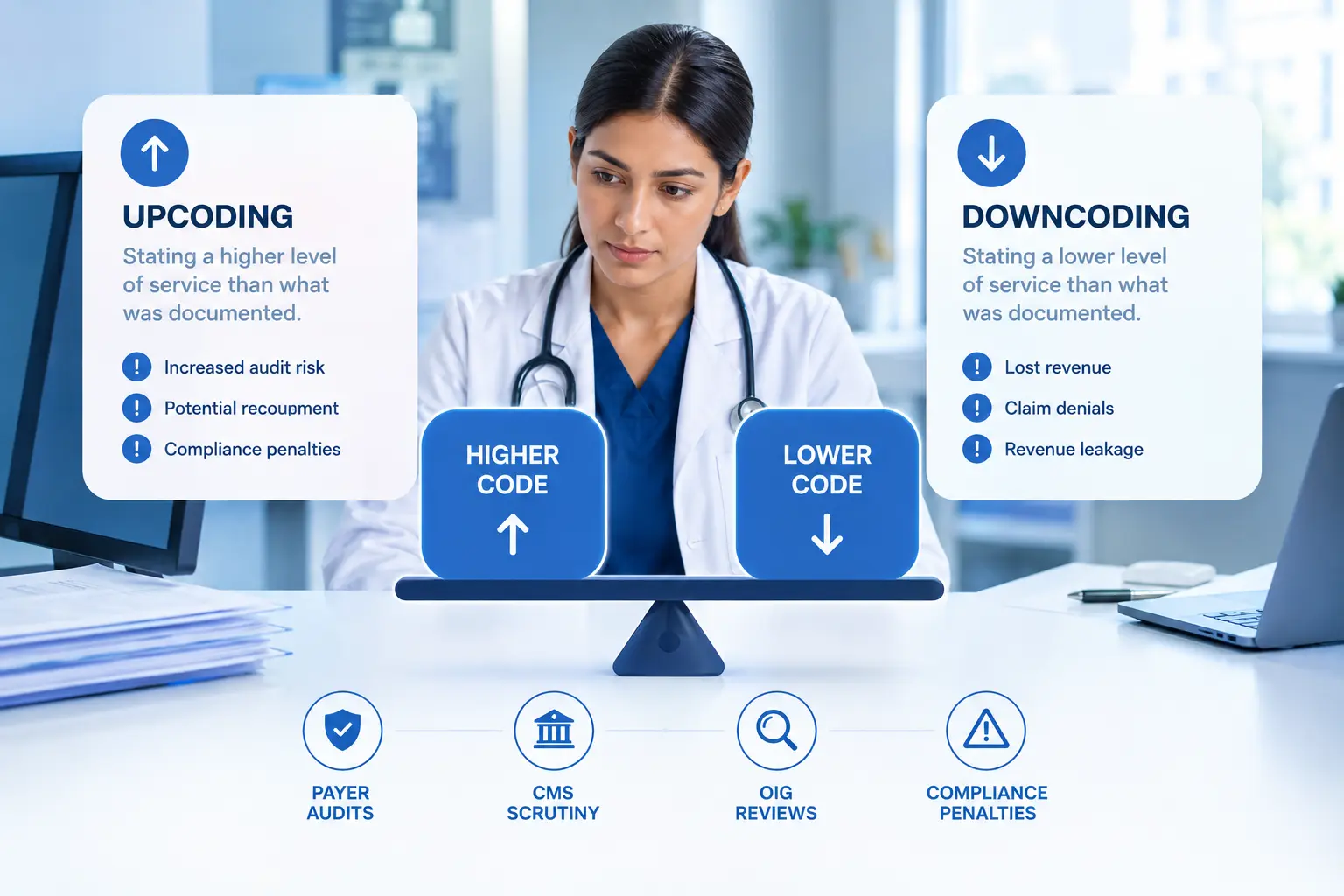
Upcoding: The Danger of Artificial Revenue Inflation
- Billing a Level 4 or 5 E/M visit when documentation only supports a Level 2 or 3
- Reporting a comprehensive procedure code for what was actually a limited or minor service
- Using modifiers to unbundle services that should be billed together
- Coding a diagnosis at a higher severity than clinical notes justify (a driver of risk-adjustment fraud in Medicare Advantage)
Why Upcoding Is a Compliance Landmine
-
False Claims Act exposure:
Submitting a claim you know (or should know) is inflated qualifies as a false claim. Penalties run into treble damages plus per-claim fines. -
Federal exclusion risk:
Repeated violations can get providers excluded from Medicare and Medicaid entirely, a career-ending outcome. -
Systemic clawbacks:
Payers don't just deny the flagged claim. They extrapolate the error rate across your entire claims history and demand repayment on a much larger sample. -
Whistleblower liability:
Qui tam provisions let employees report suspected upcoding directly to the government, often with financial incentive to do so.
Downcoding: The Hidden Drain of Defensive Coding
- Fear of audit scrutiny after a prior negative experience
- Incomplete or ambiguous provider documentation that forces a conservative guess
- Coders defaulting to a “safe” mid-level code instead of coding to the actual documentation
- Providers under-documenting complex visits because of time pressure
The Real Cost of Defensive Coding
-
Revenue leakage compounds:
A single under-coded E/M visit might cost $30 to $60 in lost reimbursement. Multiply that across thousands of encounters annually and practices lose six figures in legitimate, earned revenue. -
It's still an audit trigger:
Machine-learning claims engines used by CMS and commercial payers don't just flag high outliers. They flag statistical outliers in both directions. A practice coding significantly below its specialty's local average looks just as anomalous as one coding significantly above it. -
It signals documentation failure:
Chronic downcoding often means provider documentation isn't supporting the actual complexity of care delivered, a red flag payers interpret as a broader compliance gap, not a cautious one. -
It distorts quality and risk data:
Under-reported severity skews HCC risk scores and quality metrics, which can suppress value-based reimbursement.
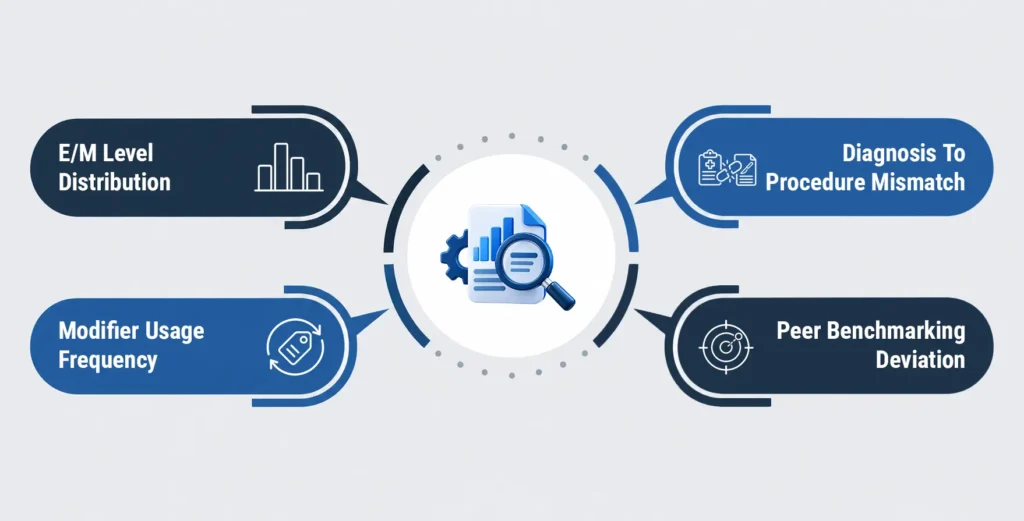
Payer Algorithms and the Metrics That Trigger Audits
How the Bell Curve Works Against You
-
E/M level distribution:
A provider billing 80% Level 4-5 visits when peers average 40% draws automatic review. So does a provider billing 90% Level 2-3 visits when the specialty norm is higher acuity. -
Modifier usage frequency:
Excessive use of modifier 25 or 59 flags potential unbundling or upcoding. -
Diagnosis-to-procedure mismatch:
Codes that don't clinically align with reported diagnoses get isolated for manual review. -
Peer benchmarking deviation:
Both CMS's Comparative Billing Reports and commercial Special Investigations Units score practices against local and national specialty averages.
The Compliance & Reimbursement Risk Matrix
| Compliance Category | Upcoding (Over-Billing) | Downcoding (Under-Billing) |
|---|---|---|
|
Definition/Intent |
Assigning a higher-level CPT, HCPCS, or E/M code than the documentation supports |
Assigning a lower-level code than the documented service actually warrants |
|
Primary Motivation |
Maximize reimbursement, fraudulent intent, or software/template defaults |
Fear of audit scrutiny, incomplete documentation, or overly conservative coder judgment |
|
Immediate Audit Trigger Level |
High. Flags instantly against specialty benchmarks and payer fraud algorithms |
Moderate to high. Sustained patterns below peer averages draw the same automated scrutiny |
|
Revenue Cycle Impact |
Short-term revenue spike followed by clawbacks, recoupments, and refund demands |
Chronic underpayment; legitimate revenue never collected, silently eroding margins |
|
Legal/Regulatory Penalty Risk |
False Claims Act liability, civil monetary penalties, OIG exclusion, criminal referral |
Lower criminal exposure, but still triggers audits, payer distrust, and compliance corrective action plans |
The takeaway: one practice inflates risk immediately, the other bleeds revenue quietly. Neither is “safe.”
Action Plan for Clean, Compliant Code Selection
- Run internal documentation audits quarterly. Sample a cross-section of E/M and procedure codes and compare them against provider notes before a payer does it for you.
- Implement real-time CDI (Clinical Documentation Integrity) workflows. Flag incomplete or ambiguous documentation at the point of care, not weeks later during claim scrubbing.
- Benchmark your own coding distribution. Compare your practice’s E/M level spread against specialty and regional averages at least twice a year.
- Train providers on documentation-to-code alignment. Coders can only code what’s documented. Provider education closes the gap that causes both upcoding and downcoding.
- Conduct annual CPT and ICD-10 update training. Code sets change every year. Outdated knowledge is one of the top drivers of unintentional coding errors.
- Use dual-review on high-risk claims. Any E/M Level 4-5, high-dollar procedure, or high-severity diagnosis should get a second set of eyes before submission.
- Track denial and clawback patterns. Recurring issues on the same code or provider signal a systemic problem, not a one-off mistake.
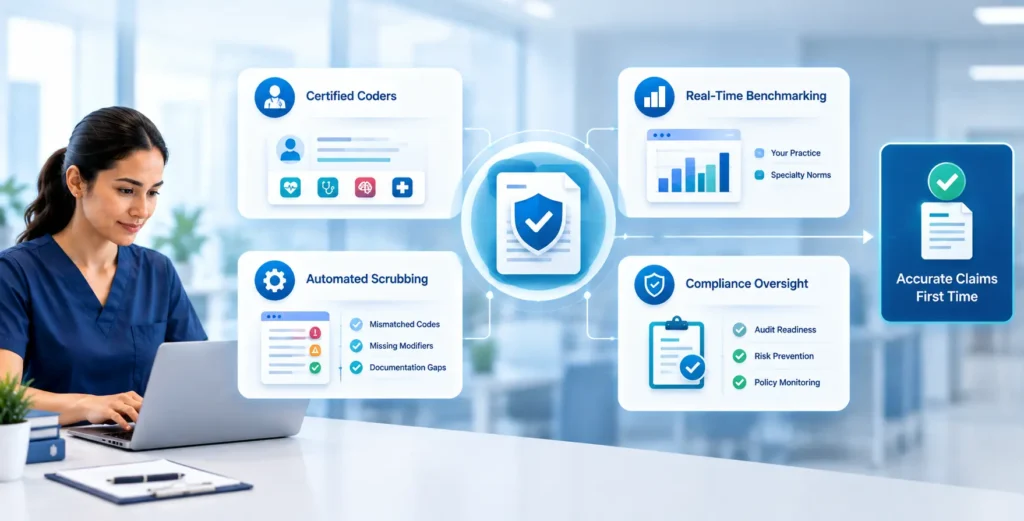
Eliminating Coding Vulnerabilities with MaxRemind
- Certified coders trained across specialties cross-check every claim against documentation before it ever reaches a payer.
- Tech-enabled clearinghouses run automated scrubbing logic that catches mismatched codes, missing modifiers, and documentation gaps pre-submission.
- Continuous benchmarking compares your coding distribution against specialty norms in real time, catching drift toward either upcoding or downcoding before it becomes a pattern.
- Dedicated compliance oversight means audits get anticipated and prevented, not just survived after the fact.
The result: claims that reflect exactly what was documented, submitted the first time, without the guesswork that leads to compliance exposure or revenue leakage.
Take the Next Step Toward Audit-Proof Billing
Coding accuracy isn’t optional. It’s the line between sustainable revenue and constant audit exposure. MaxRemind exists to keep your practice on the right side of that line, every claim, every time.
Protect Revenue Without Compromising Compliance
- What's the main difference between upcoding and downcoding?
-
Upcoding bills a higher-level code than the documentation supports, inflating reimbursement. Downcoding bills a lower-level code than documentation supports, leaving legitimate revenue uncollected. Both misrepresent the actual service delivered.
- Is downcoding actually safer than upcoding from a compliance standpoint?
-
No. Downcoding carries less criminal exposure, but it still triggers algorithmic audit flags when a practice's coding sits well below specialty averages. It also signals a documentation problem, which payers treat as a red flag on its own.
- How do payers detect upcoding and downcoding?
-
Payers and CMS run automated statistical profiling, often called Bell Curve analysis, comparing a provider's coding distribution against regional and specialty peer benchmarks. Claims that deviate significantly in either direction get routed into manual audit review.
- What are the legal risks of upcoding under the False Claims Act?
-
Knowingly submitting an inflated claim can trigger civil penalties, treble damages, and federal program exclusion. Repeated violations can lead to criminal referral and whistleblower lawsuits filed under qui tam provisions.
- How can a practice prevent both upcoding and downcoding?
-
Run regular internal documentation audits, adopt real-time clinical documentation integrity (CDI) workflows, train providers on documentation-to-code alignment, and benchmark coding distribution against specialty norms at least twice a year.
Transform Your
Practice with
AI-Powered EHR
Reduce administrative burden, streamline workflows, accelerate revenue, and deliver exceptional patient care.
- AI-Assisted Documentation
- HIPAA-Compliant Platform
- Faster Claims & Billing
- Specialty-Based Solutions