
How Incomplete Documentation Increases Compliance Risk
Introduction: The Documentation-Denial Connection
The Golden Rule: Substantiating Medical Necessity
-
Missing or vague chief complaint:
Auditors can't establish why the visit occurred in the first place. -
Thin history of present illness (HPI):
Without symptom duration, severity, or context, the visit can't justify a higher-level E/M code. -
Brief or templated physical exam notes:
Copy-pasted or minimal exam findings suggest the exam didn't match the billed complexity.
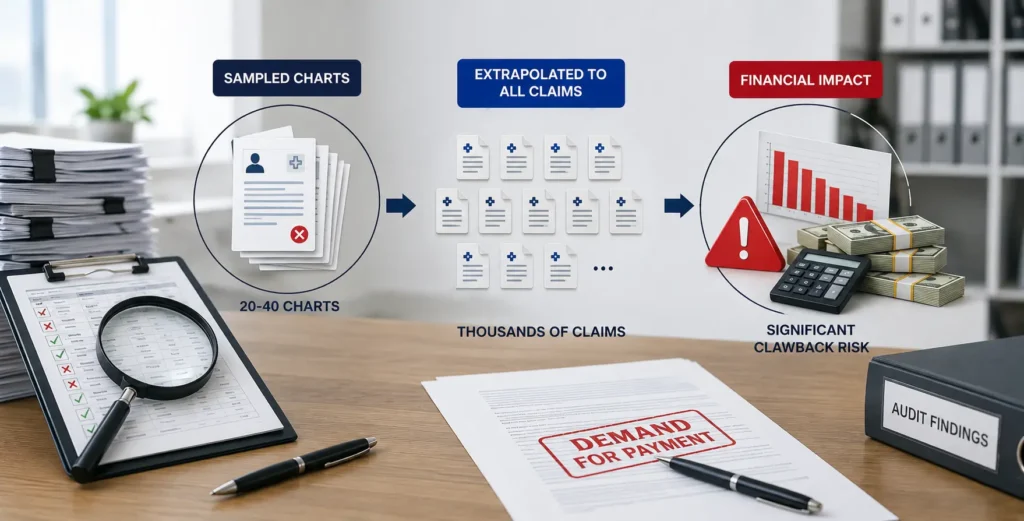
The Audit Exposure: Extrapolation and Financial Clawbacks
- A 30% error rate found in 30 sampled charts can be applied to the full 3,000 claims from the same billing period.
- A handful of vague notes can generate a six or seven-figure repayment demand.
- Appeals are possible, but they’re expensive, slow, and rarely reverse the full extrapolated amount.
Coding Vulnerabilities: The Modifier and CPT Trap
-
Upcoding exposure:
Coders under pressure to bill accurately may select a level that isn't clearly supported, creating unintentional upcoding liability. -
Modifier failure:
High-value modifiers like modifier 25 (significant, separately identifiable E/M service) or modifier 59 (distinct procedural service) require explicit documentation proving the service was separate and medically justified. Without that proof, claims are automatically flagged and denied by payer editing systems before a human ever reviews them.

The Administrative Friction of Clarification Queries
- The claim gets pulled from the billing queue.
- A query goes back to the provider for clarification.
- The provider, often buried in patient care, delays the response.
- The claim sits unbilled, sometimes for days or weeks.
The Documentation Divide: Vulnerable Records vs. Audit-Proof Claims
| Core Metric | Incomplete/Vague Documentation | Complete/Compliant Clinical Records |
|---|---|---|
|
Medical Necessity Substantiation |
Weak or absent; auditors can’t link diagnosis to treatment |
Fully supported with clear rationale for every service billed |
|
Audit Vulnerability Level |
High; flagged in payer data-mining and RAC/TPE reviews |
Low; withstands both prepayment and post-payment scrutiny |
|
Billing Modifier Defense |
Unsupported modifiers (25, 59) trigger automatic denial |
Modifiers backed by distinct, documented clinical evidence |
|
Clean Claim Probability |
Low; frequent rejections and rework cycles |
High; passes clearinghouse and payer edits on first submission |
|
Financial Clawback Risk |
Severe; exposed to extrapolated repayment demands |
Minimal; individual errors stay isolated, not extrapolated |
|
Coder Query Volume |
High; frequent provider follow-ups delay billing |
Low; charts are billable as submitted |
Building an Administrative Shield with Managed RCM
- Clearinghouse rules engines catch missing modifiers, mismatched codes, and incomplete documentation flags before a claim ever reaches the payer.
- Proactive chart auditing identifies documentation patterns that put a practice at audit risk, before those patterns become extrapolation targets.
- Coder-provider workflows are streamlined so clarification queries are resolved fast, without stalling the entire billing pipeline.
Protect Your Revenue with MaxRemind
Documentation gaps shouldn’t be the reason your practice loses revenue or lands in an auditor’s crosshairs. MaxRemind gives providers and coders the infrastructure to bill clean, defend every claim, and eliminate audit anxiety for good.
Turn Documentation Into a Revenue Safeguard
- What is considered incomplete clinical documentation in an audit context?
-
Any note that fails to clearly support the level of service billed. This includes missing chief complaints, vague HPIs without duration or severity, templated exam findings that don't match the visit complexity, or absent rationale for why a service was medically necessary. Auditors don't assume intent; they evaluate only what's written.
- How far back can payers audit and demand repayment?
-
Timeframes vary by payer type. Commercial payers typically audit within 1–2 years of the claim date, while government programs like Medicare can extend lookback periods further under certain fraud or pattern-of-error investigations. This is exactly why extrapolated findings from a small sample can apply across a much longer, much larger claims history.
- Can a practice appeal an extrapolated audit finding?
-
Yes, but appeals are resource-intensive and rarely overturn the full amount. Successful appeals usually depend on statistical challenges to the sampling methodology itself, not on re-litigating individual charts one by one, which makes prevention far more effective than post-audit defense.
- Do modifiers 25 and 59 always trigger extra scrutiny?
-
Not inherently, but they're among the most flagged modifiers by payer editing systems because they're also among the most misused. Automated claim scrubbers now check for documented justification in real time, so unsupported use of either modifier is likely to be denied before a human reviewer ever sees the claim.
- How can a small practice improve documentation compliance without hiring more staff?
-
Partnering with a managed RCM provider is typically the most efficient route. Tools like clearinghouse rules engines and proactive chart audits catch documentation gaps before submission, reducing both denial rates and the coder-provider query cycles that otherwise slow down billing.
Transform Your
Practice with
AI-Powered EHR
Reduce administrative burden, streamline workflows, accelerate revenue, and deliver exceptional patient care.
- AI-Assisted Documentation
- HIPAA-Compliant Platform
- Faster Claims & Billing
- Specialty-Based Solutions