
Payer Audit

What Happens After a Payer Audit? A Step-by-Step Breakdown

MaxRemind helps practices respond faster to payer audit findings, organize supporting documentation, reduce extrapolation risk, and strengthen billing controls before audit issues turn into major revenue losses.
What Happens After a Payer Audit

Introduction: The Audit Isn't Over When the Auditor Leaves
A payer audit notice lands like a gut punch. Your billing team scrambles. Your medical director starts second-guessing every chart from the last two years. And somewhere in the back of your mind, a number starts growing: how much could this actually cost us?
Here’s the myth that gets practices in trouble: thinking the audit ends when the auditor packs up and leaves. It doesn’t. The file review is just data collection. The real fight, the one that decides whether you owe $8,000 or $800,000, happens in the weeks after. That’s when payers calculate, extrapolate, and demand. And that’s when most practices are the least prepared.
This breakdown walks you through exactly what happens next, phase by phase, so you’re not improvising a defense strategy while the clock runs out on your response window.
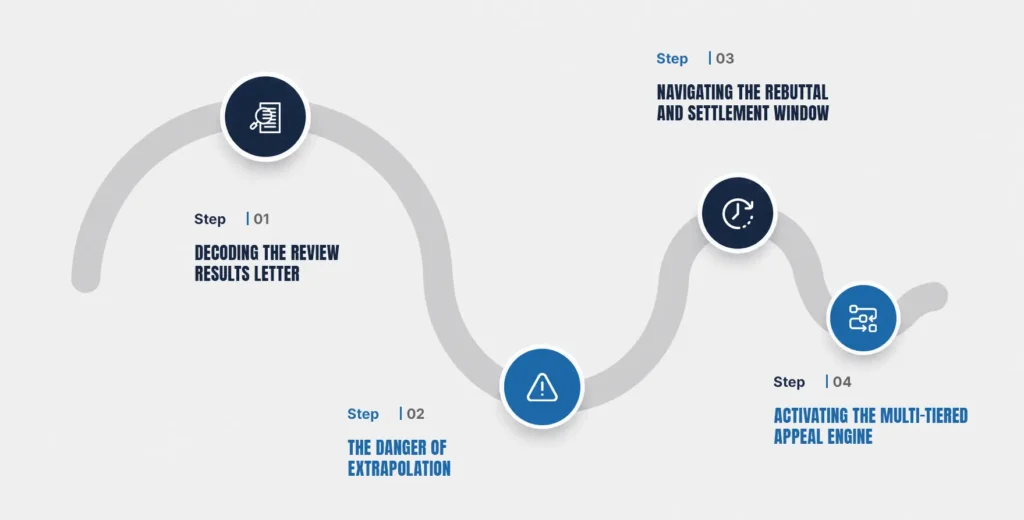
The Four Steps to Defending an Audit

Step 1: Decoding the Review Results Letter

The initial results letter is where practices either get ahead of the problem or fall behind it. Not every flagged claim is a five-alarm fire. Read closely and sort findings into two buckets:
Administrative and clerical errors are the smaller headache. Think missing modifiers, transposed dates of service, or a signature that landed on the wrong line. These are usually fixable through correction and resubmission, and they rarely trigger extrapolation on their own.
Medical necessity denials and pattern-billing flags are the real threat. These signal the payer believes documentation doesn’t support the level of service billed, or that your practice shows a repeated coding pattern across many claims. This is the category that opens the door to extrapolation, and it’s where you need clinical documentation experts involved immediately, not just billers.
Misreading which bucket a finding belongs in is the single most common early mistake. Treating a documentation gap like a simple typo wastes your rebuttal window on the wrong fight.

Step 2: The Danger of Extrapolation

This is where a manageable finding turns into an existential threat.
Extrapolation works like this: the payer reviews a sample, say 30 claims, and finds errors totaling $500. Instead of stopping there, they calculate an error rate from that sample and apply it to your entire claim universe for the audit period, which could be thousands of claims spanning two or three years.
That $500 sample error can legally become a six or seven-figure demand. A primary care practice submitting tens of thousands of claims over two years can see a sample-based documentation failure rate extrapolated into an overpayment demand well into the millions, recovered directly through offsets against current payments. The methodology is legal and regularly upheld on appeal, so you can’t fight it by arguing it’s unfair. You fight it with better math and better documentation.
The critical mistake practices make is responding only to the sample instead of the full claim universe. The correct move is to audit the full claim period independently, identify which claims actually do support the billed level, and submit counter-documentation that reduces the error rate before extrapolation gets locked in.
Extrapolation isn’t a coding problem you fix by resubmitting corrected claims. It’s a documentation problem, and it needs a documentation-first response.

Step 3: Navigating the Rebuttal and Settlement Window

The rebuttal window is short, often just 15 to 30 days, and it’s the last point where you have real leverage before the payer locks in a final number.
Move fast on three fronts:
  • Pull the full chart, not just the flagged excerpt. Auditors sometimes review incomplete records. A complete chart can flip a denial.
  • Write clinical narratives, not just checklists. A physician’s brief explanation of medical decision-making often does more than a stack of unexplained codes.
  • Structure your rebuttal claim-by-claim. Vague, general objections get dismissed. Specific, documented counters get read.
Every day you delay is a day closer to a finalized demand and accruing interest. Treat this window like a deadline that determines your practice’s cash flow for the next year, because it does.

Step 4: Activating the Multi-Tiered Appeal Engine

If the rebuttal doesn’t resolve the demand, you’re now in appeals territory, and the path looks very different depending on who you’re appealing to.
Medicare and federal payers follow a structured, five-level appeals process: redetermination, reconsideration by a Qualified Independent Contractor, an Administrative Law Judge hearing, Medicare Appeals Council review, and finally federal court. Each level has strict filing deadlines, and missing one can forfeit your right to escalate further.
Commercial payers like UnitedHealthcare and Aetna don’t follow federal rules. They run their own proprietary, contract-bound grievance processes defined in your provider agreement. That means the appeal path, timelines, and evidentiary standards vary by payer and even by contract. You need to know your specific agreement’s appeals language before you file, not after.
Either way, appeals reward practices that documented everything at every earlier stage. A weak rebuttal makes a strong appeal almost impossible.

The Post-Audit Timeline

Audit Phase Payer Action / Deliverable Practice Financial Risk Level Mandatory Defense Action
Initial Findings Letter
Payer issues a preliminary results summary flagging errors found in the sample
Low to Moderate
Review every flagged claim line-by-line; classify errors as clerical vs. clinical
Extrapolation Calculation
Payer applies the sample error rate to the full claim universe using statistical formulas
High to Severe
Independently audit the full claim population before accepting the payer’s math
Rebuttal Window
Practice submits supporting documentation and counter-arguments before the demand finalizes
High
Compile clinical narratives, corrected documentation, and clerical-error corrections fast
Formal Overpayment Demand
Payer issues a final dollar figure and recoupment timeline (often via claims offset)
Severe
File a formal appeal within the deadline; do not ignore accruing interest
Multi-Level Appeals
Payer or federal appeals body reviews the case across successive tiers
Severe
Escalate systematically; build a documentation trail strong enough to survive each level

Proactive Post-Audit Remediation: Building a Shield with Managed RCM

Surviving one audit is not the goal. Making the next one a non-event is the goal.
Audit findings are a free diagnostic of your billing operation’s weak points. Smart practices use that data to close the gaps permanently:
  • Automated claims scrubbing catches clerical errors before submission, eliminating the low-hanging fruit that triggers findings letters in the first place.
  • Regular internal documentation reviews simulate a payer audit on your own schedule, so surprises get caught internally instead of externally.
  • Certified coding controls put trained, credentialed coders between your providers’ notes and your claims, closing the exact gap that fuels extrapolation risk.

For smaller independent clinics without the staff to run this internally, a dedicated RCM partner turns audit defense from a reactive scramble into a built-in operational safeguard.
Defend Your Margins with MaxRemind

Defend Your Margins with MaxRemind

An audit finding shouldn’t be a death sentence for your practice’s margins. It should be the moment you upgrade your defense.

MaxRemind builds compliance directly into your revenue cycle, not bolted on after the fact. That combination means fewer errors reach a payer’s desk in the first place, and the ones that do get resolved fast, before they become clawback fuel.

If you’re facing an active audit or you want to close the gaps before the next one finds you, don’t wait for a demand letter to force your hand.

Defend Your Revenue Before Audit Findings Escalate

MaxRemind helps healthcare practices strengthen documentation, improve claim accuracy, manage audit risks, support appeals, and build RCM safeguards that reduce exposure before payer findings become costly clawbacks.
FAQs
How long do I have to respond to a payer audit findings letter?

It varies by payer, but most rebuttal windows run 15 to 30 days from the date of the letter, not the date you open it. Medicare interest starts accruing 31 days after you receive an overpayment demand, so treat the clock as running from day one.

Can I challenge a payer's extrapolation calculation?

Yes, and you should. Extrapolation math relies on the sample being statistically valid and the error rate being accurate. If you can shrink the error rate by proving more sample claims were actually compliant, the extrapolated total drops with it. This is the single highest-leverage move in your defense.

Is a Medicare audit appeal the same as a commercial payer appeal?

No. Medicare follows a fixed five-level federal appeals process with set deadlines. Commercial payers like UnitedHealthcare and Aetna run their own contract-based grievance procedures, and the rules live in your provider agreement, not federal regulation. Check your contract before assuming Medicare timelines apply.

What's the difference between a clerical error and a medical necessity denial?

A clerical error is something fixable, like a wrong modifier or a missing date. A medical necessity denial means the payer doesn't think your documentation supports the level of service billed. Clerical errors rarely trigger extrapolation on their own. Medical necessity and pattern-billing flags are what open the door to it.

How can I lower my risk of getting audited again?

Use the current audit's findings as a map of your weak spots. Automated claims scrubbing, regular internal documentation reviews, and certified coding oversight close the gaps that trigger findings letters in the first place. A managed RCM partner can build these controls into your daily workflow instead of leaving it to a once-a-year scramble.

Transform Your
Practice with
AI-Powered EHR

Reduce administrative burden, streamline workflows, accelerate revenue, and deliver exceptional patient care.