Patient Collections Are Getting Harder: What Practices Need to Change
Introduction: The New Third-Party Payer
That shift changes everything about how practices should collect.
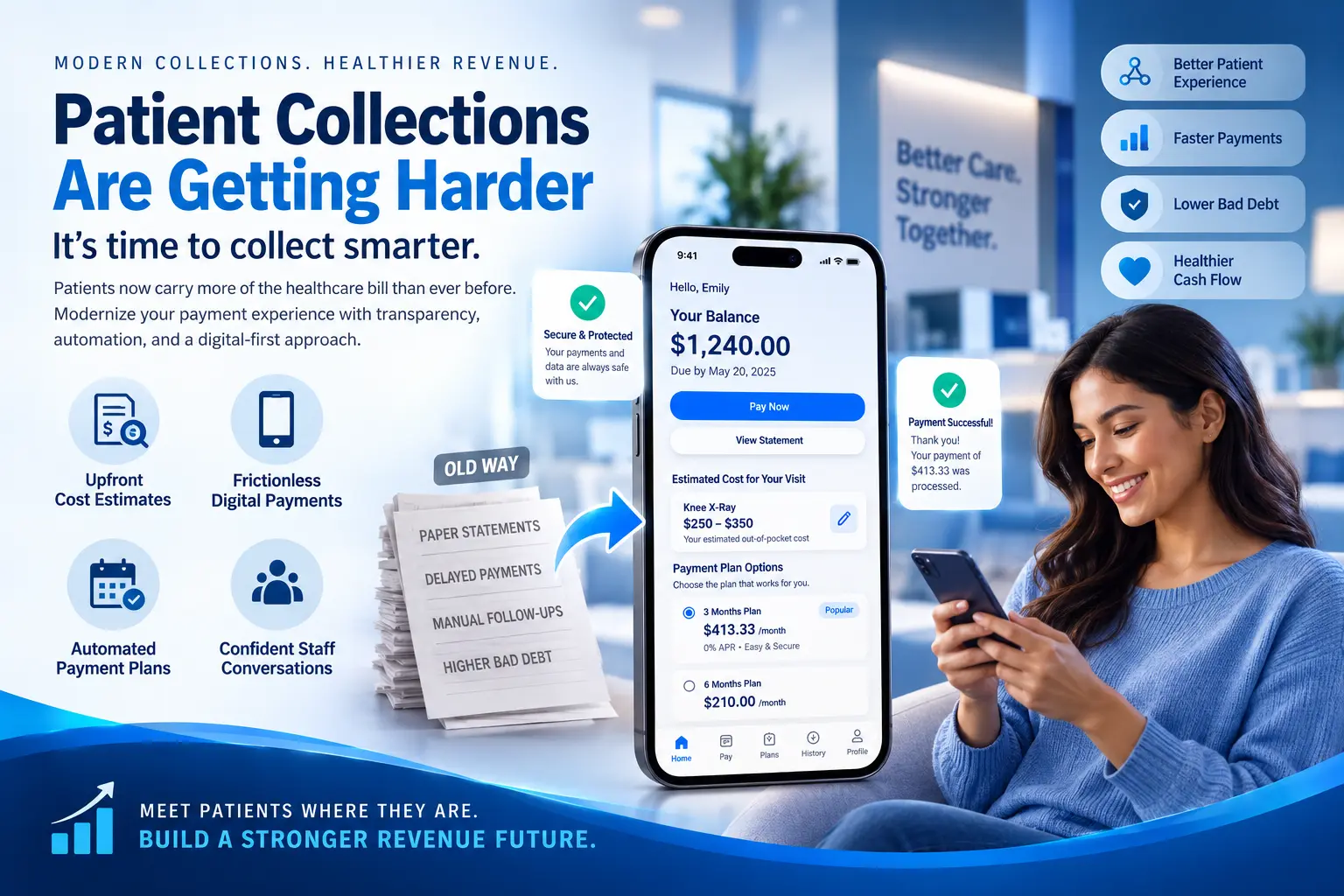
A patient statement mailed six weeks after a visit is no longer a viable revenue strategy. By the time it lands in the mailbox, the patient has forgotten the appointment, misplaced the context, or already mentally moved on. Response rates on paper statements are low, follow-up calls are labor-intensive, and every day of delay increases the odds the balance ends up in collections or written off entirely.
The Transparency Imperative: Upfront Cost Estimates
- They delay payment, hoping the number is a mistake.
- They dispute the charge, generating costly rework for billing staff.
- They avoid future care, reducing lifetime patient value.
The fix is procedural, not optional. Under the No Surprises Act, uninsured and self-pay patients are entitled to a Good Faith Estimate (GFE) before scheduled services. But the highest-performing practices go further, using real-time eligibility verification to generate estimated patient responsibility, deductible remaining, copay, and coinsurance before the patient ever sits in the waiting room.
Operational checklist for upfront transparency:
- Run eligibility verification 48–72 hours before every scheduled visit.
- Auto-generate a GFE for self-pay and uninsured patients.
- Present estimated out-of-pocket costs during scheduling or check-in, not just on request.
- Store estimate documentation in the patient record for compliance and dispute resolution.
Modernizing the Tech Stack: Frictionless Digital Payments
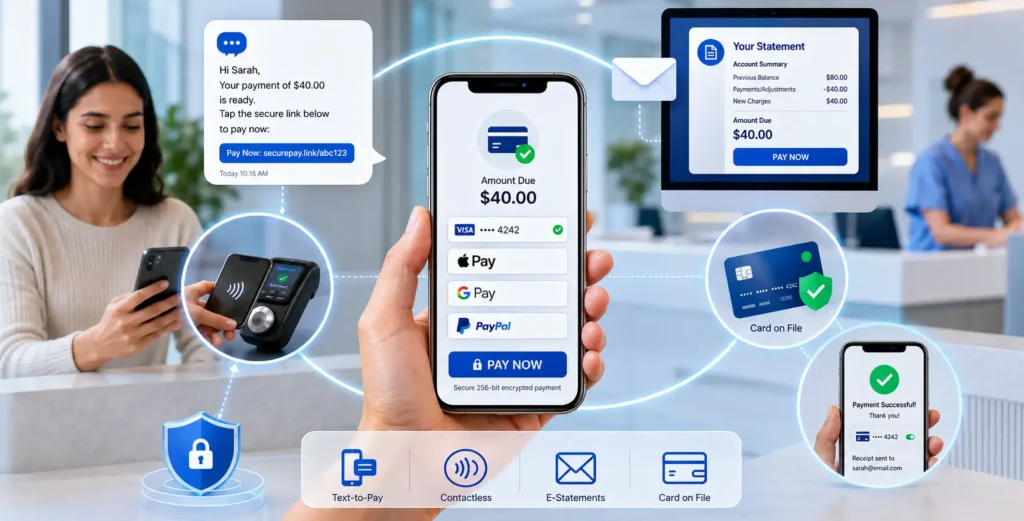
What a modern payment stack requires:
- Text-to-pay:
A secure payment link sent by SMS immediately after the encounter, payable in under 60 seconds. - Contactless mobile wallets:
Apple Pay and Google Pay integration removes manual card entry entirely. - Automated e-statements:
Digital-first statements with an embedded "Pay Now" button, replacing static PDFs. - Card-on-file capture at check-in:
Collected once, securely, and reused for future balances with patient consent.
Structuring Success: Automated, Compliant Payment Plans
A tactical blueprint for automated payment plans:
- Set a threshold trigger
Any balance above a defined amount (e.g., $200) automatically qualifies for a plan offer. - Present the plan at point of estimate
Offer 3, 6, or 12-month terms alongside the upfront cost estimate, before the visit, not after. - Capture card-on-file with signed authorization
This is the mechanism that removes manual staff follow-up entirely. - Automate the draft schedule
The system charges the stored card on a fixed monthly date, with no billing staff intervention required. - Build in automated failure handling
Failed charges trigger an automatic retry and a patient SMS/email notification, not a manual phone call. - Report by exception only
Staff should only touch an account when automation fails, not to manage active, healthy plans.

Training Staff for Financial Conversations
Point-of-check-in script (copay or current balance):
Past-due balance script:
Core protocol rules:
- Always frame payment as a routine, expected part of check-in; not an exception.
- Never ask “would you like to pay?” – offer the method, not the choice to decline.
- Offer the payment plan proactively for any balance, as staff may sense hesitation.
- Keep the tone neutral and administrative, never apologetic.
The Patient Collections Paradigm Shift
| Operational Metric | Legacy/Traditional Patient Billing | Modern/Patient-Centric Collections |
|---|---|---|
|
Cost Estimate Delivery |
Delivered after service, often on the final statement |
Delivered pre-service via real-time eligibility checks and Good Faith Estimates |
|
Payment Methods Accepted |
Check, cash, or mailed card authorization forms |
Text-to-pay, mobile wallets (Apple Pay/Google Pay), online portals, IVR |
|
Plan Management |
Manual spreadsheets tracked by billing staff |
Automated card-on-file plans with system-driven installment logic |
|
Collection Timelines |
60 –120+ days from date of service to resolution |
0–30 days, often collected at or near point of care |
|
Staff Labor Involvement |
High – manual calls, statement runs, reconciliation |
Low – exception-based follow-up only |
|
Patient Communication |
Paper statements mailed monthly |
Automated e-statements, SMS reminders, email nudges |
|
Bad Debt / Write-Off Rate |
Elevated due to delayed, confusing billing |
Reduced through clarity and immediate payment options |
Turning to the Experts: How Managed RCM Services Revitalize Patient Collections
- Pre-built real-time eligibility and estimate tools.
- Fully automated card-on-file payment plan infrastructure.
- Multi-channel digital payment collection (text-to-pay, mobile wallet, e-statement) under the practice’s own branding.
- Ongoing, exception-based staff support, without adding headcount.
The result: collection yields improve systematically, while the patient experience stays smooth, branded, and trustworthy, never outsourced-feeling.
Protect Your Cash Flow with MaxRemind
MaxRemind is built to be the strategic partner that closes that gap. With integrated eligibility verification, automated payment plan technology, and friction-free digital payment tools, MaxRemind equips your team to collect faster, reduce bad debt, and protect patient satisfaction at the same time.
Ready to modernize your patient collections strategy?
- What is a Good Faith Estimate (GFE), and is my practice required to provide one?
-
A GFE is a required cost estimate given to uninsured and self-pay patients before scheduled services, under the No Surprises Act. It outlines expected charges so patients aren't blindsided by the final bill. Practices that also extend estimates to insured patients, using real-time eligibility data, see fewer disputes and faster payment.
- How do automated payment plans actually reduce staff workload?
-
Once a patient signs a card-on-file authorization, the system automatically drafts the agreed monthly amount and retries or notifies the patient if a charge fails. Staff only intervene on exceptions, instead of manually tracking every plan, calling patients, or reconciling payments by hand.
- What's the difference between an e-statement and text-to-pay?
-
An e-statement is a digital version of a bill, usually with an embedded "Pay Now" link, sent by email. Text-to-pay goes a step further, sending a secure, one-tap payment link directly by SMS immediately after the visit, removing the need for the patient to log into any portal.
- Why are patients considered the "third-largest payer" in healthcare today?
-
As high-deductible health plans have grown, patients now carry a larger share of first-dollar responsibility than ever before, enough that their aggregate out-of-pocket payments rank behind only Medicare and commercial insurers in total healthcare spend collected.
- Should my practice handle patient collections in-house or outsource to an RCM partner?
-
It depends on bandwidth and existing infrastructure. In-house works if you can invest in eligibility automation, payment technology, and staff training. Many practices instead partner with a managed RCM provider like MaxRemind, which offers white-labeled, tech-enabled billing tools that plug into existing systems, improving collections without adding headcount.
Transform Your
Practice with
AI-Powered EHR
Reduce administrative burden, streamline workflows, accelerate revenue, and deliver exceptional patient care.
- AI-Assisted Documentation
- HIPAA-Compliant Platform
- Faster Claims & Billing
- Specialty-Based Solutions