Why Payers Terminate Contracts and How Practices Can Prevent It
Book a Free Practice Audit with MaxRemind
Introduction: The Silent Threat to Your Revenue
Most practice owners treat payer contracts like a filing cabinet document: signed once, then forgotten. That mindset is the root cause of most terminations.
Termination Risk Comparison Table
| Risk Category | Specific Trigger Event | Payer Action/Consequence | Immediate Prevention Step |
|---|---|---|---|
|
Coding Compliance |
Consistent upcoding, unbundling, or mismatched diagnosis-procedure pairs flagged in claims data analytics |
“For cause” termination after formal audit and recoupment demand |
Run monthly internal coding audits against payer-specific edit rules |
|
Utilization Rates |
Outlier billing for high-cost procedures/services far above peer benchmarks |
Placement on a corrective action plan, followed by network removal if unresolved |
Benchmark utilization quarterly against specialty and regional norms |
|
Credentialing Lapses |
Missed re-validation deadline, expired license, or lapsed malpractice coverage |
Automatic, often non-appealable termination |
Maintain a rolling 120-day credentialing calendar with auto-alerts |
|
Communication Failures |
No response to policy update notices, audit requests, or overpayment letters within payer deadlines |
Default judgment against the practice; contract termination for non-response |
Assign a single accountable owner for all payer correspondence |
|
Network Volume |
Under-utilization, too few claims submitted to justify network inclusion |
Non-renewal at contract cycle end |
Track minimum volume thresholds per payer, address gaps early |
The Compliance Trap: Coding and Billing Audits
✅ Upcoding
✅ Diagnosis-Procedure Mismatches
The escalation path is predictable:
- Automated flag from claims analytics
- Formal audit request with a documentation deadline
- Recoupment demand if violations are confirmed
- “For cause” termination if the pattern repeats or the practice fails to remediate
By the time you receive the audit letter, the payer has already built a case. Prevention has to happen before claims go out the door, not after the audit request arrives.
Utilization Management Pitfalls
✅ Over-Utilization Red Flags
- Disproportionately high rates of expensive imaging, testing, or procedures
- Referral patterns that consistently route to higher-cost specialists or facilities
- Prescribing patterns that outpace peer averages for high-cost medications
A single outlier month rarely triggers action. Sustained deviation over 2–3 quarters is what lands practices on a corrective action plan, the final step before termination.
✅ Under-Utilization Risk
This one surprises practice owners: payers can terminate you for doing too little.
Many contracts include minimum volume requirements, proof that the practice is actively serving the payer’s member population. Fall below threshold, and the payer may simply decline to renew, treating your low volume as evidence the network relationship isn’t mutually valuable.
Fatal Communication and Administrative Failures
This is the category that stings most, because it’s entirely preventable. Payers terminate practices not just for bad medicine or bad billing, but for silence. Common failure points:
- Ignoring policy update notices:
Payers regularly change coding requirements, prior authorization rules, or documentation standards. Missing an update means your claims start failing compliance without any change on your end, and repeated non-compliance is treated as a pattern violation. - Missing re-validation deadlines:
Credentialing isn't a one-time event. CAQH profiles, state licenses, malpractice coverage, and payer-specific re-validations all run on separate clocks. Miss one, and many payers terminate automatically, with no audit or warning period. - Failing to respond to audit or overpayment requests:
Payer contracts specify strict response windows, often 30 days. No response is treated as an admission, triggering default judgment and immediate termination.
These aren’t clinical failures. They’re operational failures. And they’re the easiest category to eliminate with the right system in place.
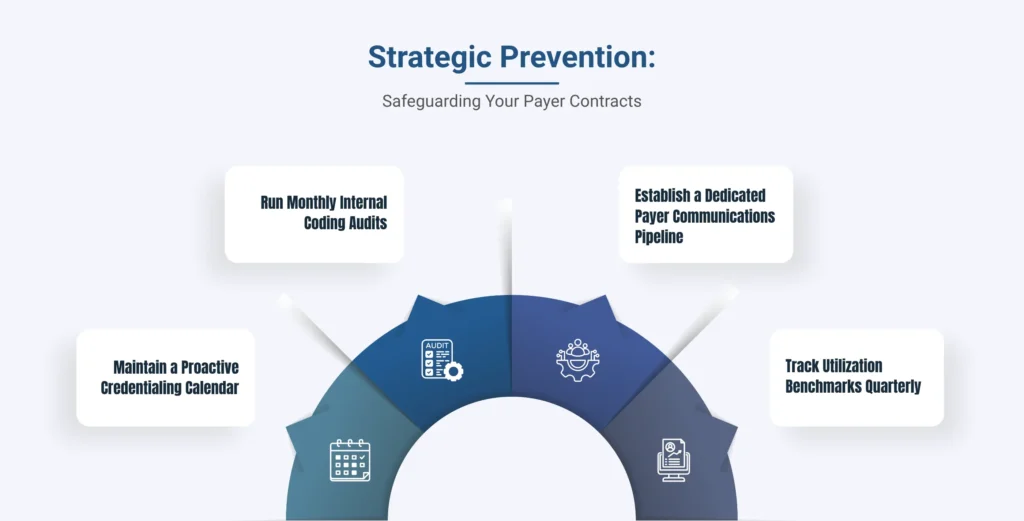
Strategic Prevention: Safeguarding Your Payer Contracts
Run Monthly Internal Coding Audits
- Sample claims across all providers, not just high-billers
- Cross-check against payer-specific NCCI and LCD/NCD edits
- Document findings and corrective actions; this history protects you if a payer audit ever happens
Maintain a Proactive Credentialing Calendar
- Track every license, certification, and payer re-validation date in one system
- Set alerts at 120, 60, and 30 days before each deadline
- Assign ownership; credentialing should never depend on “someone remembering”
Establish a Dedicated Payer Communications Pipeline
- One accountable person (or team) monitors every payer portal and mailbox
- Log every notice, deadline, and response with timestamps
- Respond to audit and overpayment requests within 48 hours of receipt, even if the full response takes longer
Track Utilization Benchmarks Quarterly
- Compare your practice’s service mix against specialty and regional peer data
- Investigate any metric that deviates more than 20% from benchmark
- Document clinical justification for legitimate outliers before a payer asks
How Professional RCM Services Protect Your Status
- Auditing claims before submission, catching upcoding, unbundling, and mismatch errors before they ever reach the payer’s analytics engine
- Monitoring credentialing timelines across every payer and provider, eliminating the single most common cause of automatic termination
- Managing payer correspondence in real time, ensuring no policy update, audit request, or deadline slips through
- Benchmarking utilization against payer and specialty norms, flagging drift long before it becomes a corrective action plan
The difference between a practice that loses a contract and one that doesn’t is rarely clinical quality. It’s operational vigilance, someone watching the compliance details every single day.
Conclusion
Don’t wait for a termination letter to find out where your practice stands.
Protect Your Payer Contracts Before Problems Escalate
- What are the most common reasons payers terminate provider contracts?
-
Payers typically terminate provider contracts due to recurring coding and billing errors, credentialing lapses, failure to respond to audits or payer communications, unusual utilization patterns, and ongoing non-compliance with payer policies. Maintaining accurate documentation and strong administrative processes can significantly reduce these risks.
- Can a practice prevent a payer contract termination?
-
Yes. Practices can minimize the risk of termination by conducting regular coding audits, tracking credentialing deadlines, monitoring utilization trends, responding promptly to payer requests, and staying updated on policy changes. A proactive compliance strategy is the best defense against contract loss.
- What happens if a payer terminates a provider contract?
-
When a payer terminates a contract, the provider may lose in-network status, resulting in reduced patient access, lower reimbursement opportunities, increased patient out-of-pocket costs, and potential revenue loss. Reinstatement can be difficult and may require a lengthy re-credentialing process.
- How do Revenue Cycle Management (RCM) services help protect payer contracts?
-
Professional RCM services help practices maintain compliance by auditing claims before submission, monitoring credentialing and enrollment deadlines, managing payer communications, tracking utilization trends, and resolving billing issues before they escalate into audits or contract termination.
- How often should a practice review its payer compliance and billing processes?
-
Practices should review coding accuracy and billing workflows every month, monitor credentialing deadlines continuously, and evaluate utilization trends at least quarterly. Regular internal reviews help identify compliance issues early and reduce the likelihood of payer audits or contract termination.
Transform Your
Practice with
AI-Powered EHR
Reduce administrative burden, streamline workflows, accelerate revenue, and deliver exceptional patient care.
- AI-Assisted Documentation
- HIPAA-Compliant Platform
- Faster Claims & Billing
- Specialty-Based Solutions