The Cost of Delayed Charge Entry in Medical Billing
How charge lag drains revenue, endangers timely filing compliance, and stalls practice cash flow
What Is Charge Entry in Medical Billing?
What Is Charge Lag and Why Does It Happen?
- Incomplete or late clinical documentation from providers
- Manual, paper-based charge capture workflows that rely on superbills or encounter forms
- Staff shortages or high billing department turnover
- Disconnected EHR and billing systems with poor interoperability
- Backlogs during high-volume periods or after holidays
- Lack of real-time charge capture tools at the point of care
Timely Filing Limits: The Hard Deadline You Cannot Miss
| Payer | Timely Filing Limit | Clock Starts | Risk if Missed |
|---|---|---|---|
|
Medicare (Part A & B) |
2 months (365 days) |
Date of Service |
Automatic denial, no appeal |
|
Medicare Advantage |
90–180 days |
Date of Service |
Plan-specific, unappealable |
|
Medicaid (varies by state) |
90 days – 12 months |
Date of Service |
Claim written off entirely |
|
Aetna |
120 days (up to 1 year for some plans) |
Date of Service |
CO-29 denial |
|
Cigna |
90–180 days |
Date of Service |
CO-29 denial |
|
UnitedHealthcare |
90–180 days |
Date of Service |
CO-29 denial |
|
Humana |
90 days |
Date of Service |
Hard denial, no exception |
|
BCBS (varies by state) |
90 days – 15 months |
Date of Service |
Varies; CO-29 common |
Source: CMS, payer provider manuals, and industry billing guidelines (2025)
How Delayed Charge Entry Disrupts Cash Flow
| Charge Entry Delay | Likely Outcome | Cash Flow Impact | Recovery Chance |
|---|---|---|---|
|
1–7 days |
Minimal risk |
Slight delay in payment |
High |
|
8–30 days |
Increased denial risk |
Payment 30–60 days out |
Moderate |
|
31–90 days |
Denial likely for short-window payers (e.g., Humana, Cigna) |
Significant A/R aging |
Low without appeal |
|
90+ days |
Unrecoverable for most commercial payers |
Revenue written off |
Very low or none |
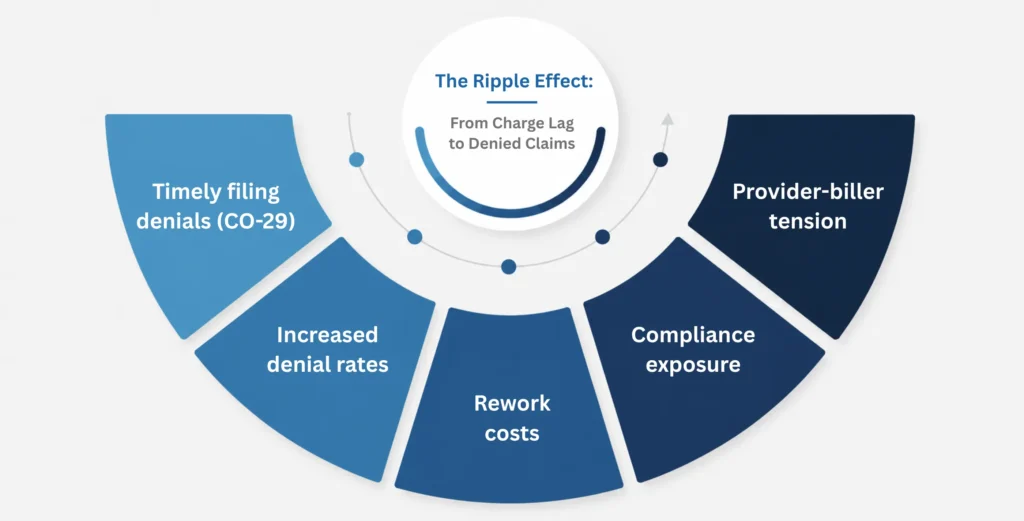
The Ripple Effect: From Charge Lag to Denied Claims
-
Timely filing denials (CO-29):
The most direct consequence. Once the payer's window closes, the claim cannot be billed. No appeal, no exception in most cases. -
Increased denial rates:
Initial claim denials reached 11.8 percent across the industry in 2024 and are projected to climb to 12 to 15 percent in 2025 (HFMA, 2024). Late submissions contribute directly to this trend. -
Rework costs:
Practices with high denial rates incur rework costs averaging $25 per claim. Multiply that across a high-volume practice and the operational cost adds up fast. -
Compliance exposure:
Patterns of incomplete or delayed charge capture can trigger payer audits, particularly if unbilled services suggest intentional or systemic billing irregularities. -
Provider-biller tension:
When billing teams cannot trace a charge back to documentation, they waste time tracking down providers or chasing incomplete encounter forms, adding hours of non-revenue-generating work.
Best Practices to Eliminate Charge Entry Delays
-
Set internal charge entry targets:
Do not wait for the payer deadline to drive urgency. Establish an internal rule of submitting charges within 3 to 5 business days of the date of service. For payers with 90-day limits, this creates a comfortable buffer. -
Use point-of-care charge capture:
Mobile and EHR-integrated charge capture tools allow providers to log billable services in real time, eliminating the documentation lag that feeds charge entry delays. -
Automate deadline tracking:
A modern RCM platform should flag claims approaching their timely filing window. Manual tracking across multiple payers and plans is error-prone and unsustainable at scale. -
Reconcile charges daily:
Run a daily charge reconciliation report to compare services rendered against charges posted. Any gap between the two is a potential missed bill. -
Integrate EHR and billing workflows:
Disconnected systems are one of the top causes of billing delays. When clinical documentation flows directly into the billing module, the manual handoff that causes most charge lag disappears. -
Train staff on payer-specific deadlines:
With 35 percent of providers citing staffing as their top RCM challenge in 2025 (AAPC), structured training on timely filing rules for each major payer is non-negotiable.

How MaxRemind Protects Your Revenue Cycle
MaxRemind is built around one principle: no billable service should leave your practice without being captured, coded, and submitted on time. As a full-service medical billing and RCM partner, MaxRemind works with practices to close the gap between clinical care and claim submission.
- Real-time charge monitoring to flag unbilled or delayed encounters before payer deadlines approach
- Payer-specific filing deadline tracking across Medicare, Medicaid, and all major commercial carriers
- Clean claims rate optimization targeting the industry benchmark of 95 percent and above
- Daily A/R reconciliation to ensure no charge ages beyond your internal billing window
- Denial management support to recover revenue from CO-29 and other preventable denials
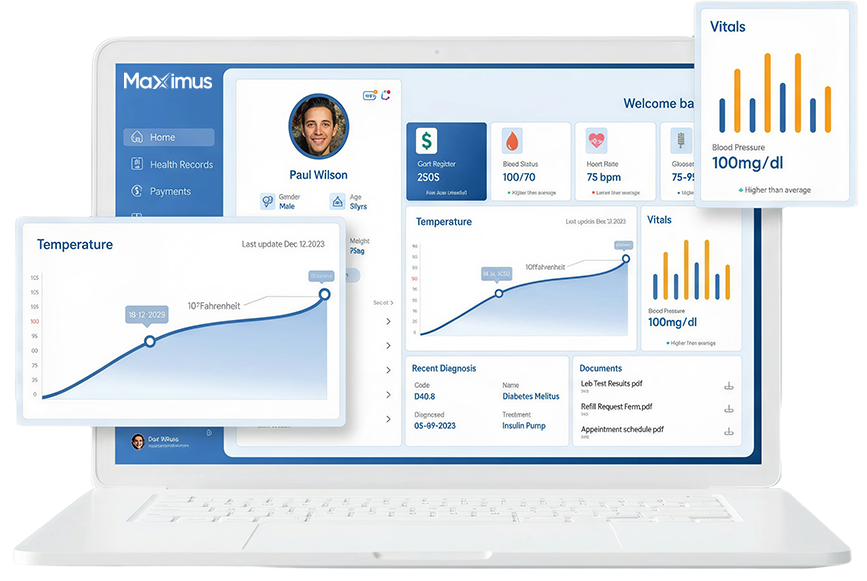
- Seamless integration with Maximus EHR for point-of-care charge capture and direct billing workflow
The Bottom Line
Ready to reduce charge lag and protect your reimbursements?
- What is charge lag in medical billing?
-
Charge lag is the time between the date a healthcare service is provided and the date the charge is entered into the billing system. Keeping charge lag within 3–5 business days helps practices submit claims on time and avoid reimbursement delays.
- How does delayed charge entry affect healthcare revenue?
-
Delayed charge entry slows down claims submission, increases accounts receivable (A/R), delays reimbursements, and raises the risk of timely filing denials. In many cases, missing a payer's filing deadline can result in permanent revenue loss.
- What happens if a claim misses the timely filing deadline?
-
If a claim is submitted after the payer's timely filing limit, it is typically denied with a timely filing denial code (such as CO-29). Most commercial payers do not allow appeals for these denials unless a valid exception applies.
- How can healthcare practices reduce charge entry delays?
-
Practices can reduce charge lag by implementing real-time charge capture, integrating EHR and billing systems, reconciling charges daily, automating deadline tracking, and setting internal charge entry targets of 3–5 business days after the date of service.
- How does MaxRemind help prevent charge entry delays?
-
MaxRemind streamlines the revenue cycle by monitoring unbilled encounters, tracking payer-specific filing deadlines, optimizing clean claim rates, reconciling charges daily, and providing proactive denial management to help practices submit claims faster and maximize reimbursements.
Transform Your
Practice with
AI-Powered EHR
Reduce administrative burden, streamline workflows, accelerate revenue, and deliver exceptional patient care.
- AI-Assisted Documentation
- HIPAA-Compliant Platform
- Faster Claims & Billing
- Specialty-Based Solutions