
MRI Billing & Prior Authorization: Steps to Prevent Revenue Loss

Magnetic Resonance Imaging (MRI) is an incredibly valuable tool that doctors rely on to see inside the body and diagnose health issues. However, because of its complexity and advanced technology, it can be quite costly. With that comes a high risk of claim denials, delayed payments, and significant revenue leakage when billing and prior authorization (prior auth) are not handled correctly.

For radiology billing professionals, imaging centers, and RCM companies, mastering MRI billing is not just about accuracy; it’s about ensuring their work remains sustainable and successful over time. This blog breaks down the essentials of proper MRI billing, outlines the necessary steps for successful prior auth, and explores how AI-powered solutions like MaxRemind can help eliminate common errors and protect your revenue cycle.

Common MRI CPT codes include:

MRI billing starts with knowing the right codes, components, and payer requirements. Mistakes here can result in underpayments or outright denials, so a solid understanding of the foundational elements is critical.
MRI procedures are billed using CPT codes based on the body part being scanned. These codes can also differ based on whether contrast is used or not.

Strategies for managing bundling in IR billing:

Understanding MRI Billing Basics
CPT Codes Description
70551-70553 Brain MRIs
72141-72142 Spinal MRIs
73721-73723 Lower Extremities
73221-73223 Upper Extremities
In addition, radiology billing involves differentiating between the technical and professional components of the procedure:
  • Use Modifier 26 when billing only for the interpretation (professional)
  • Use Modifier TC when billing for the technical component (equipment and setup)
Medical necessity is another critical part of successful billing. If there isn’t clear documentation explaining why the MRI was ordered, insurance providers might refuse to pay, even if the correct codes are used. Proper documentation is essential to ensure the claim is approved.

Prior Authorization

Prior authorization is a payer-required process that ensures the ordered MRI is medically necessary before the scan is performed. It is essential for high-cost imaging procedures and varies widely by payer, patient plan, and region.
If a provider performs an MRI without prior auth where it’s required, the claim is likely to be denied, and the provider may have to write off the entire amount or pursue time-consuming appeals.

When is prior auth required?

  • Most commercial insurance plans
  • Some Medicare Advantage plans
  • Medicaid plans (state-specific)
Even though not all MRIs require prior authorization, verifying payer policy for each case is essential to avoid denials and delayed reimbursement.
Prior Authorization

Steps for Successful Prior Authorization

Prior authorization is not just a formality, it requires detailed preparation and precise execution. Even a small misstep can result in a delay or outright denial.
Start by ensuring the patient’s insurance plan requires prior authorization for the MRI. Then follow a standardized workflow that minimizes human error.

Steps to ensure success:

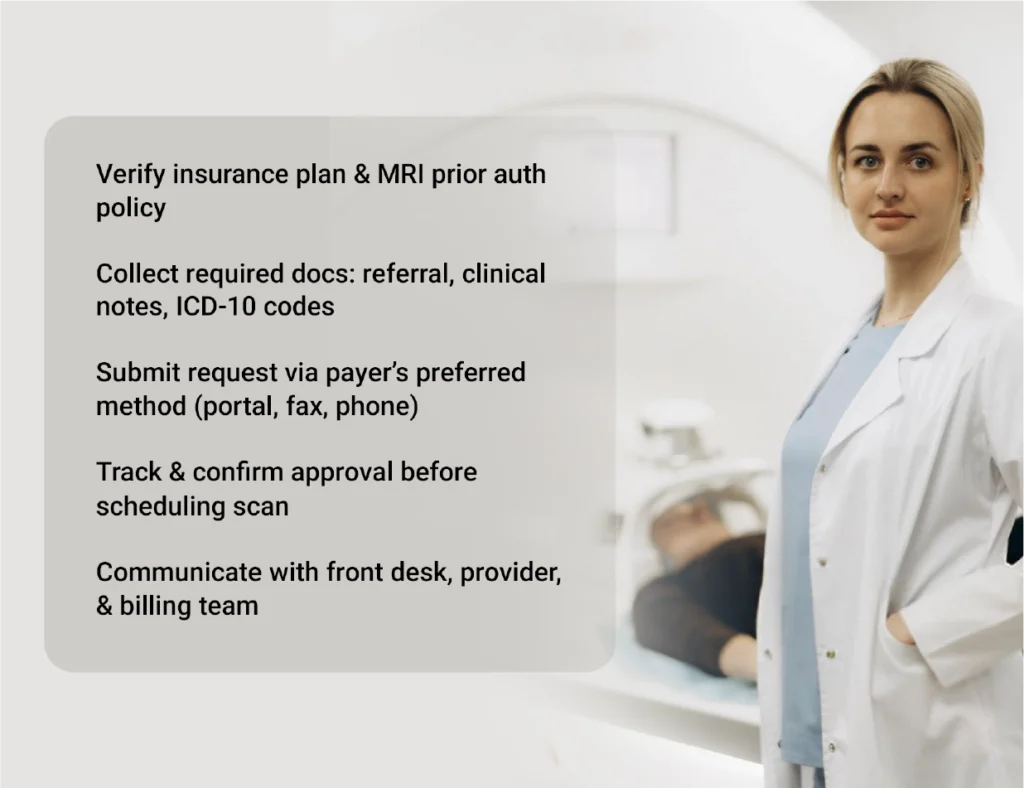
  1. Verify insurance plan and policy regarding MRI prior auth
  2. Gather necessary documentation, including:
    • Referral from the ordering provider
    • Clinical notes supporting medical necessity
    • Relevant ICD-10 codes
  3. Submit the request through the payer’s preferred method (portal, fax, phone)
  4. Track and confirm approval before the scan is scheduled
  5. Communicate across departments to make sure the front desk, provider, and billing team are all on the same page
Steps for Successful Prior Authorization
While these steps may seem straightforward, bottlenecks often happen due to missing paperwork or poor coordination between departments.

Common Pitfalls in MRI Billing

Despite best efforts, certain recurring errors plague MRI billing and cost organizations thousands in avoidable losses.

Some of the most common pitfalls include:

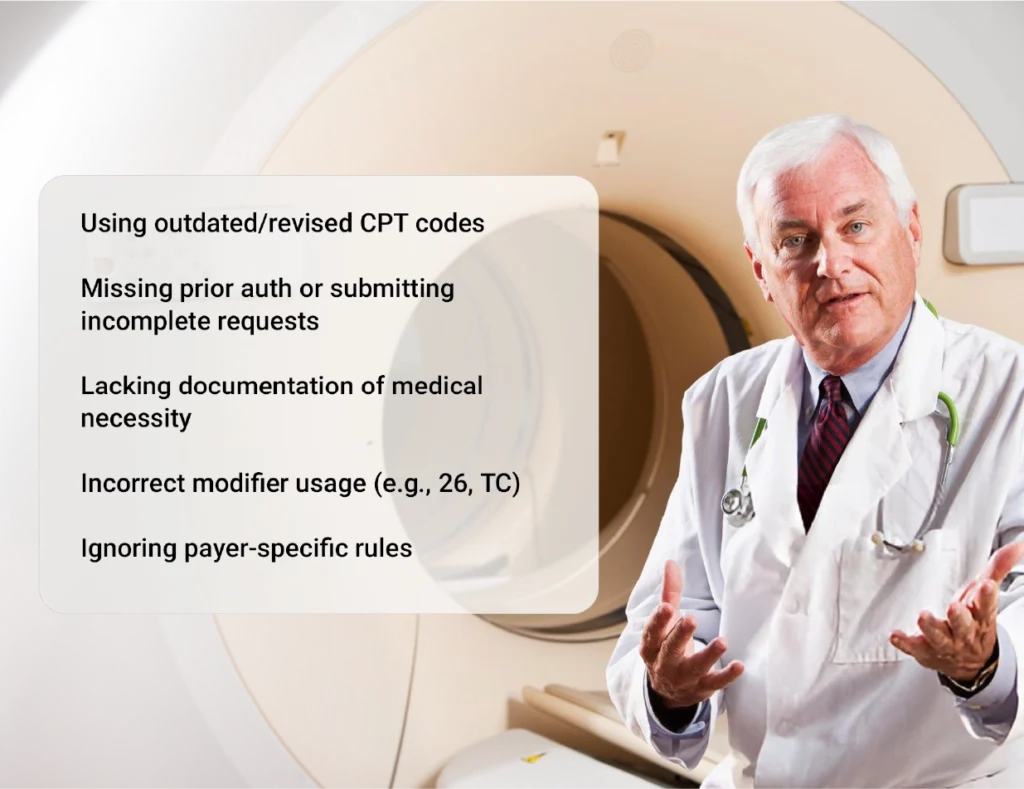
  • Using outdated CPT codes that have been revised or replaced
  • Failing to obtain prior authorization or submitting incomplete requests
  • Insufficient documentation of medical necessity
  • Incorrect modifier usage, especially with Modifier 26 and TC
  • Not knowing payer-specific rules, which can vary widely across insurance providers
These issues often go unnoticed until a claim is denied or underpaid. Avoiding them requires a mix of training, real-time verification tools, and smarter systems.

How AI and Technology Can Help Prevent Revenue Loss

Traditional billing methods often rely heavily on manual processes and staff memory, making them prone to error. But with advancements in AI and healthcare tech, the landscape is shifting.
AI can now automate many parts of the MRI billing and prior auth process, reducing the administrative burden and improving accuracy. For instance, AI-driven systems can:
  • Automatically check if prior auth is required for a specific payer and procedure
  • Alert staff when documentation is missing before claim submission
  • Cross-verify CPT and ICD-10 codes to ensure alignment and reduce denials
How AI and Technology Can Help Prevent Revenue Loss

MaxRemind’s AI-powered RCM tools are designed specifically for diagnostic imaging centers. These include:

  • Built-in prior authorization modules
  • AI-assisted coding support that flags inconsistencies in real time
  • Claim scrubbing engines that identify missing elements before submission

These tools help teams catch problems early, before they become revenue loss events.

Best Practices to Avoid MRI Revenue Loss

To stay ahead of denials and claim issues, imaging centers must implement clear billing and prior authorization protocols. A proactive approach not only safeguards revenue but also reduces administrative rework and enhances overall compliance. One of the most effective strategies is providing ongoing training to front-office and billing teams, ensuring they remain updated on the latest payer requirements and documentation standards. Keeping CPT and ICD-10 code libraries current is equally crucial, as outdated codes can lead to unnecessary denials.
Standardizing the prior authorization workflow with clearly assigned roles and responsibilities helps prevent confusion and delays in approvals. Leveraging AI-powered billing platforms can significantly reduce human error by flagging coding or documentation issues in real time. Additionally, when internal resources are stretched thin, outsourcing to experienced radiology billing partners can offer specialized expertise and operational relief. Ultimately, when schedulers, providers, and billing staff are all aligned and working within a coordinated system, the chances of revenue leakage drop dramatically.
Best Practices to Avoid MRI Revenue Loss

Conclusion

MRI billing is high-stakes. One missing step, code, or form can mean thousands of dollars lost. Prior authorization acts as a revenue safeguard in revenue cycle management.
But the good news is that providers no longer have to manage this complexity alone. With AI, automation, and purpose-built RCM tools like MaxRemind, you can streamline MRI billing, reduce errors, and improve your bottom line.

Ready to stop revenue loss before it starts?

Let MaxRemind show you how to simplify your MRI billing and prior auth process. Schedule your free demo today.
FAQs
What is the prior authorization process for MRI scans?

The prior authorization process for MRI includes checking insurance requirements, gathering supporting documentation, submitting an approval request, and waiting for payer confirmation before performing the scan.

Why do MRI claims get denied by insurance companies?

MRI claims often get denied due to missing prior authorization, incorrect CPT codes, lack of medical necessity, or incomplete documentation.

Do all insurance plans require prior authorization for MRIs?

Not all, but many commercial and Medicaid/Medicare Advantage plans require prior auth for MRI. Always check the patient’s benefits before scheduling.

Can AI help with MRI billing and authorization?

Yes, AI can help automate prior auth submissions, flag billing issues, verify eligibility, and reduce manual errors that lead to denied MRI claims.

What CPT codes are used for MRI procedures?

CPT codes for MRI depend on the body part being scanned. Examples include 70551 (MRI brain), 72148 (MRI lumbar spine), 73721 (MRI knee), and more.