

How RPA (Robotic Process Automation) Is Changing Medical Billing Workflow
What Is RPA and Why Healthcare Needs It

Challenges in Traditional Medical Billing Workflows
| Traditional Billing Challenges | Impact on Revenue |
|---|---|
|
Manual data entry errors |
Increased denials and rework |
|
Slow claim submission |
Delayed reimbursement cycle |
|
Time-consuming payer follow-ups |
Lower cash flow stabilization |
|
High cost of manual labor |
Reduced operational profitability |
|
Lack of real-time visibility |
Poor decision-making and forecasting |
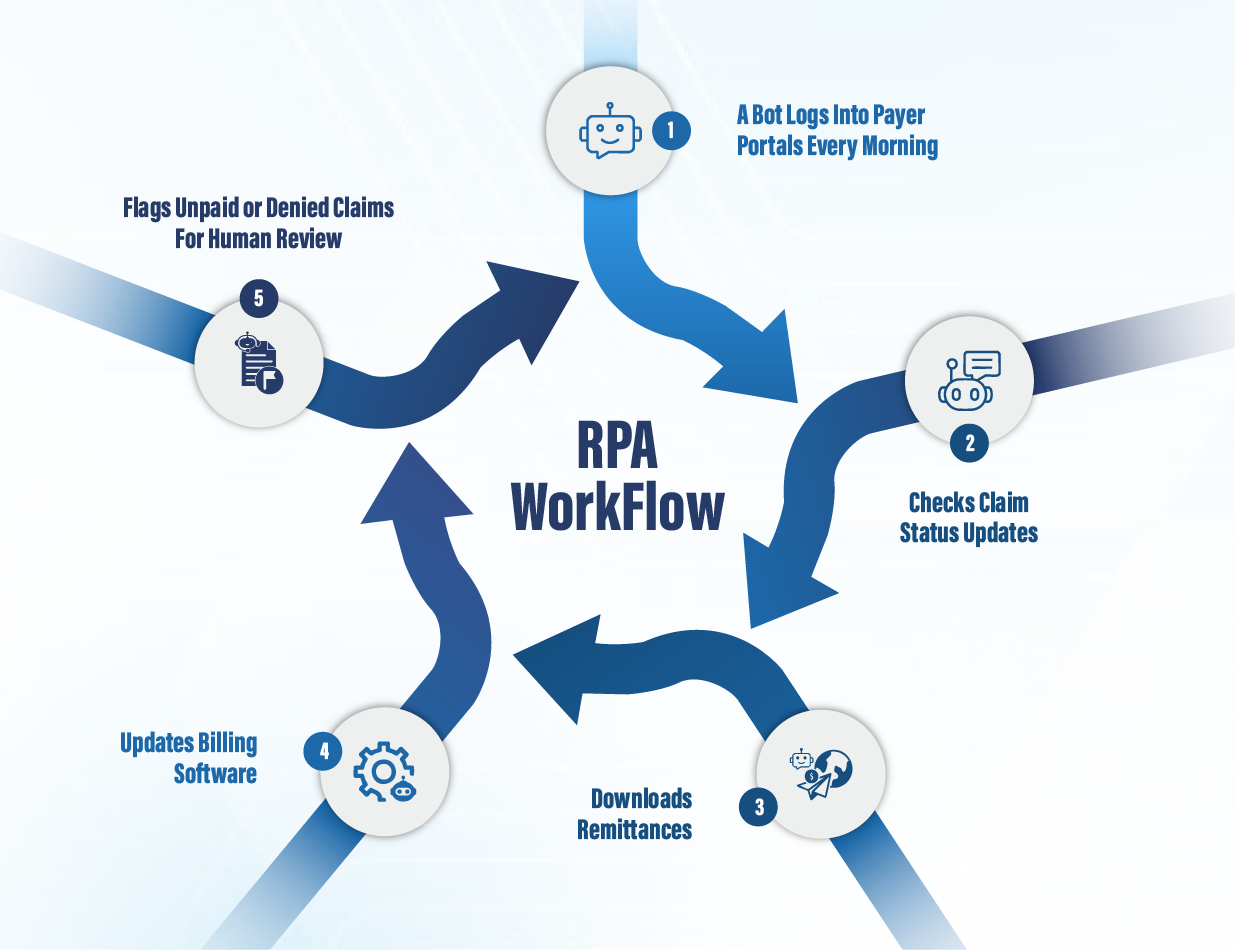
How RPA Works Inside Revenue Cycle Management
- A bot logs into payer portals every morning
- Checks claim status updates
- Downloads remittances
- Updates billing software
- Flags unpaid or denied claims for human review
Real-World RPA Use Cases in Medical Billing
- Check claim status daily
- Import results into billing software
- Alert teams when actions are needed
- Error codes
- Supporting documentation
- Recommended action priorities
Instead of searching for denials, billers can immediately begin resolution work. Together, these use cases remove thousands of manual clicks per week and allow billing teams to allocate their energy where human expertise is truly required.
Benefits of RPA for Healthcare Organizations
Faster Reimbursements
With automated submissions and daily tracking, claims move through payer systems much faster, accelerating cash flow.
Higher Accuracy and Fewer Errors
Bots do not mistype codes, miss steps, or forget portal logins – reducing preventable denials and rework.
Lower Administrative Cost
Organizations can operate efficiently with leaner teams and redirect staff toward insurance appeals or coding complexities.
Scalability for Growth
A billing department that supports 10 providers can support 50 – without hiring five times the staff.
Improved Compliance
RPA follows rules consistently, creating an audit-safe, repeatable workflow with digital tracking.
RPA vs AI: What’s the Difference?
- RPA is rule-based – it automates repetitive tasks that follow logic.
- AI (Artificial Intelligence) interprets information and makes decisions based on patterns.
- RPA can post payments and pull claim status
- AI can identify coding patterns, predict denial risks, and recommend corrections

How Hospitals & Billing Teams Can Get Started
- Mapping billing workflows
- Identifying manual actions that follow predictable rules
- Deploying bots in tasks like claim status checks or payment posting
- Training billing teams to transition into supervision roles
The Future of RPA in Healthcare Billing
- AI-driven claim validation
- Predictive denial prevention
- Fully automated payer follow-ups
- Bots that collaborate with billing teams in real time
Why MaxRemind Is the Best Partner for RPA-Enabled Billing
- Claim preparation, submission, and tracking
- Automated status checks with real-time alerts
- Electronic payment posting from ERAs/EOBs
- Denial routing and resolution prioritization
- Reporting transparency for providers and administrators

If your practice is ready to reduce manual workload, improve accuracy, and accelerate reimbursements, connect with MaxRemind and explore how RPA-powered billing can transform your financial performance.
Conclusion
Boost Billing Efficiency with RPA Automation
- What is Robotic Process Automation (RPA) in medical billing?
-
Robotic Process Automation is a technology that uses software “bots” to carry out repetitive and rule-based billing tasks. In medical billing, RPA can log into payer portals, pull claim status results, post payments, update practice management systems, and alert staff when follow-up actions are required. It mimics human actions but works faster and without manual effort.
- Will RPA replace human medical billers and coders?
-
No. RPA is designed to support billing teams – not replace them. Bots handle repetitive work like claim status checks and ERA posting, while humans perform tasks requiring judgment, such as correcting denials, resolving coding issues, and communicating with providers. Instead of job loss, most practices see improved productivity and upskilled staff.
- Which billing tasks benefit the most from automation?
-
The most impactful areas include claim submission tracking, insurance eligibility checks, ERA/EOB payment posting, denial identification and routing, and reporting. These processes involve routine data movement between systems, making them ideal for automation and reducing the use of manual labor.
- How quickly can a healthcare organization implement RPA?
-
Implementation speed varies depending on system complexity and workflow volume. However, most organizations begin seeing results within weeks, not months, by automating a few high-volume processes first. Because bots layer on top of existing systems, practices don’t need to replace billing software or EHRs to get started.
- What financial benefits does RPA provide for medical billing?
-
RPA increases operational efficiency, reduces manual errors that lead to denials, speeds up reimbursement cycles, and helps practices maintain consistent cash flow. Many organizations report lower administrative expenses, faster A/R turnaround, and the ability to scale patient volume without increasing staff.