

Coding for New Providers: Common Errors During the First 90 Days
Why the First 90 Days Are High-Risk for Revenue
- Claims denied as “provider not enrolled.”
- Incorrect reimbursement due to outdated fee schedules.
- Claims are billed under the wrong supervising physician.
- Delays due to incorrect place-of-service codes.
- Incident-to billing rejections.

Billing After Credentialing: Where Things Go Wrong
- Provider linked to the wrong group tax ID.
- Incorrect billing: NPI used instead of rendering NPI.X
- The payer portal is not updated with the supervising physician.
- Clearinghouse records are not aligned with payer data.
- Retroactive effective dates were not applied correctly.
Supervision Rules That Trigger Denials
Key Supervision Types
| Supervision Type | Description | Common Risk |
|---|---|---|
|
Direct Supervision |
Supervising physician present in the office suite and immediately available |
Physician not documented or not on-site |
|
General Supervision |
Physician oversight, but not required onsite |
Incorrect billing under the physician |
|
Incident-To Billing |
Services billed under the supervising physician at 100% rate |
Not meeting established patient or plan-of-care rules |
- The patient must be established.
- The supervising physician must be on-site.
- The physician must initiate and remain involved in the plan of care.
- Documentation must support supervision.
Place-of-Service (POS) Coding Errors
- Billing POS 11 (Office) instead of POS 22 (Outpatient Hospital)
- Incorrect telehealth POS codes
- Using facility POS without appropriate modifiers
- Failing to update the POS after transitioning locations
Common First-90-Day Errors and Their Impact
| Error Type | Why It Happens | Financial Impact |
|---|---|---|
|
Claims submitted before enrollment activation |
Miscommunication between the credentialing and billing teams |
Mass denials, delayed cash flow |
|
Incorrect supervision documentation |
Lack of clarity on CMS guidelines |
Downcoding or compliance exposure |
|
Wrong POS code |
Transition between locations or telehealth confusion |
Underpayment or denial |
|
Rendering NPI mismatch |
Clearinghouse setup errors |
Claim rejection |
|
Billing under the supervising physician improperly |
Attempt to maximize reimbursement |
Audit risk and recoupment |
How to Protect Revenue During Startup
Preventing claim denials in the first 90 days requires structured coordination between credentialing, billing, and compliance teams.
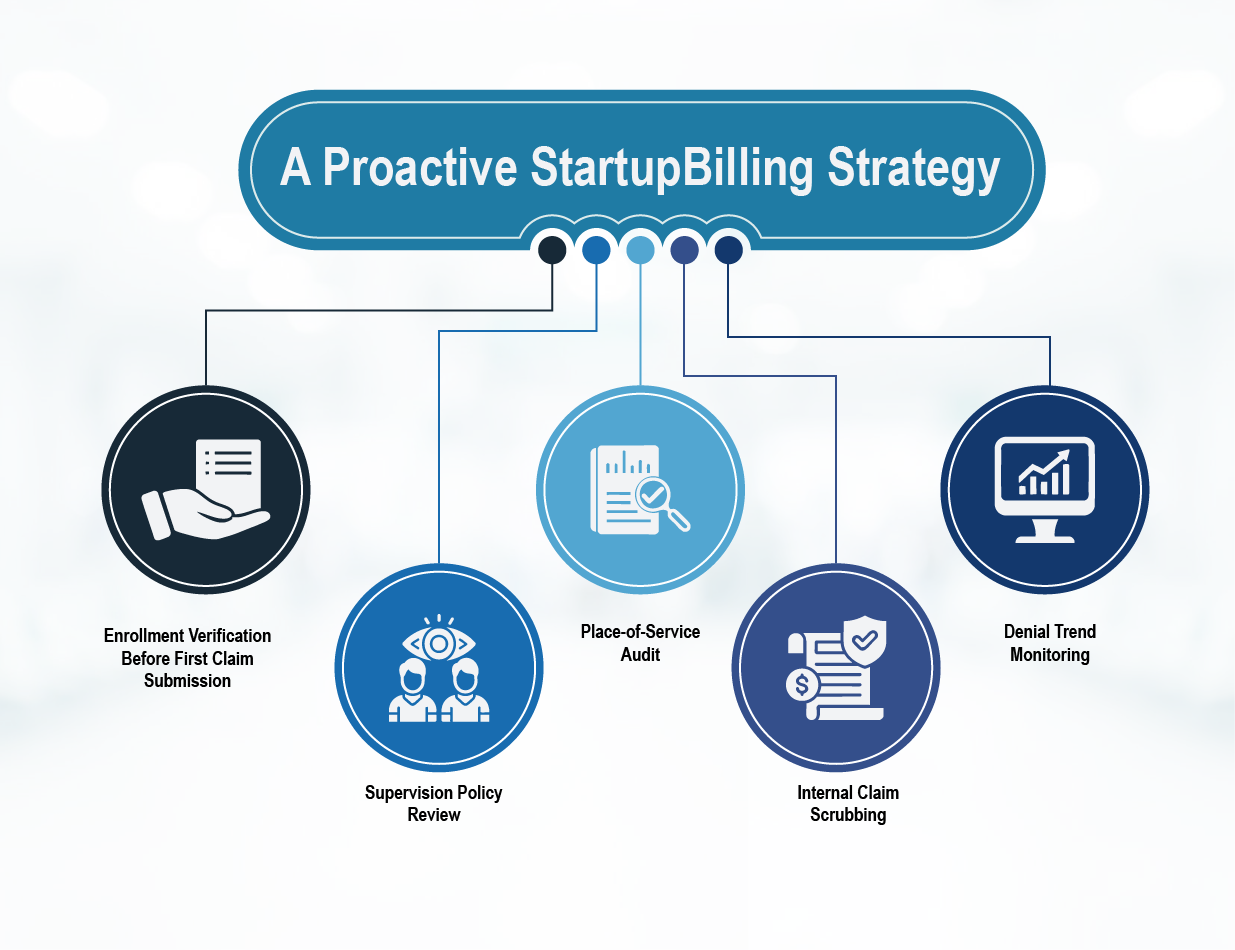
A proactive startup billing strategy includes:
-
Enrollment Verification Before First Claim Submission
Confirm payer portal activation, effective dates, group linkage, and clearinghouse alignment before submitting claims. -
Supervision Policy Review
Ensure documentation templates clearly capture supervising physician involvement. Educate providers on incident-to billing requirements. -
Place-of-Service Audit
Verify POS codes for every service location and telehealth setup. Confirm payer-specific requirements. -
Internal Claim Scrubbing
Implement pre-submission claim audits to catch NPI mismatches, modifier errors, and supervision inconsistencies. -
Denial Trend Monitoring
Track early denials closely. The first 30 claims often reveal systemic setup issues.

Why New Providers Struggle Without Structured RCM Support
- Hiring staff
- Managing patient scheduling
- Marketing their services
- Handling operational logistics
How MaxRemind Helps New Providers Avoid Costly Mistakes
At MaxRemind, we understand that the first 90 days after credentialing are critical to a practice’s financial stability.
Our team supports new providers by:
- Verifying payer enrollment activation before billing begins
- Aligning credentialing data with clearinghouse systems
- Reviewing supervision requirements to ensure compliance
- Auditing place-of-service configurations
- Monitoring early claim submissions for denial patterns
- Implementing structured revenue cycle workflows

Final Thoughts
Protect Your Revenue from Day One
- Why are claims getting denied during the first 90 days after credentialing?
-
Claims are often denied during the first 90 days because payer systems may not be fully updated, provider enrollment may not be properly linked to the group, or billing may begin before activation is complete. Supervision errors, NPI mismatches, and incorrect place-of-service (POS) codes are also common causes of early denials.
- Can new providers bill independently right after credentialing approval?
-
Not always. Even after credentialing approval, payers must fully activate the provider in their system. In addition, non-physician providers such as NPs and PAs must follow specific supervision and incident-to billing rules. Billing independently without verifying activation and supervision requirements can result in claim rejections.
- What are the most common supervision mistakes in new provider billing?
-
The most common supervision errors include billing incident-to services without meeting CMS requirements, failing to document supervising physician involvement, and submitting claims when the supervising physician was not onsite (if direct supervision is required). These mistakes can lead to denials or compliance risks.
- How does place-of-service (POS) coding affect reimbursement?
-
Place-of-service codes directly impact reimbursement rates. Using the wrong POS, such as billing office (POS 11) instead of outpatient hospital (POS 22), or incorrect telehealth POS codes, can lead to underpayment, overpayment, or claim denials. Accurate POS coding is critical during the startup phase.
- How can new practices prevent billing errors in the first 90 days?
-
New practices can prevent early billing errors by verifying payer activation before submitting claims, auditing supervision documentation, confirming correct POS codes, monitoring denial trends, and implementing pre-submission claim reviews. Partnering with an experienced revenue cycle management team like MaxRemind can also help ensure clean claims and protect early cash flow.