
What AI Can’t Fix in Your Revenue Cycle A Guide to Avoiding Over-Reliance on AI in RCM

Artificial intelligence is rapidly transforming healthcare, and revenue cycle management (RCM) is no exception. From automating repetitive tasks to accelerating claims processing, AI has become a central part of conversations around efficiency and cost reduction.
But amid all the excitement, there’s a growing disconnect between expectation and reality.
Many healthcare leaders are being sold a vision in which AI can fully optimize revenue cycles, eliminate denials, and reduce dependence on human teams. The truth, however, is far more nuanced. While AI is powerful, it is not a complete solution, and understanding its limitations is critical for making smarter operational decisions.
This article takes a grounded look at what AI still cannot fix in your revenue cycle, and why a balanced approach matters more than ever.

The Promise of AI in Revenue Cycle Management

There’s no denying that AI has introduced meaningful improvements in RCM processes. It has streamlined workflows that were once time-consuming and error-prone, helping organizations operate more efficiently.
Today, AI is commonly used for:
  • Automating eligibility checks and patient data entry
  • Assisting with medical coding and charge capture
  • Identifying patterns in claim denials
  • Accelerating claims submission and tracking
  • Supporting predictive analytics for revenue forecasting

These capabilities allow healthcare organizations to reduce administrative burden and improve turnaround times. For high-volume, repetitive tasks, AI performs exceptionally well.
However, the challenge begins when organizations expect AI to go beyond structured automation and handle the complexity of real-world revenue cycles.
The Promise of AI in Revenue Cycle Management

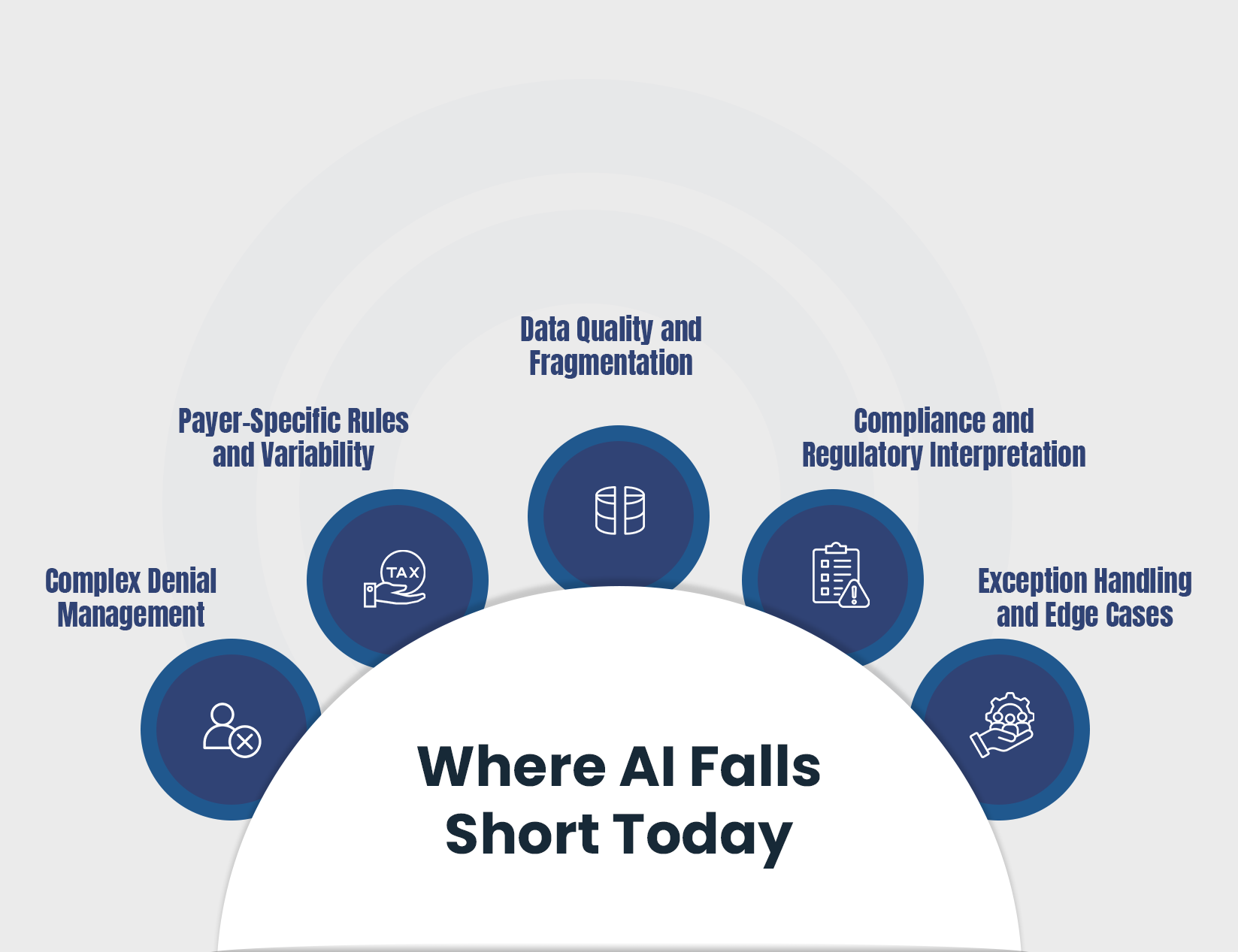
Where AI Falls Short Today

Despite its capabilities, AI still struggles in several critical areas of revenue cycle management. These gaps are not just technical; they are deeply tied to the complexity and variability of healthcare systems.

Complex Denial Management
Denial management is one of the most challenging aspects of RCM, and it is also where AI shows its limitations most clearly.
While AI can identify patterns in denied claims, it often lacks the contextual understanding needed to resolve them effectively. Each denial can involve unique payer rules, documentation nuances, or coding interpretations that require human judgment.
For example, two claims may be denied for similar reasons but require completely different resolution strategies. AI, which relies on historical data patterns, may struggle to adapt in such cases.
Where AI Falls Short Today
Data Quality and Fragmentation
AI is only as good as the data it receives. In many healthcare organizations, data is scattered across multiple systems, often incomplete or inconsistent.
When AI tools are fed poor-quality data, the results are unreliable. Errors in patient information, coding inconsistencies, or missing documentation can significantly impact outcomes.
Rather than fixing these issues, AI can sometimes amplify them, processing flawed data at scale and creating larger downstream problems.
Payer-Specific Rules and Variability
No two payers operate the same way. Policies frequently change, interpretations vary, and exceptions are common.
AI systems depend on structured datasets and predefined rules. When payer requirements shift or include ambiguous guidelines, AI may fail to interpret them correctly. This can lead to incorrect submissions, delays, or repeated denials.
Human experts, on the other hand, can navigate these gray areas by applying experience and real-time decision-making.
Exception Handling and Edge Cases
Revenue cycles are rarely linear. Exceptions are the norm, not the exception.
Unusual cases, incomplete documentation, or unique patient scenarios require flexible thinking and problem-solving. AI systems, which are designed for pattern recognition, often struggle when faced with situations that fall outside their training data.
This is where human intervention becomes essential to ensure accuracy and continuity.
Compliance and Regulatory Interpretation
Healthcare is one of the most heavily regulated industries, with strict requirements around billing, coding, and patient data privacy.
While AI can be programmed to follow rules, it cannot fully interpret regulatory intent or adapt to nuanced compliance scenarios. Regulations often require judgment calls that go beyond binary logic.
Mistakes in this area are not just operational; they carry financial and legal risks.

Human Expertise vs. Automation: Finding the Balance

To better understand where AI fits, it helps to compare its strengths with human capabilities.
Function AI Strength Human Strength
Data Processing
Fast, scalable, consistent
Context-aware validation
Pattern Recognition
Identifies trends in large datasets
Interprets anomalies
Decision-Making
Rule-based and data-driven
Experience-based and adaptive
Compliance
Follows programmed rules
Interprets regulations and intent
Problem Solving
Limited to known scenarios
Handles ambiguity and exceptions
This comparison highlights a key insight: AI is most effective when it supports human expertise, not replaces it. Organizations that treat AI as a standalone solution often face performance gaps. Those that integrate AI into a broader strategy, combining automation with skilled oversight, see far better outcomes.

The Risk of Over-Reliance on AI

One of the biggest challenges in today’s RCM landscape is not the technology itself, but how it is being adopted.
Over-reliance on AI can create a false sense of control. Automated systems may appear efficient on the surface while underlying issues go unnoticed. Denials may still occur, compliance risks may increase, and revenue leakage can persist, just in less visible ways.
There is also the risk of reduced human oversight. As organizations lean more heavily on automation, they may scale back experienced teams, leaving fewer resources to handle complex situations.
This imbalance can ultimately lead to higher costs, not lower.
The Risk of Over-Reliance on AI

A Smarter Approach to RCM

The future of revenue cycle management is not about choosing between AI and humans; it is about combining the strengths of both.

A smarter approach involves:

  • Using AI to automate repetitive, high-volume tasks
  • Leveraging human expertise for complex decision-making
  • Continuously monitoring system performance
  • Ensuring data quality and integrity
  • Staying adaptable to regulatory and payer changes
This hybrid model allows organizations to maximize efficiency without sacrificing accuracy or control.

At Maxremind, this balance is at the core of how revenue cycle management is approached. Technology is used to streamline operations, but it is always backed by experienced professionals who understand the nuances of healthcare billing and compliance.

This ensures that automation enhances performance rather than introducing new risks.
A Smarter Approach to RCM

Conclusion

AI is undoubtedly transforming revenue cycle management, and its role will continue to grow in the coming years. However, it is not a cure-all solution. There are still critical areas, denial management, compliance, payer variability, and exception handling, where human expertise remains indispensable.

For decision-makers, the goal should not be to replace people with technology, but to build a system where both work together effectively. By setting realistic expectations and adopting a balanced strategy, healthcare organizations can avoid the pitfalls of over-automation and create a more resilient, efficient revenue cycle.

If you’re exploring how to integrate AI into your revenue cycle without losing control of performance, the right partner can make all the difference. Maxremind helps healthcare organizations combine intelligent automation with expert-driven RCM strategies, so you get the best of both worlds.

Balance AI with Real RCM Expertise

MaxRemind combines intelligent automation with expert-driven billing strategies to reduce denials, improve compliance, and maximize your revenue cycle performance.
FAQs
Can AI completely manage the revenue cycle in healthcare?

No, AI cannot fully manage the revenue cycle on its own. While it can automate repetitive tasks like data entry and claims processing, complex areas such as denial management, compliance interpretation, and payer communication still require human expertise.

What are the main limitations of AI in revenue cycle management?

AI struggles with handling exceptions, interpreting changing payer rules, ensuring data accuracy, and making judgment-based decisions. It works best in structured environments but falls short in complex, real-world scenarios.

Is AI reliable for reducing claim denials?

AI can help identify patterns and flag potential issues before submission, but it cannot eliminate denials entirely. Many denials depend on nuanced payer requirements and documentation quality, which require human review and intervention.

How should healthcare organizations use AI in RCM?

The most effective approach is a hybrid model, using AI for automation and efficiency, while relying on experienced professionals for oversight, decision-making, and handling complex cases.

Why is human expertise still important in revenue cycle management?

Human expertise is essential for navigating ambiguity, adapting to changes, ensuring compliance, and resolving complex billing issues. AI supports the process, but it cannot replace the critical thinking and experience of skilled RCM professionals.