
How Under-Coding Hurts Revenue More Than Over-Coding
What Is Under-Coding in Medical Billing?
Under-coding occurs when a provider submits a claim using a lower-level CPT code than the documentation and services justify.
This most commonly happens with:
- Evaluation and Management (E/M) services
- Complex follow-up visits
- Chronic care management
- Procedures with modifiers
- Time-based billing

Why Physicians Under-Code
Understanding the psychology behind under-coding is critical. Most physicians do not intentionally reduce revenue. Instead, under-coding typically stems from:
-
Fear of Audits
Many providers assume higher-level codes increase audit risk, so they default to conservative coding. -
Documentation Uncertainty
If documentation feels incomplete or unclear, physicians may code lower to avoid potential payer challenges. -
Lack of Coding Education
E/M guideline updates and CMS documentation changes can be complex. Without ongoing education, providers may default to lower codes. -
Time Pressure
Busy clinics often lack the time for detailed coding reviews, resulting in the habitual under-selection of CPT levels. -
Absence of Internal Audits
Under-coding patterns go unnoticed without routine coding audits.

The Financial Impact of Under-Coding
| Scenario | Difference Per Visit | Visits Per Month | Annual Revenue Loss |
|---|---|---|---|
|
Level 4 coded as Level 3 |
$30 |
300 |
$108,000 |
Now consider:
- Multiple providers
- Multiple services
- Chronic care visits
- Specialty procedures
- Physician compensation models
- RVU calculations
- Practice valuation
- Expansion capability
- Staffing decisions
- Investment in technology
Under-Coding vs Over-Coding: Understanding the Real Risk
| Factor | Under-Coding | Over-Coding |
|---|---|---|
|
Compliance Risk
|
Low direct risk |
High if intentional |
|
Revenue Impact |
Negative (missed revenue) |
Short-term gain, long-term risk |
|
Audit Likelihood |
Rarely flagged |
More likely |
|
Long-Term Effect |
Systematic financial loss |
Penalties, repayments |
|
Visibility |
Often unnoticed |
Highly visible |
Compliance-Safe Revenue Optimization
- Proper documentation alignment
- Correct CPT and ICD-10 selection
- Appropriate modifier usage
- E/M level validation
- Internal coding audits
- Ongoing provider education
When documentation supports a higher-level code, billing it accurately is not aggressive; it is compliant. Modern Evaluation and Management (E/M) guidelines emphasize:
- Medical decision-making
- Time spent
- Clinical complexity
- Reduced reimbursement
- Skewed productivity metrics
- Lower reported complexity
- Diminished revenue cycle performance
How to Identify and Prevent Under-Coding
-
Conduct Regular Coding Audits
Internal or third-party audits help identify patterns such as consistent downcoding of E/M services. -
Compare Documentation to Billed Codes
Does the clinical documentation justify a higher CPT level? -
Review E/M Distribution Reports
If your Level 4 or Level 5 percentages are significantly below specialty benchmarks, under-coding may be occurring. -
Educate Providers on Updated Guidelines
Many physicians are unaware of how E/M rules have evolved. -
Monitor Revenue Trends
Flat reimbursement despite increasing patient complexity may signal coding inefficiency. -
Partner with Revenue Cycle Experts
An experienced RCM partner can perform compliance-safe reviews and identify revenue leakage without increasing audit exposure.
The Bigger Picture: Revenue Integrity in Modern Healthcare
- Cash flow stability
- Strategic growth plans
- Provider compensation alignment
- Investment in patient experience
- Competitive positioning

Protecting Revenue Without Increasing Risk
How MaxRemind Helps Practices Optimize Revenue Safely
At MaxRemind, we work with healthcare practices to identify revenue leakage, improve coding accuracy, and strengthen revenue cycle performance, all while maintaining strict compliance standards.
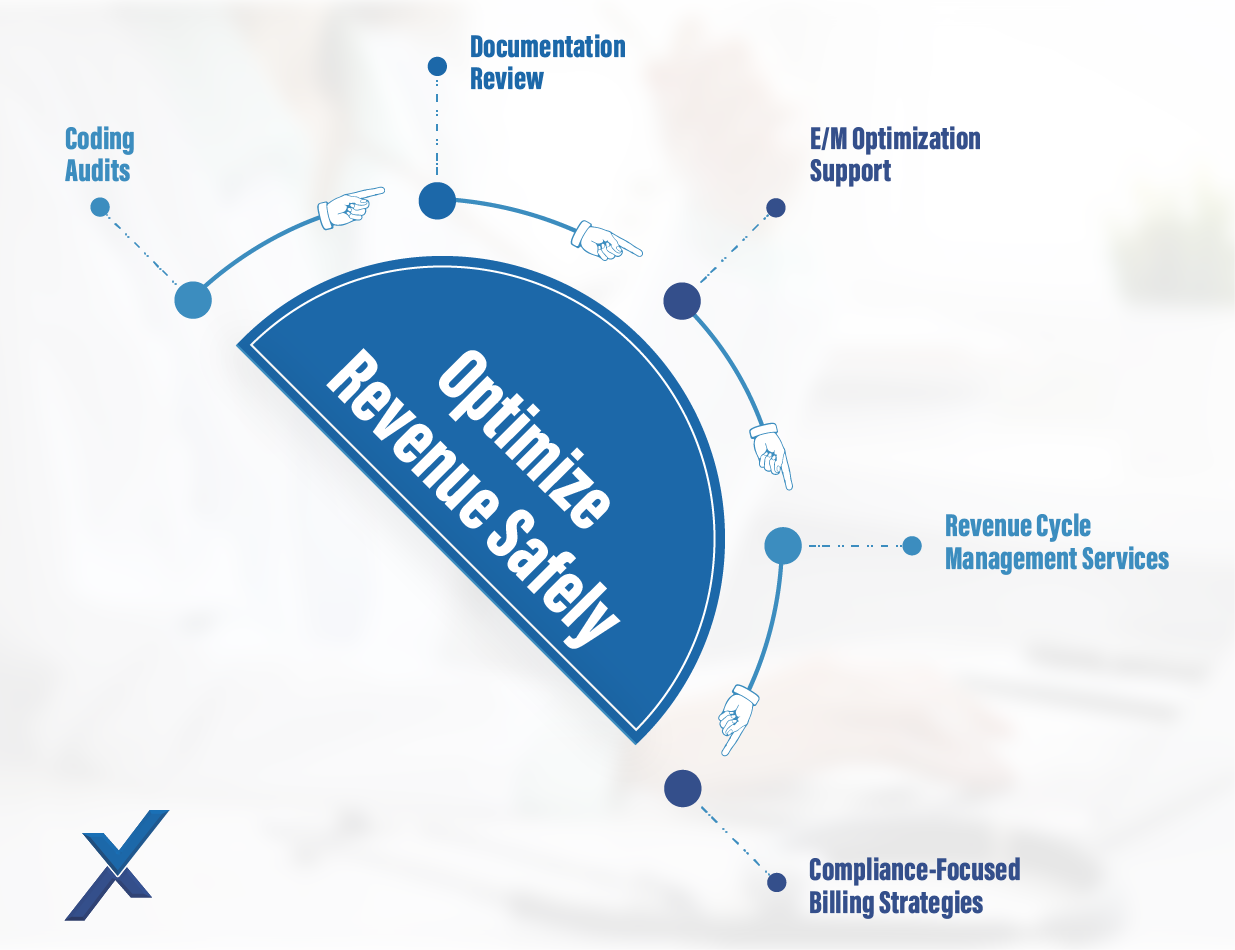
Our team provides:
- Coding audits
- Documentation review
- E/M optimization support
- Revenue cycle management services
- Compliance-focused billing strategies
A structured, proactive revenue cycle strategy reduces denials before they occur. Accurate coding is not aggressive; it’s responsible. Contact MaxRemind to discover how compliance-safe revenue optimization can strengthen your practice’s financial health.
Stop Revenue Leakage Without Increasing Risk
- What is under-coding in medical billing, and how does it impact healthcare practices in the USA?
-
Under-coding in medical billing occurs when a physician reports a lower-level CPT code than the documentation supports. For healthcare practices in the USA, this can lead to significant revenue loss over time, reduced RVUs, and inaccurate reporting of patient complexity. Even small coding discrepancies can result in thousands of dollars in missed reimbursement annually.
- How does under-coding affect revenue cycle management for small and mid-sized practices?
-
Under-coding directly weakens revenue cycle management by reducing reimbursement at the claim submission stage. For small and mid-sized practices, this revenue leakage can impact cash flow, staffing decisions, and long-term growth. Accurate coding is essential to maintain financial stability and maximize reimbursement without increasing compliance risk.
- Is under-coding safer than over-coding from a compliance standpoint?
-
While under-coding generally carries less regulatory risk than intentional over-coding, it is not a recommended strategy. Accurate, documentation-supported coding is the compliant approach. Consistently under-coding may indicate gaps in documentation, training, or billing oversight that need professional review.
- How can physicians identify if their practice is losing revenue due to under-coding?
-
Physicians can identify under-coding by conducting coding audits, reviewing E/M distribution reports, and comparing their billing patterns to specialty benchmarks in the United States. Partnering with a professional medical billing and revenue cycle management company can help uncover hidden revenue loss while ensuring compliance.
- How can MaxRemind help prevent under-coding and improve reimbursement?
-
MaxRemind provides comprehensive medical billing services in the USA, including coding audits, documentation review, and compliance-focused revenue cycle management. Our team helps practices identify revenue leakage, optimize coding accuracy, and improve reimbursement, all while maintaining strict adherence to CMS and payer guidelines.