
Top CPT Codes for Occupational Therapy Billing in 2026
In 2026, accurate CPT coding is more important than ever for occupational therapy (OT) practices across the US. With evolving healthcare regulations and increasingly stringent Medicare and private insurance requirements, staying compliant is critical for both revenue and patient care. Incorrect or outdated coding not only leads to denied claims but can also trigger audits and delay payments. For busy OT clinics already juggling patient care, the financial strain caused by billing errors can be overwhelming.
Understanding the latest CPT codes and using them correctly ensures you receive timely reimbursements while staying compliant. With audits becoming more frequent and therapy caps under closer scrutiny, OTs must adapt their billing practices to meet payer demands. In this guide, we’ll break down the top CPT codes for 2026, offer compliance and reimbursement tips, and share how practices can reduce their billing workload while improving revenue.
Why Accurate CPT Coding Matters for OT Practices in 2026
- Higher audit risks when coding errors or insufficient documentation are found.
- Stricter rules for timed vs. untimed codes, particularly for Medicare.
- Lost revenue opportunities due to denied or underpaid claims.
OT services are often individualized and complex, making it crucial to document and code each session accurately. The right CPT code communicates the service provided, its complexity, and its medical necessity. Missteps here can result in compliance issues and financial penalties.

Top Occupational Therapy CPT Codes for 2026
To help you stay current, here are the most frequently used OT CPT codes for 2026, along with what they represent:
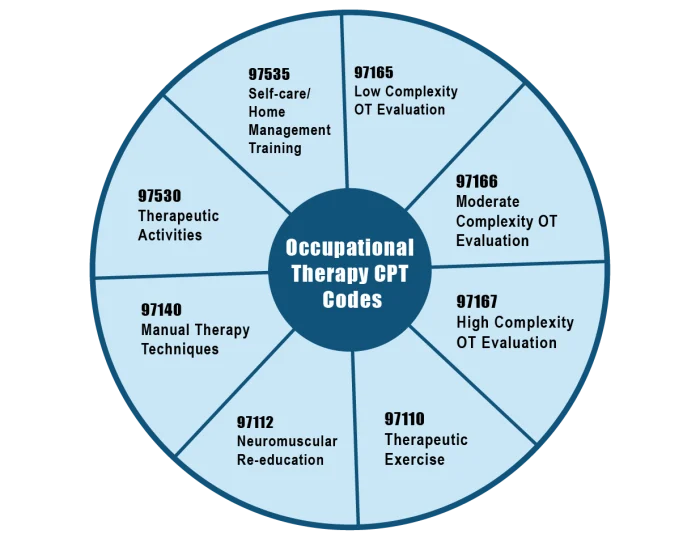
97165 – Low Complexity OT Evaluation
97166 – Moderate Complexity OT Evaluation
97167 – High Complexity OT Evaluation
97110 – Therapeutic Exercise
97112 – Neuromuscular Re-education
97140 – Manual Therapy Techniques
97530 – Therapeutic Activities
97535 – Self-care/Home Management Training
Additional codes often used in OT include those for modalities such as electrical stimulation, ultrasound, or group therapy sessions. Many of these codes are timed, meaning reimbursement is based on the duration of service, while others (like evaluations) are untimed. Understanding the difference is key to avoiding underbilling or overbilling.
OT Billing Best Practices for 2026
Understand the Medicare therapy threshold
Document medical necessity thoroughly
Apply the 8-minute rule correctly
Avoid duplicate or missing codes
Stay updated on payer requirements

READ MORE: Outsource Medical Billing in 2026
How MaxRemind Simplifies OT Billing and Improves Revenue
Managing billing in-house can be time-consuming and stressful. That’s why many OT practices are turning to specialized medical billing partners like MaxRemind. By outsourcing billing, providers can focus on patient care while ensuring their claims are accurate and compliant.
MaxRemind offers:
- Expert CPT and ICD-10 coding support tailored for OT services.
- Real-time claim submission and follow-ups to minimize delays.
- Denial management and revenue recovery for underpaid or rejected claims.
- Automated RCM tools and detailed financial reporting, giving you better insight into your practice’s revenue cycle.

Conclusion
Correct CPT coding is essential for occupational therapy clinics in 2026. With payer audits on the rise and evolving documentation rules, OTs must stay updated to avoid compliance issues and revenue loss. By using the right codes, following best practices, and leveraging expert billing support, you can protect your practice financially and deliver care without administrative burdens.
If you want to simplify OT billing and improve your revenue cycle, consider partnering with a team that specializes in OT billing, like MaxRemind. Let professionals handle the coding and claims so you can focus on providing patient care.
Ready To Improve Your OT billing Practice Revenue Cycle?
- What are the most commonly used CPT codes for occupational therapy in 2026?
-
The most frequently used OT CPT codes include 97165–97167 for evaluations of varying complexity, 97110 for therapeutic exercises, 97112 for neuromuscular re-education, 97140 for manual therapy, 97530 for therapeutic activities, and 97535 for self-care training. Using these correctly with proper documentation helps ensure accurate billing and timely reimbursements.
- What is the difference between timed and untimed OT CPT codes?
-
Timed codes, like 97110 and 97140, are billed in 15-minute increments based on the actual one-on-one therapy time spent with the patient. Untimed codes, such as the evaluation codes 97165–97167, are billed once per session regardless of the duration, but documentation must still reflect the services provided.
- How can OT practices avoid claim denials related to CPT coding?
-
To reduce denials, ensure documentation supports medical necessity, follow payer-specific billing rules, and use modifiers like KX or 59 correctly when required. Regular audits, proper code selection, and staff training on insurance policies also help prevent billing errors and delays.
- What are the Medicare OT therapy thresholds for 2026?
-
Medicare maintains an annual therapy threshold for occupational therapy services, and once a practice exceeds this amount, the KX modifier must be added to justify continued medical necessity. Practices should monitor patient progress and maintain detailed records to stay compliant and avoid reimbursement issues.
- How can outsourcing OT billing to a company like MaxRemind help my practice?
-
Outsourcing OT billing can save administrative time, reduce claim errors, and improve cash flow by leveraging expert coders who specialize in therapy billing. Services often include denial management, compliance monitoring, and payer follow-ups, which allow practices to focus more on patient care and less on billing complexities.